
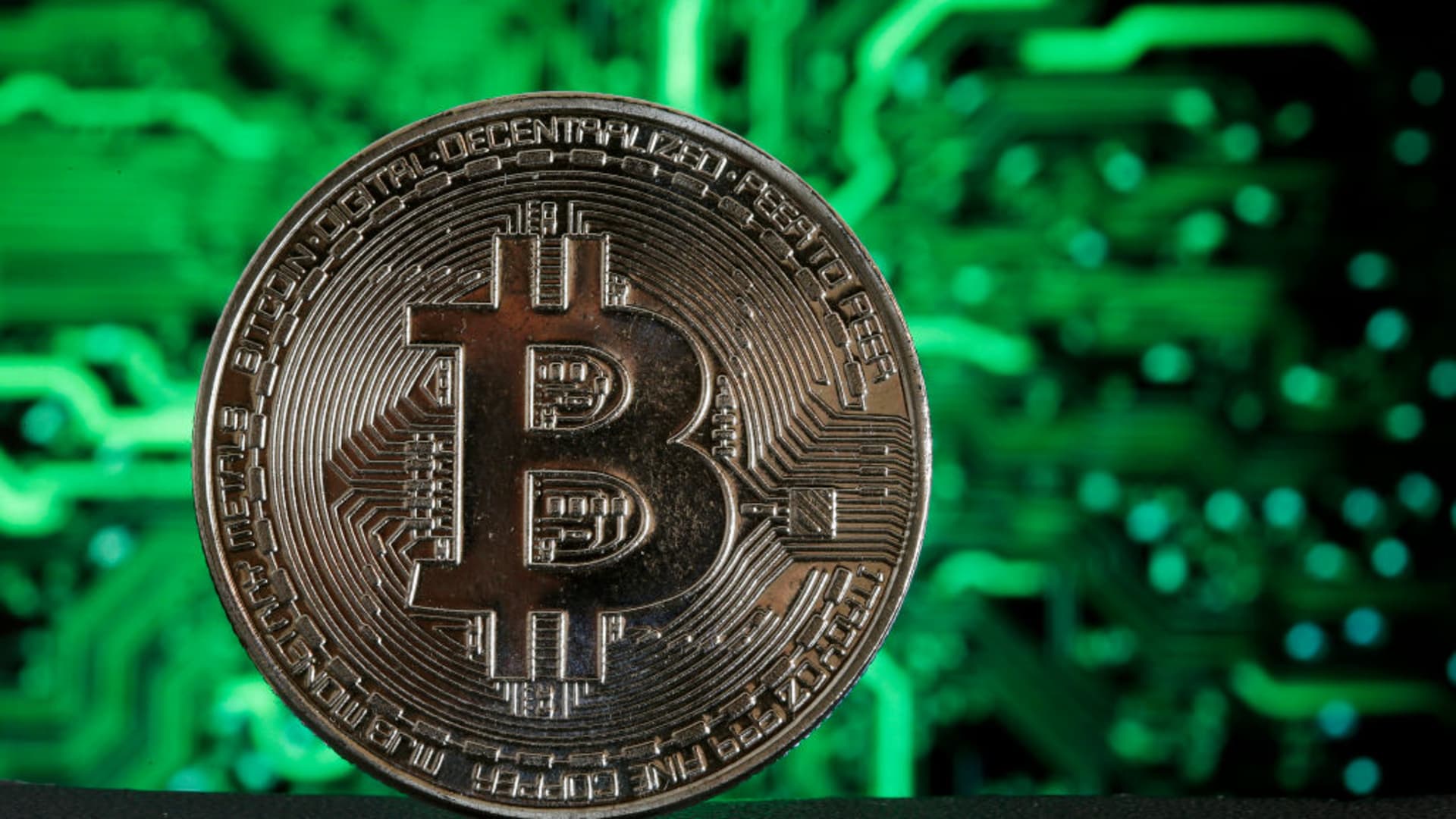
An illustration of Bitcoin, a digital cryptocurrency, displayed in Paris, France, on December 23, 2017.
Chesnot | Getty Images
LONDON — The United Kingdom is renewing its efforts to establish itself as a leading global center for the cryptocurrency industry. However, this ambition faces significant hurdles, including skepticism from local business owners and increased competition from the United States under its new leadership.
<p>The current British government is dedicated to creating a favorable environment for businesses involved in cryptocurrencies and technologies using blockchain.</p>

<p>In a recent address, Tulip Siddiq, the U.K.'s Economic Secretary to the Treasury, stated that the government intends to consult with companies on proposed legal frameworks for digital assets, particularly stablecoins (cryptocurrencies linked to traditional currencies), "as early as possible in the coming year."</p>

<p>She also clarified that the government will not classify crypto staking services, which reward users for holding tokens, as collective investment schemes. This decision alleviates concerns among industry participants that such a classification would impose excessive regulatory burdens.</p>

<p>"This sector holds immense potential and already plays a vital role in the U.K.'s thriving technology landscape," commented Poppy Gustafsson, Britain's investment minister, at a recent event organized by the U.K. branch of Stand With Crypto, an advocacy group supported by <span class="QuoteInBody-quoteNameContainer" data-test="QuoteInBody" id="SpecialReportArticle-QuoteInBody-2"><a href="https://www.cnbc.com/quotes/COIN/">Coinbase</a><span class="QuoteInBody-inlineButton"><span class="AddToWatchlistButton-watchlistContainer" id="-WatchlistDropdown" data-analytics-id="-WatchlistDropdown"><button class="AddToWatchlistButton-watchlistButton" aria-label="Add To Watchlist" data-testid="dropdown-btn"><span class="AddToWatchlistButton-addWatchListFromTag"/></button></span></span></span>.</p>

<p>Gustafsson affirmed the government's "commitment to fostering and embracing blockchain" and emphasized that it is "already taking decisive steps to support this sector and ensure that we remain at the forefront of this global innovation."</p>
She highlighted the launch of the Digital Securities Sandbox, a testing ground for developing innovative distributed ledger technology solutions for issuing, trading, and settling securities within a regulated environment.
<p>Another example is the "<a href="https://www.gov.uk/government/speeches/mansion-house-2024-speech" target="_blank">digital gilt</a>" pilot project initiated last month, which explores the possibility of issuing U.K. government bonds using blockchain technology.</p>Can the UK Become a Major Crypto Player?
Despite the U.K.’s proactive approach to crypto regulation, not everyone is convinced that it can become a globally dominant force in the industry.
<p>"I'm uncertain whether we possess the right policymakers, government support, risk tolerance, and pro-entrepreneurship mindset needed to truly capitalize on this once-in-a-generation opportunity," stated Steven Bartlett, a British entrepreneur known for his "Diary of a CEO" podcast, during a discussion at the Stand with Crypto event.</p>

<p>Bartlett explained that his experience working at both the San Francisco and London offices of his blockchain startup, Thirdweb, leads him to believe that "building a company here is significantly more challenging compared to being there."</p>

<p>Data published by the U.K.'s Financial Conduct Authority (FCA) indicates rising demand for crypto assets within the country. A <a href="https://www.fca.org.uk/news/press-releases/fca-finds-crypto-ownership-continues-rise-it-delivers-plans-regulate-crypto" target="_blank">survey released by the regulator</a> last month showed the average value of crypto holdings among British residents increased from £1,595 to £1,842 ($2,337) this year.</p>

<p>The FCA also <a href="https://www.fca.org.uk/publication/documents/crypto-roadmap.pdf" target="_blank">released a detailed plan</a> for implementing regulations for the crypto sector. Over the next two years, the regulator will publish discussion papers on stablecoins, trading platforms, lending, and staking, with a <a href="https://www.cnbc.com/2024/11/26/britains-fca-sets-out-plan-to-implement-crypto-regime-by-2026.html">full regulatory framework expected to be in place by 2026</a>.</p>
Competition Intensifies from the U.S.
Following the election of President Trump, Tom Duff Gordon, Coinbase’s vice president of international policy, cautioned the U.K. against allowing its regulatory momentum on crypto to wane.
<p>The new leader campaigned on a distinctly pro-crypto platform, promising that he <a href="https://www.cnbc.com/2024/11/26/britains-fca-sets-out-plan-to-implement-crypto-regime-by-2026.html">would not sell any bitcoin seized by the federal government</a>. He also pledged to replace the current Securities and Exchange Commission (SEC) Chair, Gary Gensler, whose tenure was marked by aggressive enforcement actions against numerous crypto firms.</p>

<p>Last month, Gensler announced his <a href="https://www.cnbc.com/2024/11/21/sec-chair-gensler-will-step-down-jan-20-making-way-for-trump-replacement.html">intention to resign as SEC chair</a> on January 20, the date of the upcoming presidential inauguration.</p>
“The U.K. has accomplished a great deal,” Gordon of Coinbase stated to CNBC during an interview at the Stand with Crypto event. “There is a significant opportunity for the U.K. to achieve real success in this field, but regulatory clarity is essential.”
<p>"We hope to see secondary legislation on staking and stablecoins," Gordon added. "The city minister has mentioned this, so we're optimistic that it will materialize."</p>

<p>While the U.K. now possesses a regulatory roadmap, crypto industry executives are concerned that waiting until 2026 to fully implement the regime could leave the country lagging behind its counterparts across the Atlantic.</p>

<p>Coinbase's chief policy officer, Faryar Shirzad, told CNBC in a recent interview that he now believes the U.S. is <a href="https://www.cnbc.com/2024/12/02/coinbase-policy-chief-us-can-adopt-crypto-regulation-quickly-now.html">on track to approve federal crypto legislation "fairly quickly"</a>, potentially as early as 2025.</p>

<p>Meanwhile, in the European Union, the Markets in Crypto-Assets (MiCA) regulation, a comprehensive legislative package, is scheduled to take full effect later this month.</p>
Outdated Rules Hinder Growth
George McDonaugh, CEO of KR1, a publicly-traded digital asset investment firm specializing in blockchain technology, argues that outdated regulations in the U.K. are making it challenging for crypto-focused investment firms like his to gain wider recognition on public markets.
<p>KR1 is currently listed on the Acquis Stock Exchange, a trading platform for high-growth companies.</p>
McDonaugh stated that KR1 has been attempting to list on the London Stock Exchange’s main market for several years but is blocked by a 2018 regulation that prohibits tokens such as bitcoin and ether from being included in publicly listed investment vehicles.
<p>"The world has changed since then," McDonaugh said. "We believe we could unlock a massive influx of capital into British markets by removing this restriction."</p>

<p>As the FCA works towards developing and implementing a regulatory framework for crypto, experts hope it will encourage and foster innovation, rather than stifle it.</p>

<p>Irfan Baluch, a crypto lawyer at Cripps, expressed his hope that the U.K. will draw inspiration from the EU, which has already taken a "leading position" on crypto regulation with MiCA.</p>

<p>"Applying 20<sup>th</sup> century law to 21st-century technology will only stifle innovation and drive crypto businesses offshore," Baluch warned, adding that the FCA's crypto regulation roadmap appears to be "a step in the direction of addressing this issue" – at least for now.</p>

<p>"The U.K. has an incredible opportunity right now to act decisively in the direction of innovation," Bartlett said.</p>

<p>"If we do that in a way that the United States seems to naturally do, we won't find ourselves as merely a residual beneficiary of blockchain or AI technology. We can play a truly meaningful role in ensuring that the value of these technologies accrues to this country. But it requires a radical shift," he concluded.</p>