
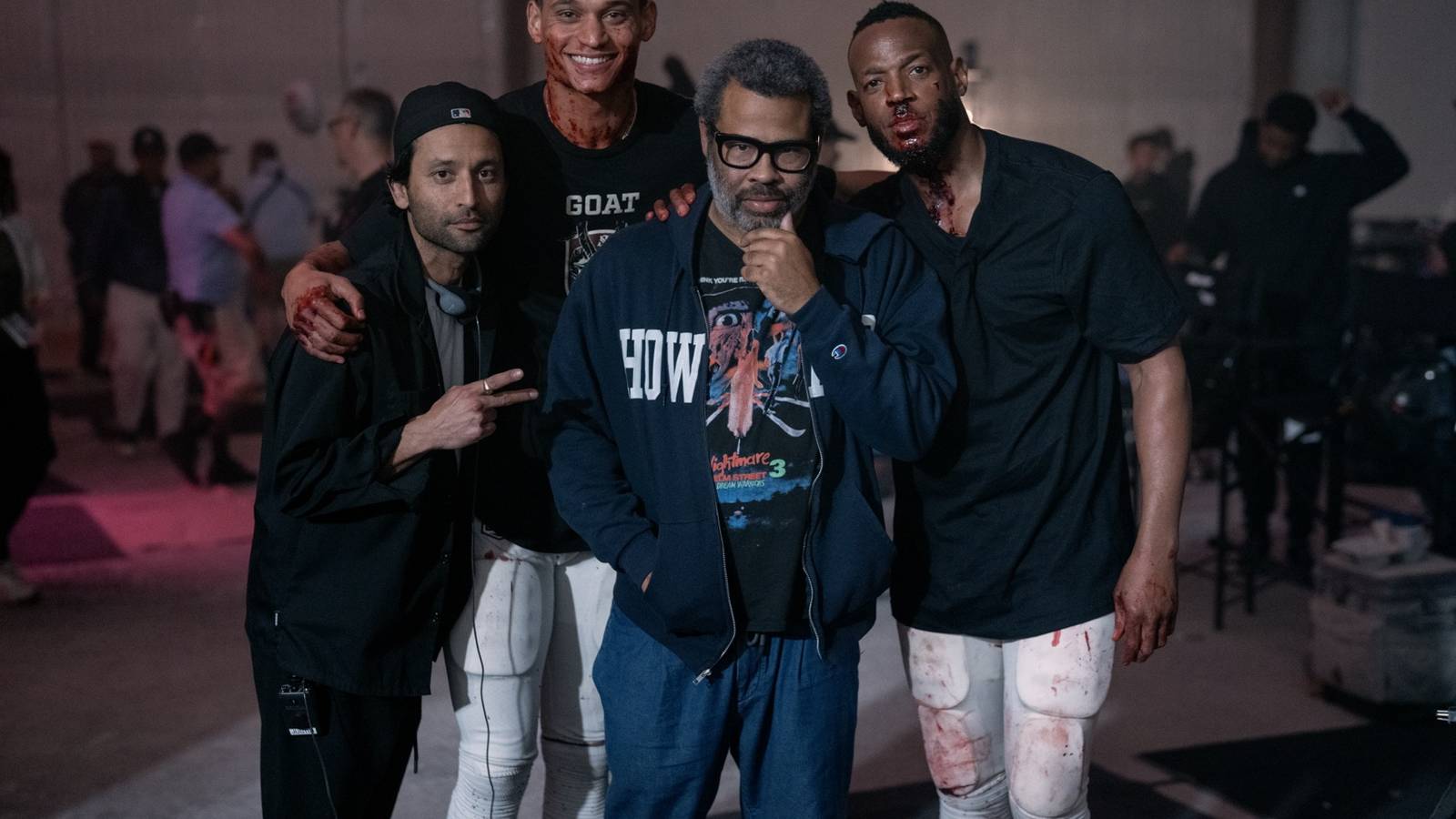
Those anticipating a mind-bending, socially aware thriller akin to Jordan Peele’s signature style might want to adjust expectations before seeing Him. Despite Peele’s prominent association as an executive producer, the film, starring Tyriq Withers as a promising football player navigating a complex relationship with a veteran quarterback (Marlon Wayans), is actually the work of director Justin Tipping. And, frankly, the end result falls short. Him prioritizes visual flair but only superficially explores its themes. By the final act, one is left wondering why Peele’s name is attached, a sentiment that echoes previous disappointments.
While acknowledged as a visionary, each Peele-produced venture raises questions about his influence. Following the groundbreaking success of Get Out, Us, and Nope, numerous critics drew comparisons to Steven Spielberg, a parallel that holds some merit. However, with such recognition comes the reality that not every project will reach the same heights.
Spielberg’s Jaws revolutionized the summer movie season, while Get Out redefined Black horror and surrealism. Both filmmakers have leveraged their influence to support other creatives through their production companies. Yet, both also have a catalog that includes both critical successes and less memorable films.
Consider Three O’Clock High (helmed by Phil Joanou), an ’80s teen film that contrasted with the era’s more popular fare like Ferris Bueller’s Day Off. Its poor reception led Spielberg to remove his name from the credits. Then there’s We’re Back! A Dinosaur’s Story, a ‘90s animated feature with multiple directors, that attempted to capitalize on the success of Jurassic Park but failed to connect with audiences. Spielberg also served as executive producer for Cowboys & Aliens (directed by Jon Favreau), a sci-fi western that faded quickly from the public consciousness. In response to these failures, Spielberg seemingly prioritized projects associated with established franchises like Jurassic movies, Transformers, Indiana Jones, and Men in Black movies, with the quality declining in later installments.
Peele, a more recent figure in the spotlight, has a smaller body of work as a director, writer, and producer. He ushered in a new wave of horror with Get Out, followed by Us and Nope, although the latter two revealed some vulnerabilities. Alongside these major releases, Peele also executive-produced a variety of projects, including comedies (Keanu, The Last O.G.) and horror ventures (Hunters, Scare Tactics, and his 2019 Twilight Zone reboot). Peele’s producing highlights often involve collaborations with directors who possess distinct artistic visions, such as Spike Lee (BlacKkKlansman) and Dev Patel (Monkey Man). On the other hand, films like Nia DaCosta’s Candyman and Him, while exhibiting traces of Peele’s signature horror style, lack the impact of his directorial efforts. And that reveals the core difference between Peele and Spielberg.

Spielberg has often been credited as a “ghost director”, with films like Poltergeist and The Goonies reflecting his distinct visual style and storytelling techniques, despite his official role as executive producer. Even on projects directed by others, like Gremlins, Back to the Future, and Young Sherlock Holmes, Spielberg’s considerable input is apparent. But how much influence does Jordan Peele truly exert? For The Last O.G., which he co-created, his involvement was limited; he wrote only one episode. His role in BlacKkKlansman appears relatively minimal beyond supporting Spike Lee, while his involvement in Monkey Man was a more traditional producer role, championing the film and convincing Universal to release it theatrically.
However, films that lean into his signature brand of socially conscious horror, such as Candyman and Him (both of which Peele co-wrote), lack the sharp intelligence he’s known for. Why this disconnect? Why does a “Jordan Peele caliber movie” require him to both write and direct? Perhaps Peele intentionally softens his approach when collaborating, or perhaps the missing piece is his direct hand behind the camera.
Spielberg eventually realized the value of focusing on projects within his own established franchises. Perhaps Peele should adopt a similar strategy – concentrating on building his own cinematic universe rather than promoting other visions. Otherwise, the “executive producer” credit could weaken his brand.
The release of Him has served as a wake-up call for many who view Peele as an infallible filmmaking genius. Some viewers seeing Him during its opening weekend may assume he directed it. He didn’t, but perhaps he should have.