

Key Points
Understanding the Crypto Market Plunge
The recent downturn in the cryptocurrency market was driven by a combination of factors including large-scale liquidations, a decrease in trading activity, outflows from Exchange Traded Funds (ETFs), and the expiration of numerous options contracts.
Potential Future Market Trends
The market might be preparing for a turnaround, mirroring the recovery observed in the last quarter of 2024.
Cryptocurrency markets experienced a significant drop for the second consecutive day this week. This decline follows a period of weakening, with the total market capitalization falling below the $4 trillion mark, currently resting at $3.91 trillion.
Several factors contributed to this market downturn: substantial liquidations, a reduction in trading volumes, selling pressure from institutional ETFs, and the expiry of options. We will examine these elements in more detail.
Significant Liquidations and Decreased Trading Volume
On September 23rd, the crypto market saw extensive liquidations totaling over $1.7 billion across various cryptocurrencies. This represents the highest liquidation volume observed since the beginning of the year.
The majority of these liquidations involved long positions, accounting for approximately $1.65 billion, while short positions made up only $145 million. The market maker Wintermute reportedly facilitated the rapid liquidation of 50x leveraged orders on the Binance exchange during a single trading session.
The largest liquidations occurred on the Bybit, Binance, and OKX platforms, respectively. Data from CoinGlass indicates that nearly a billion dollars in value was affected on Bybit’s derivatives market.
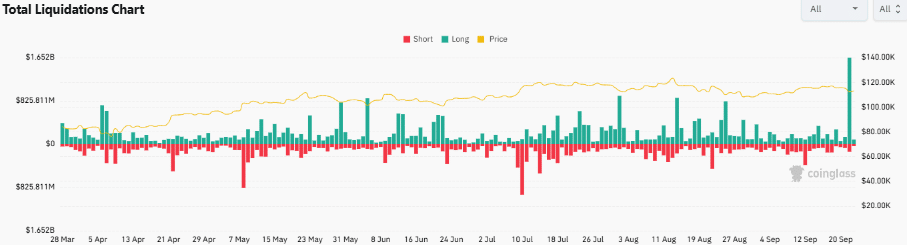
Source: CoinGlass
Ethereum [ETH] experienced the most significant liquidations, totaling around $497 million. However, liquidation clusters were also forming around Bitcoin [BTC] positions, both short and long.
Short positions clustered at $113.8K and long positions at $111.5K are acting as price attractors. Solana [SOL] saw almost $100M in capital being liquidated during the drop.
Consequently, further liquidations remain a possibility. High leverage levels could further destabilize the markets if prices continue to fall. Nevertheless, some view this as a necessary reset before a potential crypto market rally in the fourth quarter.
In addition, the daily trading volume across all crypto markets decreased by over 12.93%. The total market volume was approximately $294 million, with Bitcoin accounting for $55 billion of that total.
Impact of Options Expiry and ETF Outflows
The recent market crash was intensified by the expiration of a large number of options contracts, which increased selling pressure. Additionally, the expiration triggered stop-loss orders, leading to the closure of further positions.
Approximately $265 million in call options and $155 million in put options for Bitcoin were expiring. This represents nearly half a billion dollars in capital exiting the market. Furthermore, around $67 million in Ethereum options also expired.
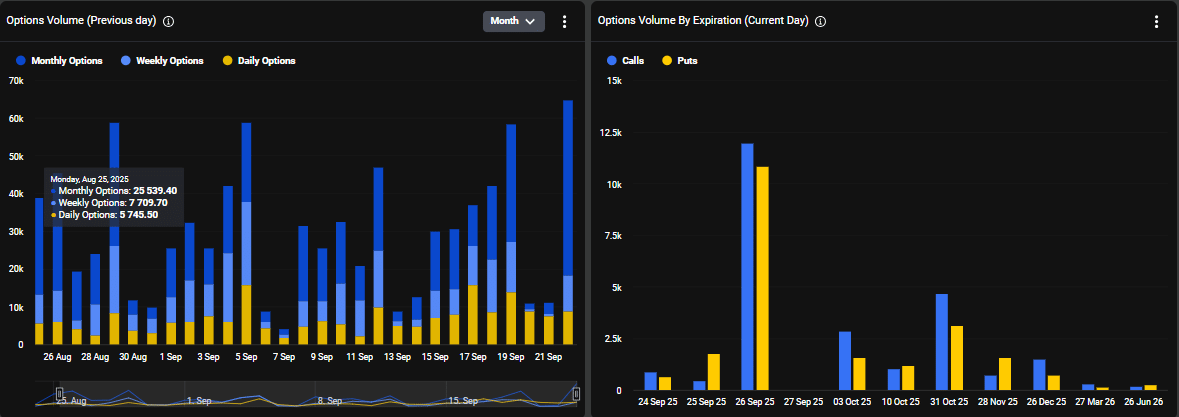
Source: Deribit
Further examination revealed sell-offs by institutional ETFs, primarily involving BTC and ETH. Bitcoin ETFs experienced outflows of over $363 million, suggesting capital withdrawal from the market.
Moreover, Ethereum tokens were being sold by ETF issuers. According to Whale Insider, Fidelity, specifically, sold 7,454 ETH, valued at $31.2 million.
Looking Ahead After the Crypto Downturn
This substantial market correction could potentially set the stage for a broader market recovery.
Historically, similar events have preceded market upturns, such as the correction on August 5th that initiated the crypto rally observed in Q4 2024.