


Journalist
Published:
Important Points to Note
Why is the CFTC considering the addition of stablecoins to derivative markets?
To facilitate round-the-clock settlements, enhance liquidity management, and foster advancements in the financial sector.
When can we expect the CFTC’s plan for tokenized assets to be implemented?
Specifics will be made available following the collection of public feedback, which is due by October 20th.
The U.S. Commodity Futures Trading Commission (CFTC) is deepening its involvement in the crypto space. Recent proposals involve integrating stablecoins and other tokenized assets as acceptable forms of collateral within regulated derivatives markets.
According to a declaration released on September 23rd, CFTC Chair Caroline D. Pham believes this initiative will stimulate positive evolution within derivatives markets, stating:
“The public has voiced its opinion: tokenized markets are established and represent the future. I have long advocated that collateral management is the pivotal application for stablecoins in the market arena.”
Industry Leaders Applaud the Initiative
Currently, the derivatives market permits only cash and government bonds, such as T-bills, to be used as collateral (or margin).
Consequently, the proposal to broaden collateral options to include stablecoins and tokenized assets is viewed as a progressive move for the crypto industry.
Tether’s CEO, Paolo Ardoino, expressed his support, describing the update as “a stride towards bolstering U.S. prominence in global finance and heightening market competitiveness.” He further commented:
“Stablecoins, which now represent a global market of nearly $300 billion, are increasingly becoming fundamental components of contemporary finance, enabling quicker settlements, amplified liquidity, and greater market stability.”
Jack McDonald, SVP of stablecoins at Ripple, mirrored this sentiment, stressing that tokenized collateral will “foster greater efficiency and clarity” in the derivatives markets.
Representatives from Coinbase and Circle, participants in the CFTC’s strategy, also reaffirmed that this action would stimulate financial innovation within the United States.
Crypto.com’s CEO, Kris Marszalek, suggested that the alternatives should not be restricted to stablecoins and tokenized assets alone. In a statement, he noted:
“We endorse the recommendations put forth by the GMAC concerning the utilization of non-cash collateral, including BTC and CRO, to fulfill regulatory margin obligations.”

Source: X
Ondo Finance [ONDO], a provider of tokenized assets, believes that incorporating crypto into the trillion-dollar derivatives market will reduce the distinctions between traditional and tokenized financial systems.
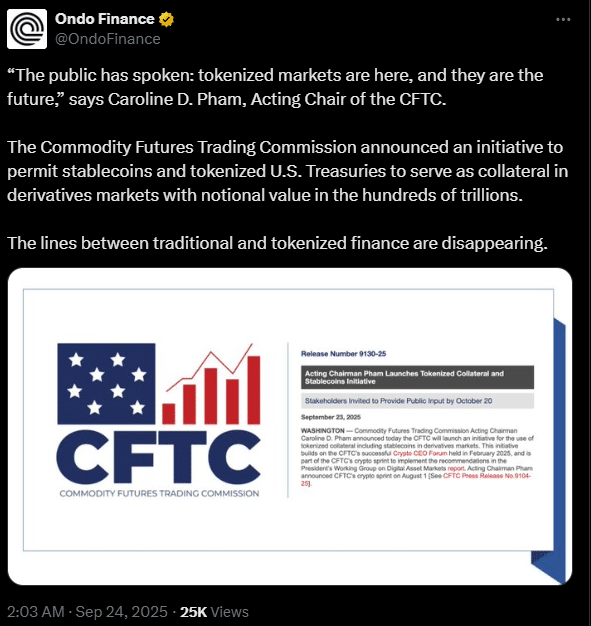
Source: X
Since August, the agency’s “Crypto Sprint” has revealed several regulatory initiatives designed to realize President Trump’s vision for digital assets.
The CFTC has since authorized the listing of spot crypto trading on both national and futures exchanges.
It has also teamed up with the SEC’s “Project Crypto” to enhance clarity within the industry through collaborative oversight.
The regulators are scheduled to hold a joint roundtable on September 29th to address and align certain regulatory issues.
The CFTC is soliciting public feedback on the tokenized collateral plan until October 20th, before proceeding with the creation of formal regulations.