
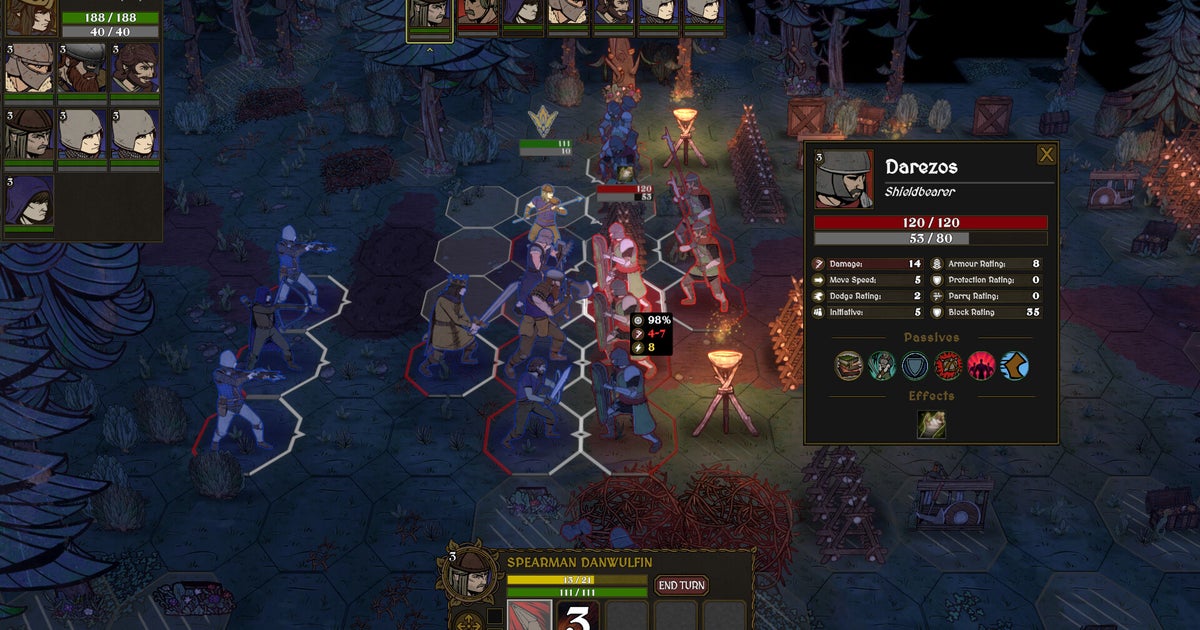
My introduction to Lost In The Open ended abruptly on the edges of civilization. My makeshift squad, a collection of worn-out bodyguards and hastily gathered wanderers, was overwhelmed by the well-equipped Strathian army. Heavily outnumbered, under-prepared, and already wounded, my soldiers struggled against the polished Strathian armor, quickly finding themselves surrounded and defeated.
It was then that I realized my hasty escape through the mountains and forests had been too efficient. I should have dedicated more time to battling bandits, scavenging ancient workshops, and accumulating resources for the inevitable confrontation with a powerful enemy. However, I can’t entirely fault my haste. After all, I am King Nrvesk, barely clinging to life after a failed assassination attempt during a formal dinner, with a relentless army pursuing me across the land.
Lost In The Open, developed by Black Voyage Games in Stockholm, is described as a “low-fantasy” tactical role-playing game. It merges the roguelike elements of fleeing and strategic resource management seen in FTL: Faster Than Light with an aesthetic inspired by games like Wildermyth and The Banner Saga. You take on the role of King Nrvesk, notorious for being a ruthless ruler, which explains the recent attempt on his life.
Starting with a small group of surviving guards – just two on the “Merciful” difficulty setting – your objective is to escape north from the Strathian capital. You must reach your own kingdom of Ruedome before the Strathian forces engulf you in a flood of red hexagons. Each location on the map presents a choice: engage in battle, gather essential supplies, or embark on complex story quests, sometimes with multiple stages. For example, I encountered a noblewoman who tasked me with recovering a stolen heirloom from robbers. I will leave it to you to discover whether accepting her request was a wise decision.
Engaging in combat in Lost In The Open carries significant risks. Characters can suffer permanent death if they are defeated in battle. Even if they survive, they will require time to recover, consuming valuable medical supplies in the process. Severe wounds can become permanent scars, negatively affecting a unit’s statistics, unless properly treated. Needless to say, if King Nrvesk is defeated, your game ends.
However, battling is essential for leveling up and collecting scrap and gold, which are necessary for trading and upgrades. Inevitably, you will face battles you cannot avoid. You also need to build alliances by recruiting soldiers and completing quests that may offer future benefits.
The combat system is enjoyable and familiar. Characters act based on an initiative bar, and they take more damage when attacked from the sides or rear. Each unit possesses a layer of armor that absorbs damage, preventing health loss, although some abilities can bypass this armor. Character classes include crossbowmen who must use action points to reload, resilient shield-bearers who can protect nearby allies, and berserkers with powerful moves that inflict additional damage based on the number of enemies defeated.
While it might not be as complex as the games mentioned earlier, this assessment is based on a brief 62-minute session with the Steam demo. The full game launches into early access on September 26th, featuring the first of three acts, “5 factions with 20 unit types (most are recruitable), 3 zones, 3 biomes, a wide variety of terrains, 6 boss encounters, and hundreds of unique events to discover.”
One of the questions I have is whether King Nrvesk will undergo a moral transformation during his journey to Ruedome. The name “Ruedome” hints at the possibility of regret and redemption. The Steam page suggests that “you must recruit strategically, fight desperately and repent sincerely,” but perhaps I can “repent strategically” instead. Surely Machiavelli had some strategic advice on timely apologies?