


Bitcoin’s network processing power, or hashrate, achieved a record peak of 1,073 exahashes per second (EH/s) on September 23rd. This substantial increase reflects an approximate 21% rise in computational capacity over the preceding month.
Looking at the bigger picture, the hashrate has surged by roughly 70% in the last three months. Examining the year-over-year trend reveals a striking climb of approximately 675%, demonstrating explosive growth in Bitcoin mining infrastructure.
Previously, Bitcoin hashrate was a metric primarily tracked by mining professionals and technical experts. Today, it serves as a key performance indicator for the Bitcoin mining sector, a tradable industry with significant capital expenditure implications.
So, what exactly is hashrate, and why should those outside the mining sphere be interested?
Hashrate represents the total computational power dedicated to securing the Bitcoin network through its proof-of-work system. In essence, it quantifies the difficulty of overpowering the network and altering the blockchain’s record. A higher hashrate translates to greater security, making attacks significantly more challenging and costly. Beyond security implications, hashrate provides insight into the expanding scale and investment behind the Bitcoin mining industry.
Reaching a zetahash level demands substantial investment: establishing mining facilities, installing power transformers, procuring vast quantities of specialized hardware, and securing long-term energy agreements to power the mining operations. Each surge in the hashrate signifies real-world investments in infrastructure and technology.
The Bitcoin protocol is engineered to maintain a consistent block creation rate. It adjusts the mining difficulty every 2016 blocks, similar to a treadmill that automatically increases speed as runners improve. A hashrate surge, such as the one witnessed in September, prompts an increase in mining difficulty in the following periods, impacting miner profitability.
This mechanism shapes the Bitcoin mining business. As more mining machines come online, the block creation rate accelerates, prompting an upward adjustment in mining difficulty. This, in turn, squeezes profit margins, rewarding the most efficient mining operations. The Bitcoin protocol remains impartial. Miners must meet their power cost and operational efficiency targets to maintain a competitive edge.
The most recent data indicates a new daily peak around 1,073 EH/s. The network added roughly 184 EH/s during the last 30 days. This substantial addition would have represented the entire network capacity just a short time ago.
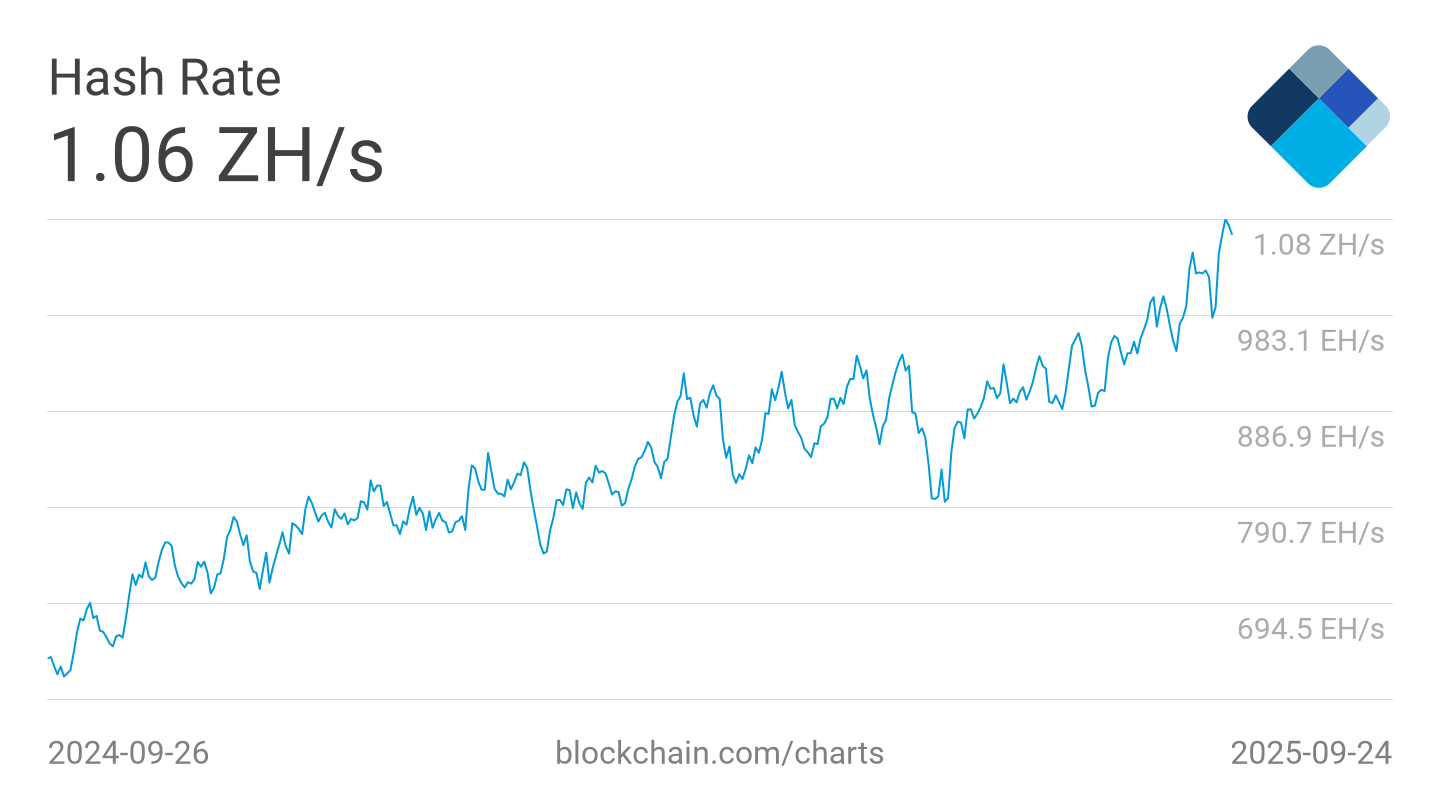
So far this year, the hashrate has increased by approximately 36%. The hashrate passed key milestones on a predictable timeline: 1 EH/s in early 2016, 10 EH/s by late 2017, 100 EH/s by late 2019, 500 EH/s in late 2023, and now surpassing 1,000 EH/s. Each benchmark indicates advancements in ASIC technology, optimized hardware configurations, improved software, and access to more affordable energy sources.
This underlines why hashrate’s significance extends beyond mere mining. Its importance to the mining industry stems from the prominent role of publicly traded mining companies. Companies like MARA, RIOT, CLSK, CORZ, IREN, and CIFR represent more than just investment vehicles for Bitcoin exposure. They are operating businesses directly impacted by the dynamic between hashrate and mining difficulty.
When the hashrate expands faster than the price of Bitcoin, mining difficulty increases accordingly, which then compresses the profitability for miners. This squeeze becomes apparent during financial results announcements, where metrics like hardware efficiency and electricity costs gain increased importance.
Mining firms that can secure electricity at a cost below $0.04-$0.05/kWh, operate advanced cooling systems (like immersion cooling or highly utilized air-cooled setups), and successfully hedge against energy price volatility can navigate these adjustments without significant margin erosion. Others see their break-even points rise.
The stock market perspective is easily understood but difficult to execute effectively.
Achieving scale is now a genuine infrastructural problem, with extended lead times for substations, grid constraints, and local regulatory hurdles. This underscores why the hashrate trajectory effectively illustrates which companies have successfully overcome these challenges.
A network that has surpassed one zetahash is driven by a global industry with substantial physical assets, situated in regions offering affordable energy and a supportive regulatory framework. Stock prices reflect this landscape.
Companies with new mining equipment and access to plentiful electricity are positioned to increase their market share during periods of growth. Those that lag face potential dilution, acquisition, or decreased relevance.
The industry often looks at the fluctuations in the hashrate as indicators of future Bitcoin price movements.
However, a more accurate interpretation suggests that price indicates market sentiment while hashrate shows true long-term commitment. Mining hardware isn’t installed instantaneously in response to positive social media buzz. The recent hashrate growth reflects months of capital investment already spent and future deployments secured.
If the price of Bitcoin remains stagnant, the mining difficulty will still rise, pressuring the industry to streamline operations. If Bitcoin’s price increases in tandem with the hashrate, publicly traded mining companies stand to benefit significantly as operational leverage becomes favorable.
The past month’s +20% and the quarter’s +70% increases are not just substantial, but also exceptionally rapid. The largest 30-day increase occurred in mid-September, highlighting the current pattern where equipment deployments and infrastructure development happen in bursts as mining containers are delivered, power is connected, and grid conditions change with the seasons.
This cycle will determine the performance ranking of various mining companies over the coming periods.
One can easily fabricate a misleading narrative, but one cannot easily fabricate delivered power.