
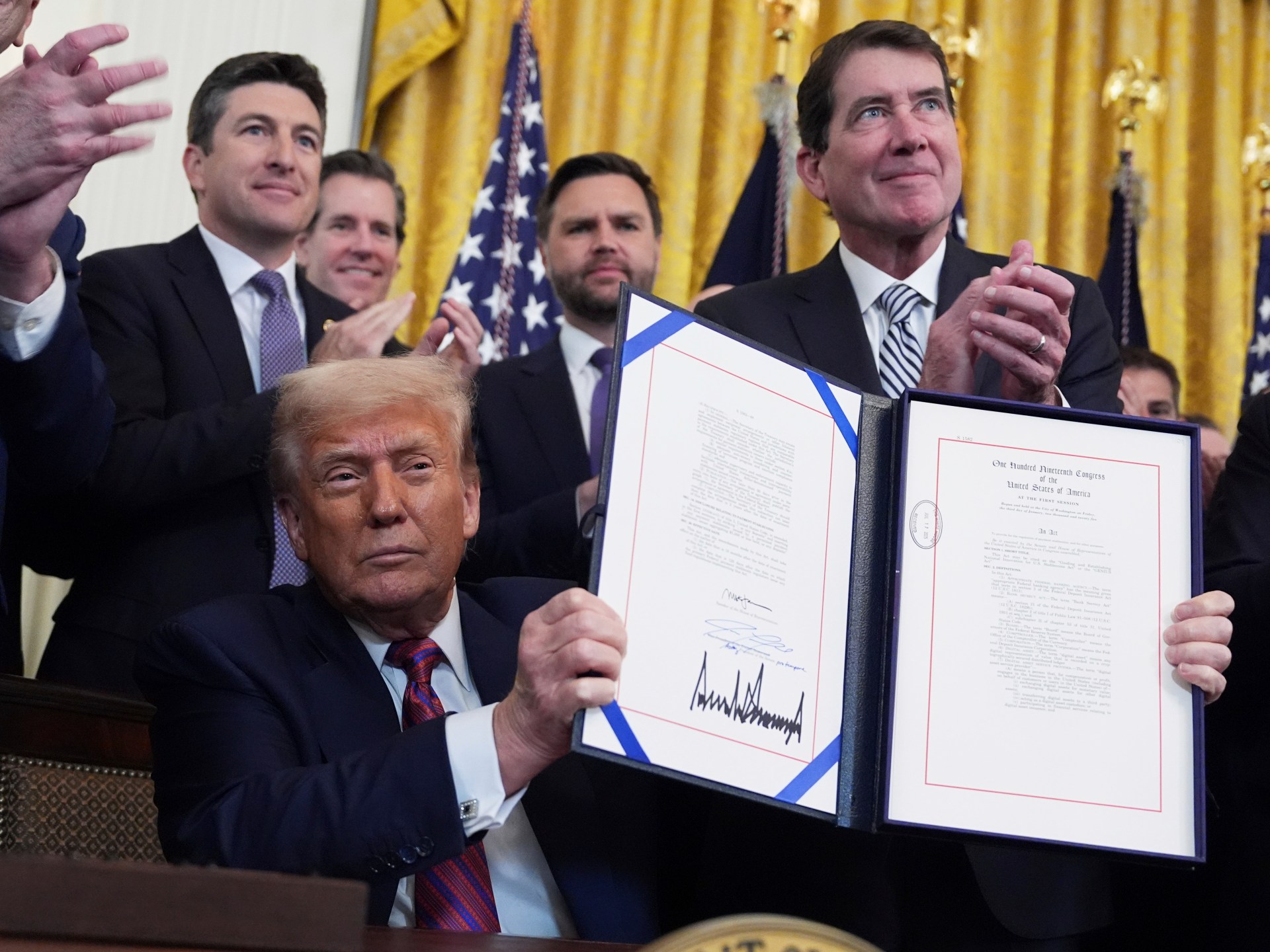
The White House hosted figures from the cryptocurrency sector, some of whom have faced government scrutiny, raising concerns about potential conflicts of interest related to Trump’s business ventures.
Washington, DC – President Donald Trump has signed into law new digital currency legislation. Supporters believe this law signifies a pivotal advancement for the industry.
During a White House address on Friday, the President championed the GENIUS Act. This legislation introduces guidelines and consumer safeguards for stablecoins, a type of digital currency designed to maintain a stable value by being linked to a traditional currency or asset.
Recommended Stories
list of 3 itemsend of list
The bill’s enactment concluded what Trump called “digital currency week,” a period during which Congress considered three bills related to digital currencies.
Ultimately, only the stablecoin legislation reached the President’s desk for signature.
Two additional proposed laws – one aiming to prevent the creation of government-backed digital currencies, and another seeking to clarify regulatory classifications for various digital currency products – were passed by the House of Representatives on Thursday and sent to the Senate, where they are awaiting consideration.
Nevertheless, Trump portrayed Friday’s signing as “a significant step toward securing America’s leading role in global finance and digital currency technology.”
Industry advocates assert that laws like the GENIUS Act will contribute to greater mainstream acceptance of digital currencies within the United States. They argue that regulatory uncertainties have hampered broader public adoption of these currencies.
However, critics have expressed reservations regarding potential conflicts of interest stemming from the Trump family’s connections to the digital currency space, specifically referencing their investment in World Liberty Financial, a company that has launched its own stablecoin called USD1.
These critics point out that the recent surge in Republican-sponsored legislation fails to address the question of whether a president should be allowed to hold digital currency investments, creating potential vulnerabilities to corruption.
Democrats have also raised concerns that the GENIUS Act’s regulatory framework is insufficient, potentially leading to future financial instability and allowing large corporations to introduce their own private digital currencies.
Despite these concerns, President Trump affirmed his continued support for the digital currency industry on Friday, including promoting his plan to establish a national “digital currency reserve,” outlined in a previous announcement.
Trump also presented his administration’s approach as a marked shift away from the policies of former President Joe Biden, who adopted a more proactive stance on investigating digital currency-related offenses.
Since beginning his second term in January, Trump discontinued several digital currency investigations initiated during Biden’s presidency and disbanded a specialized Justice Department enforcement team dedicated to the sector.
Among those present at the White House signing ceremony were some digital currency leaders who had previously been subject to government investigations.
Addressing the attendees, Trump stated, “You’ve come a long way since the Biden administration, when they didn’t understand what you were talking about, and some of you were being investigated for no real reason.”
He specifically mentioned Brian Armstrong, Chris Pavlovski, and the Winklevoss twins, Tyler and Cameron, all of whom faced inquiries from the Securities and Exchange Commission (SEC) during Biden’s tenure.
Trump added, “Let me say to the entire digital currency community, for years you were dismissed and counted out.”
“As recently as a year and a half ago, you were being counted out, but this signing is a huge validation.”