The cryptocurrency industry’s outreach to potential users is increasingly governed by a complex web of advertising regulations. The rules of the game are changing rapidly, influencing marketing strategies and demanding honest communication from crypto businesses. Expect exchanges to police their platforms for misleading ads, while regulators are scrutinizing the content promoted by influencers. Delve into key figures that paint a clear picture of the effects on consumer trust and regulatory adherence.
Editor’s Choice
- The total value of the global crypto market experienced a 9% decrease during the first quarter of 2025, eventually settling around $2.62 trillion, influenced by more stringent advertising standards.
- Bitcoin continues to lead with a 42% share of the market, demonstrating its continued importance despite increased scrutiny.
- On July 18, 2025, the United States implemented the GENIUS Act, establishing the country’s first federal framework for advertising stablecoins.
- Over 40 states within the U.S. have proposed or ratified legislation related to cryptocurrencies in 2025, many incorporating specific clauses that target advertising.
- The EU’s MiCA regulation was fully enacted in January 2025, creating consistent standards for cryptocurrency advertisements across all member nations.
- A concerning 90% of crypto applications assessed in the UK failed to meet anti-money laundering requirements, indicating a serious challenge for advertising compliance and fraud prevention.
- Losses stemming from crypto scams reached $9.9 billion in 2024, intensifying calls for improved data sharing among platforms and heightened regulatory oversight of advertising practices.
Recent Developments
- The GENIUS Act, having passed through legislative bodies, was signed into law on July 18, 2025. It stipulates that stablecoin advertisements must accurately reflect the assets backing them on a 1:1 basis.
- The White House issued a comprehensive report (July 30, 2025), totaling 166 pages, which recommended moving away from “regulation by enforcement” towards more clearly defined advertising guidelines for the crypto industry.
- In March 2025, the FDIC revised its guidance, permitting banks to engage in cryptocurrency advertising without initial approval, as long as risks are properly managed.
- More than 40 states made advancements in crypto regulation during 2025; examples include Arizona, which mandated disclosure requirements at cryptocurrency kiosks, and other states that introduced new consumer safeguards.
- With full activation in January 2025, the EU’s MiCA regulation is streamlining the rules governing cryptocurrency-related advertisements within the European Union.
- According to PwC, 2025 represents a turning point, with the regulatory climate in the U.S. becoming more “crypto-friendly” and offering clearer direction for advertising frameworks.
- In early 2025, Pakistan established a Crypto Council to guide the nation’s blockchain policies, including the development of future standards for cryptocurrency advertising.
Crypto Offer Payouts vs Other Vertical Payouts
- The crypto sector offers the most substantial commissions, ranging from $150 to $750, making it a highly profitable area for affiliates.
- Nutra commissions are notably lower, ranging between $45 and $120.
- Sweepstakes offers yield the smallest commissions, between $10 and $60.
- Dating offers provide payouts of $30 to $100, placing them above sweepstakes but far below those offered by crypto companies.
- The data underscores the reason for crypto’s dominance in commission earnings, offering payouts significantly higher than other industry verticals.
Global Overview of Cryptocurrency Advertising Regulations
- The global cryptocurrency market saw a 9% reduction in value during Q1 2025, holding steady at $2.62 trillion amidst increasing regulatory burdens.
- As of January 2025, the EU’s MiCA regulation is now the governing law for the marketing and promotion of crypto-assets across all EU member states.
- The EU’s Digital Services Act (DSA) mandates that online advertisements are transparent and prohibits targeted ads to children based on profiling.
- A staggering 90% of UK crypto apps failed to meet anti-money laundering standards, which regulators view as a key risk in markets influenced by advertising.
- Pakistan’s Crypto Council was formed in March 2025 and will likely play a significant role in defining future cryptocurrency advertising regulations.
- In the U.S., the recently adopted GENIUS Act will be used to regulate stablecoin advertisements, setting a precedent for national oversight.
- More than 40 U.S. states currently have crypto-related legislation pending or enacted that affects advertising transparency.
Country-Specific Crypto Ad Regulations
United States
- Effective July 18, 2025, the GENIUS Act requires stablecoin advertisements to be backed by U.S. dollars and establishes regulatory oversight at both the federal and state levels.
- The FDIC’s March 2025 guidance allows banks to pursue advertising strategies for cryptocurrencies without seeking prior authorization, given that appropriate risk management controls are in place.
- Over 40 states are actively involved in shaping cryptocurrency legislation, with Arizona requiring advertising disclosures at kiosks and Georgia creating a study committee to explore regulatory options.
European Union
- Starting in January 2025, MiCA ensures standardized regulation of crypto ads throughout the European Union.
- The DSA enforces transparency in online advertising, requires public ad repositories, and restricts profiling-based targeting for sensitive demographics.
United Kingdom
- 90% of UK crypto apps failed AML checks, influencing their eligibility to advertise and increasing compliance risks.
- Following instances of high-profile crypto scams utilizing deepfakes, Liberal Democrats are advocating for stricter regulations on YouTube advertising.
Pakistan
- Launched in March 2025, the Crypto Council is dedicated to developing advertising policy for digital assets.
The Two Cap Tables of Crypto Companies (Equity vs Token)
- Seed investors possess 12% of the company’s equity, representing early-stage financial supporters whose investment carries a high level of risk.
- Series A investors hold 24% of the equity, indicating a significant level of ownership resulting from the first major funding round, typically used to scale product and market development.
- Series B investors account for 18% of the equity, reflecting their financial contributions in the mid-stages of company growth.
- Series C investors are allocated 12% of the equity, representing strategic capital that often supports efforts to achieve market dominance or readiness for an initial public offering (IPO).
- The largest share of equity, at 25%, is held by Founders & Employees, underscoring the importance of internal ownership in the company.
- An ESOP (Employee Stock Option Pool) is set at 10%, designed to retain talent by offering employees a direct stake in the company’s future.
- In contrast, the Community commands the largest portion of the token cap table with 55%, highlighting the principles of decentralization and user empowerment.
- Employees are allocated 15% of tokens as an incentive to contribute to the project’s success.
- The Treasury retains 15% of tokens to maintain liquidity and support future funding requirements.
- Lastly, Investors are provided with 15% of tokens, ensuring alignment between traditional backers and the potential growth of the tokenized ecosystem.

Regulatory Statistics by Region
- North America: The U.S. has seen federal changes via the GENIUS Act, and 40+ states are involved in shaping crypto laws.
- Europe: With MiCA and DSA now in effect, the region has strict advertising rules.
- UK: The failure of 90% of cryptocurrency apps to pass AML checks and active calls for YouTube oversight highlight regulatory pressures.
- Asia (Pakistan): The creation of a Crypto Council points towards the development of future advertising regulation.
- Global: A 9% decline in the crypto market cap during Q1 2025, bringing it to $2.62 trillion, signals the impact of tighter regulations.
- U.S. regulatory tone is shifting towards clearer, more supportive advertising frameworks, as observed by PwC in early 2025.
- Regulatory emphasis is increasingly focused on transparency and preventing fraud across regions.
Crypto Advertising Restrictions and Bans
- The DSA restricts behavioral advertising by prohibiting the use of sensitive data and targeting of children on VLOP platforms.
- UK Liberal Democrats are urging the government to ban deceptive cryptocurrency advertisements on YouTube following deepfake scams.
- Pakistan’s Crypto Council has the potential to implement bans or restrictions on advertising that is considered misleading.
- EU MiCA places strict licensing requirements on providers, preventing unauthorized entities from advertising crypto assets.
- Some U.S. states are already limiting the promotion of unregistered crypto assets at locations such as kiosks and tourist destinations.
- Tighter advertising restrictions have been implemented globally due to the $9.9 billion lost to crypto scams in 2024.
- FDIC guidance offers insight into safe advertising practices for institutions involved in cryptocurrency activities.
Public Opinion on Which Investment Carries More Risk
- Only 18.3% of surveyed individuals see the stock market as carrying more risk, reflecting a higher degree of confidence in traditional investments.
- Conversely, 45% perceive cryptocurrency as the riskier investment, which is indicative of concerns regarding its volatility and regulatory landscape.
- 36.7% believe both investment options are equally risky, suggesting that many recognize the risks associated with both traditional and digital assets.

Licensing and Certification Requirements for Crypto Ads
- In 2024, 62% of token sales were subjected to securities laws across multiple jurisdictions, creating extra burdens for advertising compliance.
- During the same year, 48% of initial coin offerings (ICOs) failed to meet basic disclosure obligations and were subsequently placed under enforcement review.
- The SEC pursued 67 enforcement actions against fraudulent ICOs in 2024, imposing fines that exceeded $600 million.
- Approximately 75% of token issuers in 2025 now conduct legal reviews prior to launching tokens to avoid being classified as unregistered securities.
- 40% of token-based projects encountered launch delays due to confusion regarding the classification of tokens as either utility or security tokens.
- The OECD’s CARF rules call for Crypto-Asset Service Providers to compile user tax information and provide it to authorities, underpinning licensing transparency efforts.
- In Japan, the FSA now requires pre-sale licensing for token offerings targeting retail investors.
Platform-Specific Crypto Advertising Policies
- Many major platforms, including Baidu, LinkedIn, Snapchat, Twitter, Facebook, Google, Bing, MailChimp, Tencent, Weibo, and Yandex, have imposed outright bans on cryptocurrency advertising.
- The EU’s Digital Services Act obliges very large online platforms (VLOPs) to maintain publicly accessible advertising registries and restricts profiling-based targeting of vulnerable groups, which includes children.
- In the UK, a total of 1,702 cryptocurrency advertisements were banned between October 2023 and October 2024, but only 54% were taken down, and no fines have been issued to date.
- Lacking real-time supervision, the platform YouTube remains under pressure, with demands for enhanced enforcement authority, backed by the ability to issue fines.
- Under recent legislation, social media platforms like X (formerly Twitter) in Australia could face penalties of up to $50 million for failing to prevent the distribution of scam advertisements.
- The Financial Conduct Authority (FCA) in the UK is pressuring technology platforms such as Google, Meta, and Bing to comply with voluntary bans on cryptocurrency ads that have not been approved.
- Even with broad advertising bans in place, some platforms permit indirect promotion through influencers and peer-to-peer channels, thereby sidestepping centralized controls.
Global Cryptocurrency Exchange Platform Market Growth
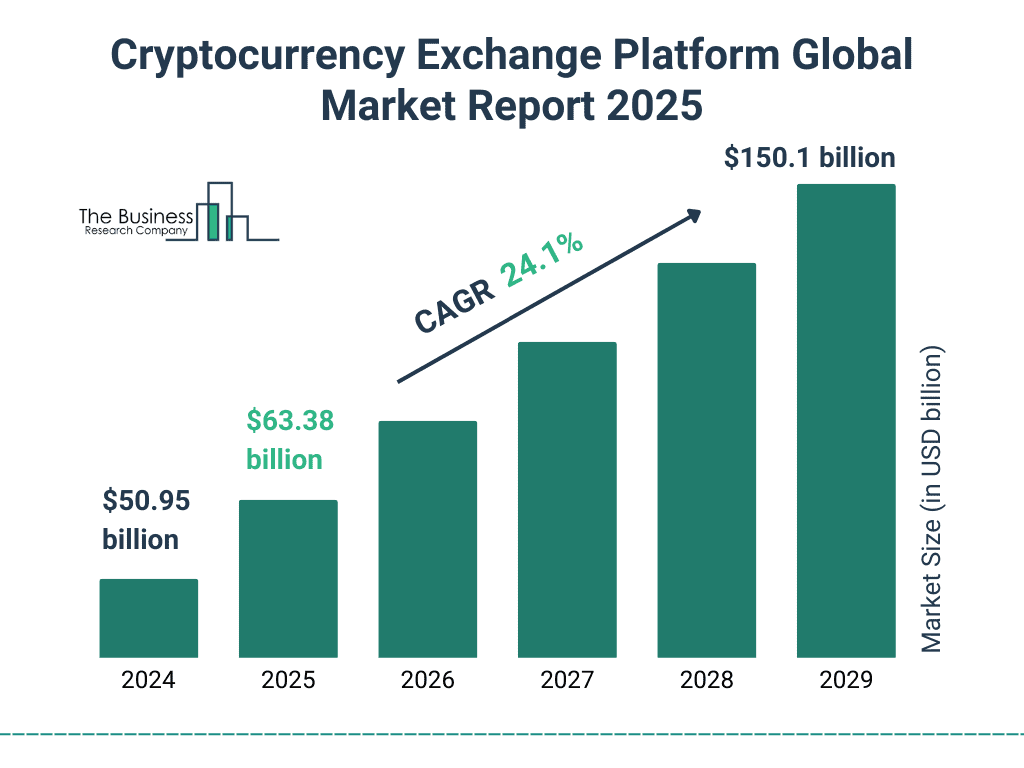
- The global cryptocurrency exchange platform market is projected to grow from $50.95 billion in 2024 to $63.38 billion in 2025.
- The market is expected to expand at an annual growth rate (CAGR) of 24.1% throughout the forecast period.
- The market is expected to reach $150.1 billion by 2029, indicating strong long-term growth prospects.
- This rapid growth is driven by increasing acceptance of cryptocurrency trading platforms and an expanding global user base.
Compliance and Enforcement Actions Statistics
- The level of enforcement drastically increased in 2024, with average SEC fines reaching $426 million, a significant jump from $3.39 million in 2018.
- One particularly large enforcement action involved Terraform Labs and Do Kwon, who faced a $4.68 billion fine.
- The SEC initiated a lawsuit against Ramil Palafox in early 2025 for operating a $198 million Ponzi-style cryptocurrency scheme, demonstrating continued regulatory vigilance.
- Globally, penalties for non-compliance in cryptocurrency transactions exceeded $5.1 billion in 2024, marking a 39% increase year-on-year.
- The United States alone accounted for $2.4 billion (47%) of these global fines.
- The average penalty per business was $3.8 million globally in 2025.
- The Asia-Pacific region saw a 55% increase year-on-year in enforcement actions in 2024.
Crypto Advertising Fines and Penalties
- Violations of AML and KYC regulations accounted for 83% of cryptocurrency-related penalties in 2024.
- Misleading or false advertising resulted in $115 million in fines globally in 2024, representing an 18% increase from 2023.
- Stablecoin issuers incurred a total of $410 million in fines related to reserve and disclosure failures.
- Unlicensed exchanges were penalized with fines totaling $940 million.
- Tax evasion related to cryptocurrency led to actions worldwide, with the IRS alone collecting $235 million in unpaid cryptocurrency taxes in 2024.
- Cryptocurrency-related penalties in regions like Africa (+78%) and the Middle East (+45%) experienced significant percentage increases, even though absolute figures remained lower.
- Cross-border cryptocurrency activity was responsible for 63% of compliance-related penalties in 2024.
Future Value Expectations for Cryptocurrency (5-Year Outlook)
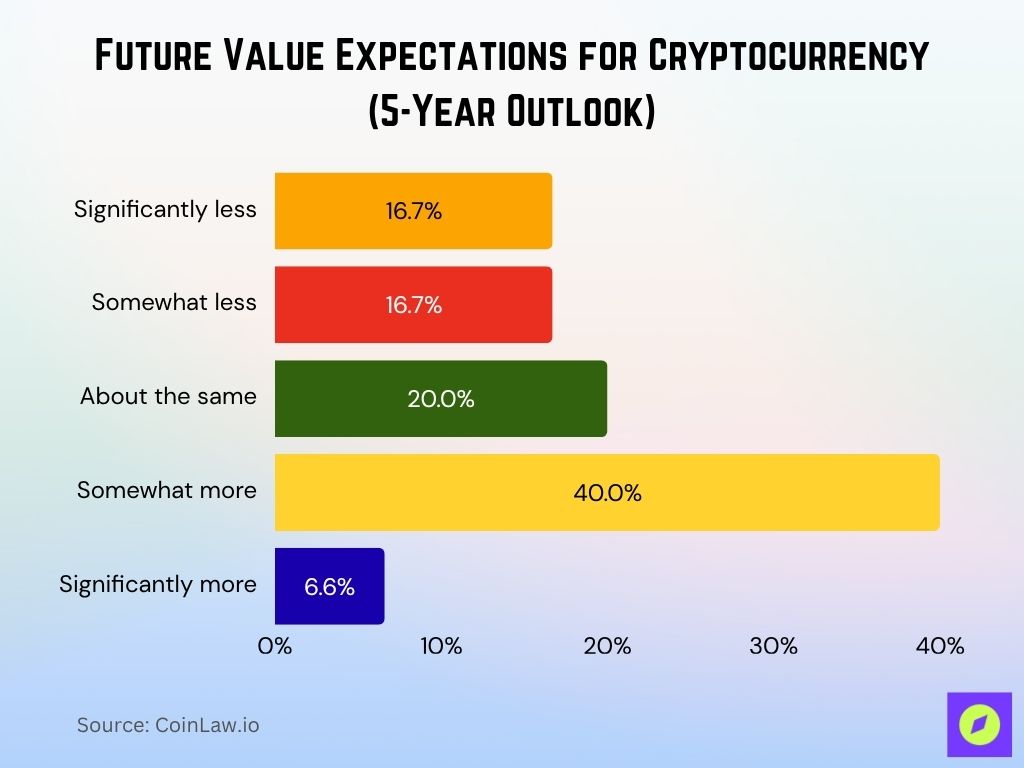
- 16.7% of respondents anticipate that cryptocurrency will be worth significantly less in five years, reflecting a pessimistic outlook.
- Another 16.7% expect it to be worth somewhat less, indicating a mildly negative view.
- 20% predict that values will remain about the same, expressing a neutral market sentiment.
- The largest portion of respondents, at 40%, expects it to be worth somewhat more, signaling cautious optimism.
- A smaller group, 6.6%, believes it will be worth significantly more, underscoring a strong bullish perspective.