
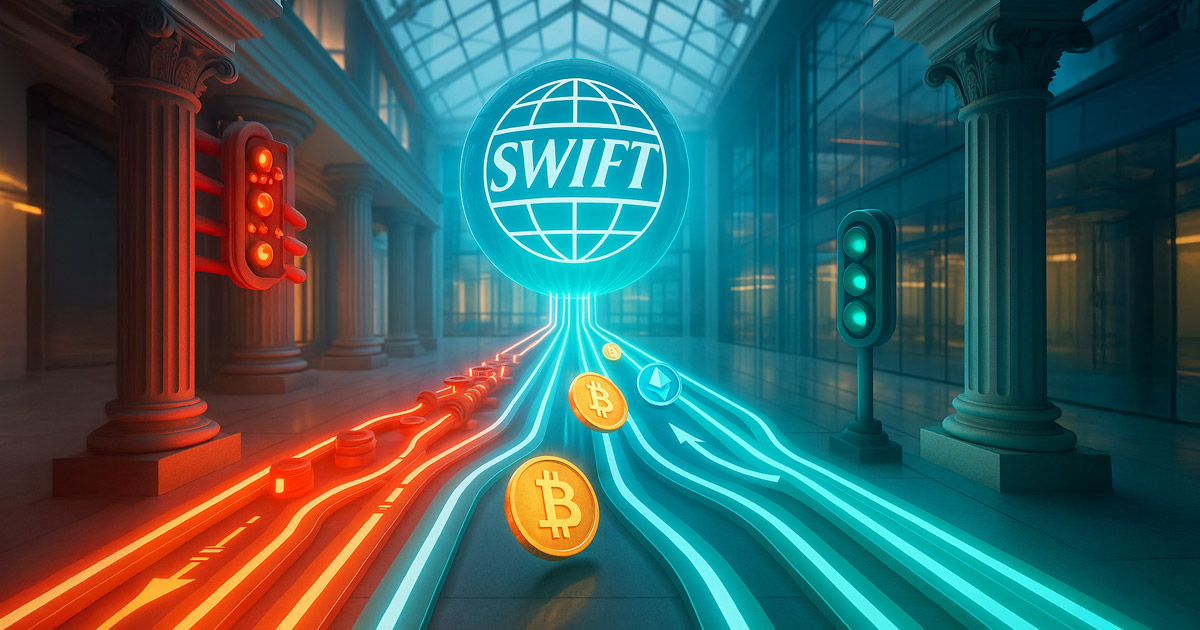

SWIFT, the global financial messaging network, has revealed plans to integrate a blockchain-powered ledger into its core infrastructure. This innovative ledger, developed in collaboration with Consensys, aims to connect banks, tokenized deposits, and diverse digital asset platforms directly to SWIFT’s vast payment network.
This initiative represents a significant strategic shift for SWIFT, moving beyond a simple test project to fundamentally reshape its operations, which currently handle $150 trillion in international transactions annually. It establishes a point of convergence between traditional bank settlement systems and the more open structures characteristic of the cryptocurrency sector. This will inevitably prompt the market to adapt to evolving liquidity dynamics as the world’s foremost payment network undergoes a major infrastructural upgrade.
For decades, SWIFT has served as a reliable and neutral intermediary, facilitating the secure transfer of trillions of dollars via messages between financial institutions. The newly introduced ledger, a collaborative effort with Consensys, is not conceived as a standalone blockchain. Instead, it functions as an interoperability tool designed to seamlessly connect digital asset platforms, tokenized deposits, and central bank digital currencies with existing fiat currency systems.
By directly incorporating this ledger into its framework, SWIFT is positioning itself as the central connector of disparate financial systems, rather than operating its own public blockchain. This strategic decision means that global banks will no longer be required to create custom integrations with each individual stablecoin or Real World Asset (RWA) platform; they can simply connect to SWIFT’s unified ledger.
Impact on Bitcoin and Crypto Markets
A key consideration for the cryptocurrency industry is whether this development will ultimately boost or diminish liquidity.
Stablecoin issuers have effectively become the primary facilitators of dollar settlements within the crypto ecosystem, transferring substantial amounts across exchanges and digital wallets. If banks develop a SWIFT-native method for issuing tokenized deposits or managing on-chain settlements, the incentive to utilize USDC-based channels could diminish. Fees currently earned by exchanges and stablecoin issuers may be redirected to traditional banking channels, potentially reducing profit margins for existing participants.
The implications for Bitcoin and Ethereum are expected to be slightly different. While not designed for final settlement in the same manner as traditional bank money, they are increasingly integrated into these financial flows through ETF liquidity and derivatives markets. When an ETF provider or market maker manages their exposure, the process often involves stablecoins before interacting with BTC or ETH.
A SWIFT ledger that reduces settlement costs for banks could lessen the comparative advantage of crypto-based solutions in arbitrage and cross-exchange settlements.
However, it could also broaden the overall market reach. If banks become more willing to hold tokenized liabilities, they might become more receptive to using BTC or ETH liquidity as collateral. The ultimate outcome will depend on integration complexity, the establishment of industry standards, and the project’s timeline.
Looking at the figures highlights the magnitude of the undertaking. SWIFT processes over $150 trillion each year, involving over 11,000 financial institutions. The average costs associated with remittance corridors remain above 6%, with settlement times often extending to several days.
A ledger that reduces these transaction costs by even 50 basis points could unlock tens of billions of dollars in annual savings. The extent to which these savings benefit banks or spill over into the crypto sector will depend on adoption rates. If exchanges and custodians are approved participants, the difference between traditional wire transfers and crypto liquidity pools could narrow significantly in real time.
Potential Challenges and Risks
There are inherent risks involved with this initiative.
A permissioned ledger might not integrate seamlessly with public blockchains, potentially creating isolated systems rather than fostering open liquidity.
Disagreements regarding standards, such as the ISO 20022 messaging protocol versus smart contracts, could also impede progress.
Banks could also be hesitant to adopt tokenized assets on a large scale, due to concerns about regulatory uncertainties. However, SWIFT’s past demonstrates that once standards are established, adoption tends to accelerate rapidly. Its original GPI program transitioned from a small number of banks to a global standard in less than five years.
The prevailing view in the cryptocurrency space has been that public blockchains would eventually dominate cross-border settlements as mass adoption occurs. SWIFT’s current project presents a competing vision: bank-controlled systems incorporating blockchain technology.
The critical question is whether these systems will stifle existing stablecoin channels or expand the overall market for tokenized settlements. Regardless, BTC and ETH liquidity are closely connected to the outcome. The world’s financial network now incorporates blockchain, and the next steps are up to the banks.