

As October begins, the digital currency Ethereum (ETH) sees increased excitement, with the expectation of a potential price surge commonly referred to as “Uptober.”
However, a closer look reveals potential challenges that Ethereum investors should carefully consider.
Ethereum: Navigating Potential Pitfalls This October – 3 Key Risks
Sponsored
Sponsored
This positive outlook follows a quarter where the second-largest cryptocurrency by market capitalization experienced notable investment inflows into Ethereum Exchange Traded Funds (ETFs). The crypto market as a whole also enjoyed a period of increased positivity, particularly among larger financial institutions.
Despite this, on-chain data indicates potential issues, with investors seemingly adopting a more cautious approach.
Slower Growth in Staking
Since the Merge, one of Ethereum’s strengths has been the consistent growth in the amount of ETH staked. This upward trend, however, seems to have come to a standstill.
Data from CryptoQuant shows that the validated ETH balance within the Ethereum deposit contract has stabilized around 36 million ETH since approximately July 20th.
This stagnation may reflect increased hesitancy among investors to stake ETH within decentralized finance (DeFi) platforms. For a considerable period, the expansion of staking offered strong support for Ethereum, reducing the available supply and bolstering network security.
Sponsored
Sponsored
The chart illustrates a correlation between Ethereum’s price increases and the growth in staking, with periods of stagnation mirroring price stability.
This pause suggests investors are carefully evaluating potential risks, which could be related to overall market instability, reduced returns from yield farming, or a shift of capital towards Bitcoin.
Reduced Interest in ETFs
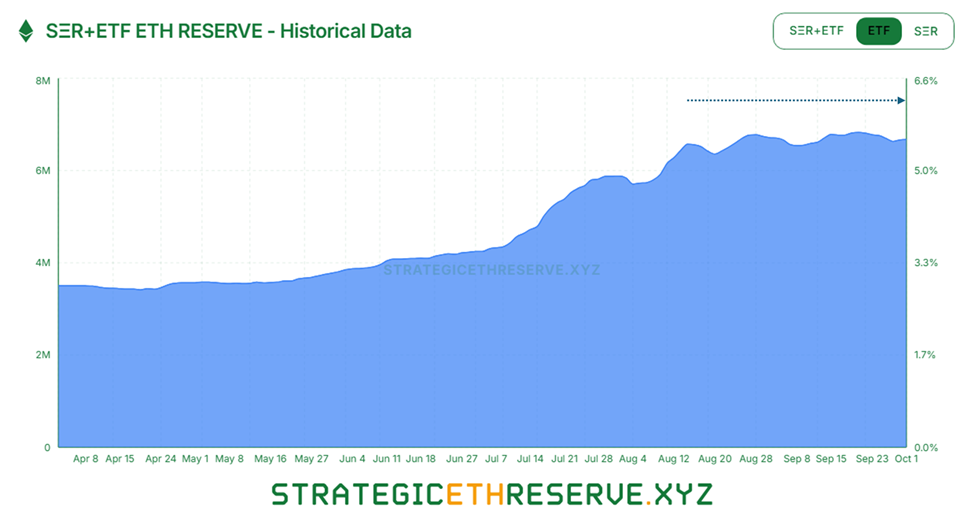
Another potential concern involves Ethereum ETFs. After an initial surge in investment earlier in the year, growth has significantly slowed down.
Data from StrategicETHReserve.xyz indicates that the amount of ETH held by ETFs has plateaued since the beginning of August, with inflows and outflows roughly balancing each other out.
Sponsored
Sponsored
This lack of significant net buying undermines a key positive argument. ETFs were expected to generate consistent demand for Ethereum, mirroring how Bitcoin ETFs have attracted institutional investment.
Instead, the current ETH ETF activity reflects uncertainty, suggesting that while some buying interest exists, it is being offset by selling pressure. For Ethereum’s price to move decisively higher, ETFs likely need to return to a pattern of net accumulation.
Decreasing Stablecoin Availability
Perhaps the most immediate concern is the availability of liquidity. On-chain data reveals that the average net flow of stablecoins to centralized exchanges (CEXs) has been negative since September 22nd.
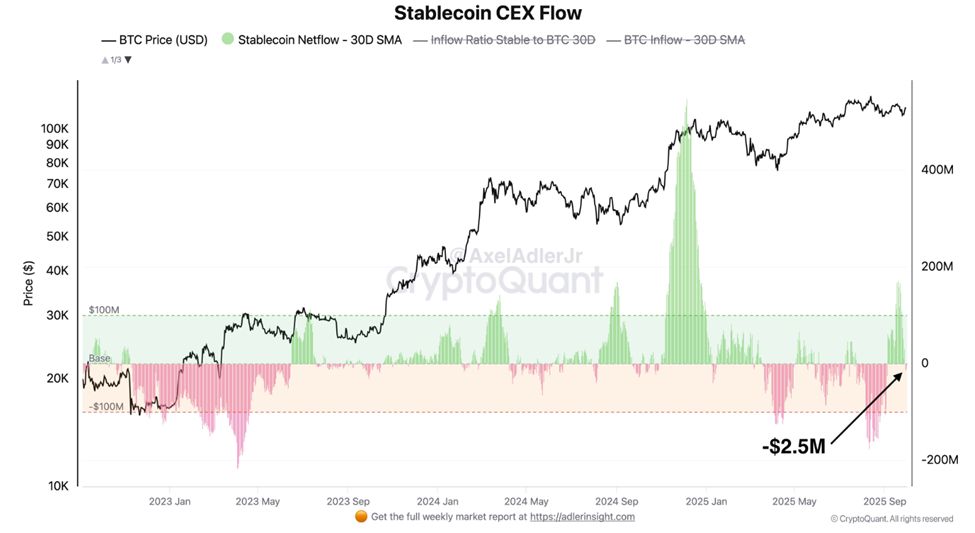
This trend, highlighted by on-chain analyst Axel Adler, suggests a reduction in the capital available for immediate spot market purchases.
Sponsored
Sponsored
“The average stablecoin net flow to CEXs has been negative and decreasing since September 22nd. Spot liquidity is diminishing while the BTC price remains high. This is a worrying sign,” stated Adler.
He further noted that while ETFs have brought in $947 million in inflows in recent days, this may not be sufficient to sustain a full “Uptober” rally without stronger spot market liquidity.
Balancing Expectations and Potential Risks
Despite these concerns, the fundamentals of Ethereum remain robust, and October could still see positive price movement if the broader market sentiment continues to improve.
Investment inflows into Bitcoin and historical positive trends in October provide a favorable environment. However, the potential risks – slowing staking growth, stagnant ETF demand, and decreasing spot liquidity – are important to consider and provide context to overly optimistic forecasts.
Understanding these underlying factors can help investors minimize potential losses should the market perform contrary to expectations. Consequently, investors should proceed cautiously and conduct their own thorough research, as October could present both opportunities and disappointments.