

The following insights are shared by Jamie Elkaleh, Chief Marketing Officer at Bitget.
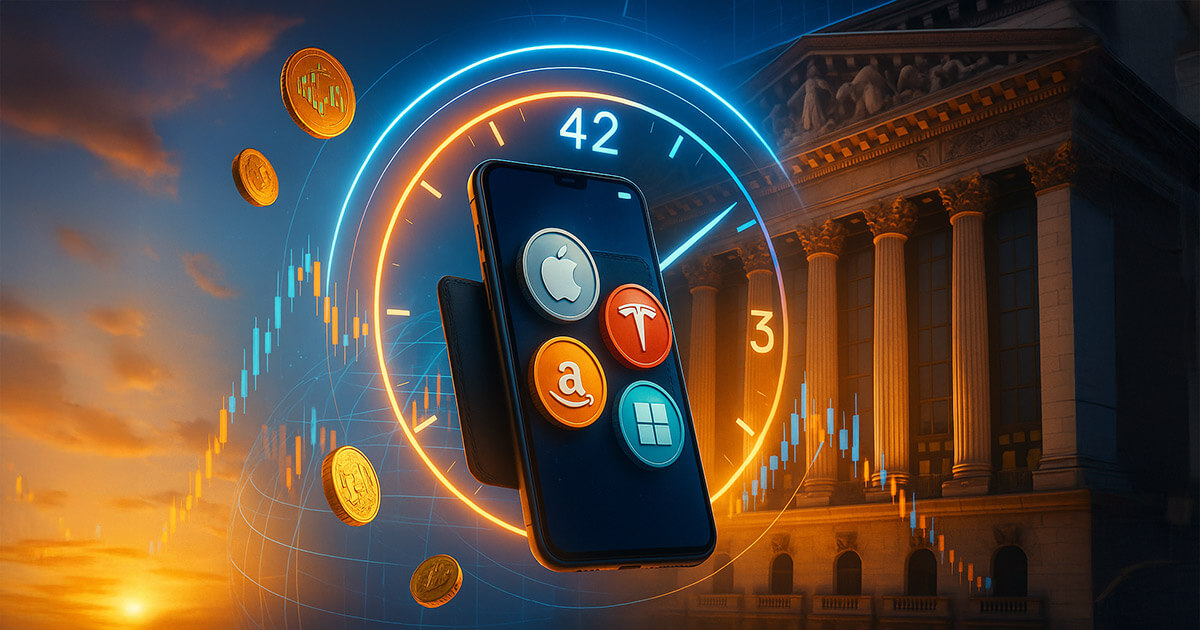
Imagine an investor in Hong Kong, just before the New York markets open, purchasing a single dollar’s worth of Tesla stock directly from their personal, self-custody digital wallet. This transaction occurs without the need for a broker, without foreign exchange spreads, and outside of traditional trading hours. This is becoming reality, driven by tokenized U.S. stocks and Exchange Traded Funds (ETFs) offered via platforms like Ondo Global Markets and integrated into digital wallets such as Bitget, subtly transforming Wall Street into a continuous, always-available, blockchain-based marketplace.
In the coming years, digital wallets – not traditional brokerage firms – may become the primary access point to U.S. equities for investors located outside the United States.
From Flawed Synthetics to Asset-Backed Tokens
The concept of tokenizing real-world assets (RWAs) – representing securities, investment funds, and bonds as digital tokens on a blockchain – has been a topic of discussion for over a decade. Initial approaches included synthetic models where tokens mirrored stock prices using external data feeds (oracles) but did not grant actual ownership (examples include Synthetix and Mirror). Other strategies involved Contracts for Difference (CFDs), where brokers issued contracts reflecting market exposure, and fully backed tokenized securities representing claims on real shares held by a regulated custodian under structures designed to protect assets even if the issuer becomes insolvent (bankruptcy-remote).
Progress is accelerating with fully backed securities. In August 2025, Galaxy Digital became the first publicly listed U.S. company to tokenize its own common stock, utilizing Superstate and the Solana blockchain. Subsequently, Nasdaq submitted a proposal to the SEC to potentially enable trading of tokenized securities on its primary market by 2026. Kraken has also launched “xStocks,” providing tokenized versions of Apple, Tesla, Nvidia, and over 50 other stocks, each backed one-to-one by actual shares held with Backed Finance. Robinhood has also expanded into Europe with 200+ tokenized U.S. stocks and ETFs—although these are contracts, not actual shares, which has sparked concerns about the issuer’s role.
The Stablecoin Blueprint
Stablecoins have demonstrated the potential for rapid migration of traditional assets to the blockchain. By making the U.S. dollar accessible on blockchain networks, stablecoins have grown into a market exceeding $160 billion and have become the primary currency within the crypto ecosystem, facilitating remittances, payments, and decentralized finance (DeFi) lending.
The parallels with equities are evident. Just as stablecoins broadened access to the U.S. dollar globally, tokenized equities have the potential to extend the reach of Wall Street. Rather than solely holding dollars in their digital wallets, users may soon hold fractional shares of prominent companies like Apple and Tesla, or even indexes like the Nasdaq – assets that are priced in dollars but tradable around the clock, even when U.S. markets are closed.
Current Real-World Asset (RWA) market trends support this, with tokenized U.S. Treasuries and cash equivalents reaching over $7.4 billion. The overall RWA supply on-chain has exceeded $25 billion in 2025, marking a significant increase from just $100 million five years prior.
Digital Wallets: The New Financial Hub
For many decades, access to U.S. financial markets required intermediaries such as brokerage firms, bank accounts, and adhering to specific jurisdictional regulations. Today, a crypto wallet can serve as the point of entry.
Digital wallets are evolving into comprehensive financial hubs, integrating payments, savings, and investment functionalities. Individuals in locations such as Lagos or Manila can receive stablecoin remittances, settle bills, and allocate remaining funds to tokenized shares of the S&P 500 – all within a single application.
Bitget Wallet’s integration with Ondo Finance provides a prime example. Users now have access to over 100 tokenized U.S. stocks and ETFs, with settlements processed on-chain. This user experience mirrors the way mobile money systems bypassed traditional banking infrastructure in Africa and Asia. Digital wallets could potentially bypass brokerage firms, offering low-barrier access to capital markets.
Liquidity, Regulation, and Remaining Hurdles
Liquidity has traditionally been a pain point for tokenized assets. Past projects have suffered not from a lack of user interest, but from insufficient trading volume. Newer approaches seek to address this by directly connecting on-chain tokens to the liquidity of traditional markets. The scalability of these models remains to be seen.
The regulatory landscape is another key area. Access today is mostly limited to users outside the United States and often requires KYC (Know Your Customer) verification or eligibility checks. Investors should understand how dividends, stock splits, and voting rights are handled, as well as the custodian responsible for safeguarding the underlying shares.
Tokenized assets face ongoing challenges like reliance on centralized custodians, whitelisting procedures, valuation transparency issues, and a limited number of decentralized trading venues. Tokenized stocks currently represent just a $420 million market capitalization – a small fraction of the larger $28 billion RWA market, emphasizing the early stage of this sector.
Key Takeaways
This transformation hinges on three core shifts:
Tokenized equities are democratizing access to Wall Street, creating a 24/7 trading environment that surpasses traditional market hours.
The rise of wallet-centric investing is emerging, as digital wallets evolve into the primary interface seamlessly combining payments, savings, and equity investments.
Regulatory compliance will define the scale of adoption – the speed at which this transition occurs will depend on how quickly regulators establish clear rules regarding eligibility requirements, custodianship standards, and voting rights for tokenized securities.
The Next Phase of Finance
The financial world is evolving towards a faster, borderless model. Stablecoins demonstrated this with fiat currencies; tokenized securities are now testing it with stocks.
The eventual outcome might involve paychecks delivered in stablecoins, with a portion automatically converted into a tokenized S&P 500 index fund. Everything resides within a single digital wallet – dollars, stocks, and crypto – coexisting in a unified digital ecosystem.
Wall Street will not disappear entirely, but its traditional operational model is being redefined. The opening bell is gradually giving way to a 24/7, on-chain economy.