

Entering October, Bitcoin (BTC) experienced a notable rise, seemingly unaffected by the US government shutdown, which has created uncertainty surrounding applications for altcoin exchange-traded funds (ETFs).
While the market welcomed this period dubbed “Uptober”, regulatory challenges and novel policy approaches dominated the news.
In the UK, a pair of individuals admitted guilt in connection to what law enforcement has described as the world’s largest cryptocurrency confiscation. Courts are now grappling with determining whether victims should be compensated based on Bitcoin’s current valuation or the value at the time of their losses.
Brazilian energy providers are actively seeking partnerships with crypto mining operations to utilize their surplus energy, while lawmakers in New York are considering new tax measures that could potentially force the industry to relocate.
Across Europe, regulatory bodies are issuing renewed warnings regarding stablecoins, even as banks and the European Central Bank (ECB) are progressing with plans to introduce their own digital euro alternatives.
Here’s the latest installment of our Global Express report:
US Government Shutdown Clouds Altcoin ETF Prospects as Bitcoin Enters “Uptober”
Bitcoin’s price surpassed $120,000 on Friday, as the US government shutdown continued, now in its third day. This situation is fostering hope that the leading cryptocurrency, as measured by market capitalization, will be able to continue its historical October gains, frequently called “Uptober”.
Lawmakers in the US failed to reach a funding agreement on Wednesday, resulting in the government shutdown. So far, traditional markets have shown little reaction, with major indexes showing slight increases. Bitcoin’s surge, however, has been significantly more pronounced.
The current government impasse is particularly significant for both traditional and digital assets, as it’s delaying the release of critical US jobs data, including the nonfarm payroll report initially scheduled for Friday. This report is a vital economic indicator that investors closely monitor to gain insights into the Federal Reserve’s future policy direction, ahead of the upcoming Federal Open Market Committee (FOMC) meeting starting on October 28.
Related: Strategy stacks 7K Bitcoin, stablecoins cross $295B: September in charts
Bitcoin experienced its last October decline just before the 35-day shutdown that started in December 2018, during which the cryptocurrency dropped from $3,900 to $3,550. Analysts attributed this drop to the Financial Action Task Force’s decision in October 2018 to expand its guidelines to include virtual assets, which dampened market sentiment. Since then, Bitcoin has recorded positive October performances for six consecutive years.
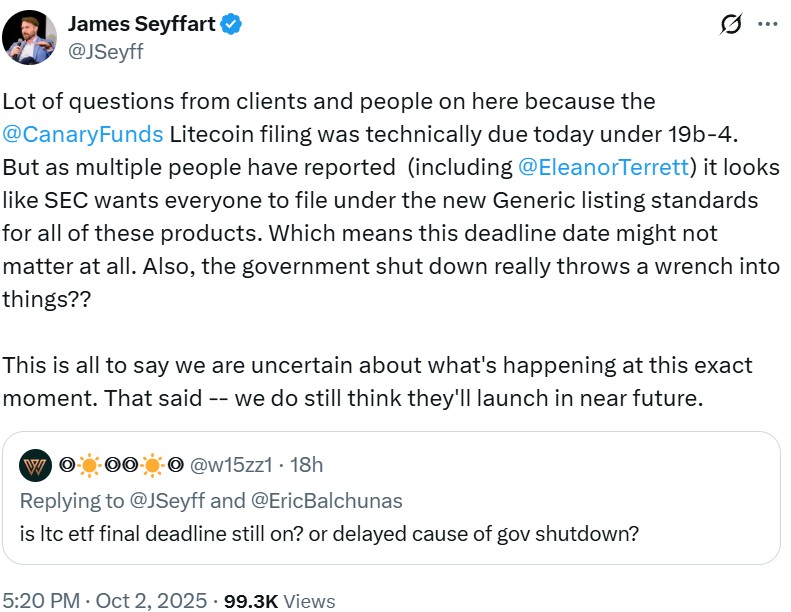
The ongoing government shutdown is expected to slow down the Securities and Exchange Commission’s (SEC) processing of routine applications, including those for crypto exchange-traded funds (ETFs). Deadlines for decisions on proposals related to Litecoin (LTC), Solana (SOL), and XRP are set throughout the month, but these are now likely to be postponed until the agency resumes normal operations.
Brazil Courts Bitcoin Miners to Address Energy Surplus
Brazil is emerging as a surprisingly welcoming destination for crypto miners, as energy companies view them as a way to solve persistent energy oversupply issues.
According to reports, numerous projects are currently under discussion, with some local energy plants reporting up to 70% excess output. Laos has adopted a similar strategy, attracting miners with cheap hydropower in an effort to pay off debts incurred from the dams that caused the electricity surplus.
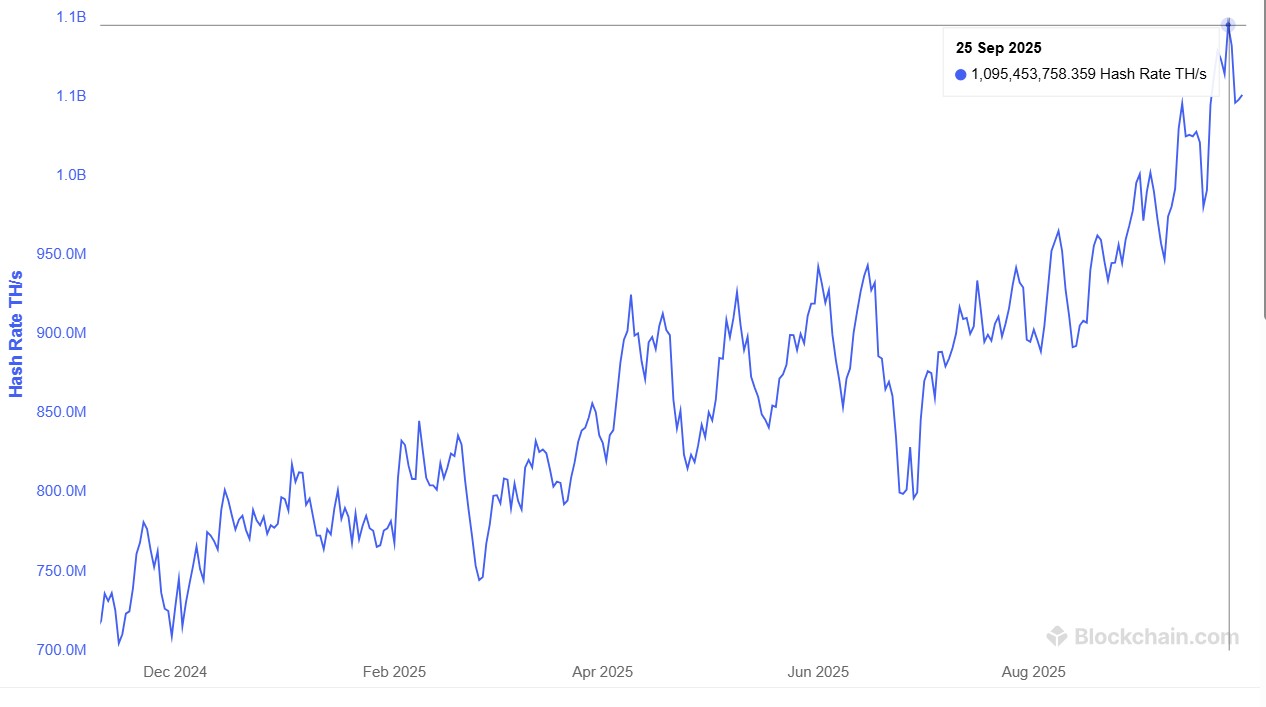
It is noteworthy that Brazil and Laos are embracing crypto mining to absorb excess energy, while other regions have been forced to remove them. China’s widespread ban in 2021 led to the shutdown of entire mining operations and the relocation of hash power. In Thailand, authorities raided mining facilities for allegedly causing grid instability and increasing electricity costs. In contrast, Brazil is treating the industry as a safety mechanism for its energy system instead of as a threat.
In contrast, New York State Senator Liz Krueger recently introduced legislation that seeks to impose a tiered excise tax on electricity used for crypto mining. The proposed tax would range from $0.02 per kilowatt-hour for medium-sized operations to $0.05 for larger ones, with exemptions only for miners that rely completely on renewable energy sources.
Related: France goes rogue, Bitcoin pumps on Fed rate cut: Global Express
This follows a two-year moratorium on fossil fuel-powered mining, which ended in 2024. Considering that the average cost of mining 1 BTC is already over $70,000 this year, the addition of this tax could drive miners reliant on the power grid out of the state.
Two Individuals Admit Guilt in Massive Bitcoin Seizure Case
Zhimin Qian, who orchestrated a large Ponzi scheme in China, pleaded guilty in a London court to laundering proceeds from criminal activities, including 61,000 BTC. Qian’s associate, Hok Seng Ling, also confessed to similar charges.
Between 2014 and 2017, Qian defrauded more than 128,000 investors through her company, Tianjin Lantian Gerui Electronic Technology, in one of China’s most significant fundraising scandals, before fleeing to the UK using falsified documentation.
Authorities seized her assets in 2018 after tracking Ling. The seized cache included Bitcoin, encrypted communication devices, cash, and gold, in what the UK Metropolitan Police called the largest cryptocurrency seizure in history.

The seized Bitcoin is currently valued at over $7.24 billion and is at the center of a debate concerning whether victims will be repaid at its current value or the original value of their losses years ago.
Reports indicate that the High Court might limit the restitution to the original investment value, roughly 640 million British pounds ($862 million). This would leave the $6.4 billion balance under government control. While Treasury officials have explored the possibility of using the excess to alleviate the budget deficit, others have cautioned that such a move could trigger extensive legal challenges.
Europe Restricts Private Stablecoins and Supports Digital Euro
European authorities are implementing stricter regulations on private digital currencies as they develop their own digital currency.
The European Systemic Risk Board (ESRB) has suggested a ban on stablecoins jointly issued by entities within and outside the European Union. While this recommendation lacks legal enforcement, it echoes concerns voiced by European Central Bank (ECB) President Christine Lagarde and Italian central bank officials, who claim that stablecoins not from EU companies could threaten financial stability.
Tether’s USDt (USDT), the world’s most prominent stablecoin, has already been removed from several EU trading platforms after Tether declined to comply with the bloc’s Markets in Crypto-Assets regulatory framework. This change has benefited Circle’s USDC (USDC), but the ESRB’s proposal might extend regulatory pressure to Tether’s competitor based in the U.S. as well.
Local initiatives are also gaining momentum. A group of nine major European banks, including ING and UniCredit, revealed plans to jointly create a euro-pegged stablecoin.

Meanwhile, the European Central Bank (ECB) is moving forward with its digital euro initiative. They recently announced agreements with seven technology providers, including Feedzai and Giesecke+Devrient, to develop systems for detecting fraud, managing risk, and facilitating offline payments. ECB executive board member Piero Cipollone stated that a launch by mid-2029 “could be a fair assessment.”
Magazine: Japan tours on XRP Ledger, USDC and USDT payments via Grab: Asia Express