
Washington, D.C. — A procedural vote on a groundbreaking crypto regulation bill failed in the Senate on Thursday, as Democratic senators blocked the measure. This action followed increasing scrutiny of connections between the digital currency sector and the Trump family.
The proposed law, known as the GENIUS Act, aimed to establish a regulatory structure for stablecoins. Stablecoins are cryptocurrencies whose value is linked to assets like the U.S. dollar. While the Senate Banking Committee approved the bill with bipartisan support back in March, Democratic backing has diminished. Concerns over former President Trump and his family’s cryptocurrency business dealings contributed to this shift.
The vote tally was 48 in favor and 49 against, falling short of the required 60 votes to proceed. Republican Senators Rand Paul from Kentucky and Josh Hawley from Missouri joined all Democratic senators in opposing the bill.
The committee’s earlier approval occurred before an announcement earlier this month regarding an investment of billions of dollars by an Abu Dhabi-backed company into World Liberty Financial, a crypto firm associated with the Trump family. This investment involved the purchase of $2 billion in stablecoins issued by World Liberty Financial, which would then be used for investments in the Binance crypto exchange.
Despite bipartisan collaboration on numerous versions of the legislation, Senator Elizabeth Warren, a Democrat from Massachusetts and a leading member of the Senate Banking Committee, informed reporters that Democrats had not received the final draft until just hours before the vote.
Warren highlighted several “problem” areas within the most recent version of the bill. She specifically criticized provisions that, in her view, would “supercharge Donald Trump’s corruption” and weaken consumer protection laws.
“It carries a significant risk of potentially destabilizing the U.S. economy and once again placing us in a situation where taxpayers are forced to rescue billionaires, effectively footing the bill for the risks taken by the wealthy,” Warren stated.
While acknowledging ongoing discussions, Warren clarified that no agreement had been reached between Democrats and Republicans before the vote. She suggested that a version of the legislation incorporating “appropriate regulations on stablecoins” could secure a broad majority in the Senate, with substantial support from both parties.
In a statement released earlier in the week, White House representative Anna Kelly told CBS News that Mr. Trump’s “assets are held in a trust managed by his children, thus eliminating any conflicts of interest.”
“Passing stablecoin legislation on a bipartisan basis is essential. President Trump remains committed to establishing America as the global leader in cryptocurrency and transforming our digital financial landscape,” she added.
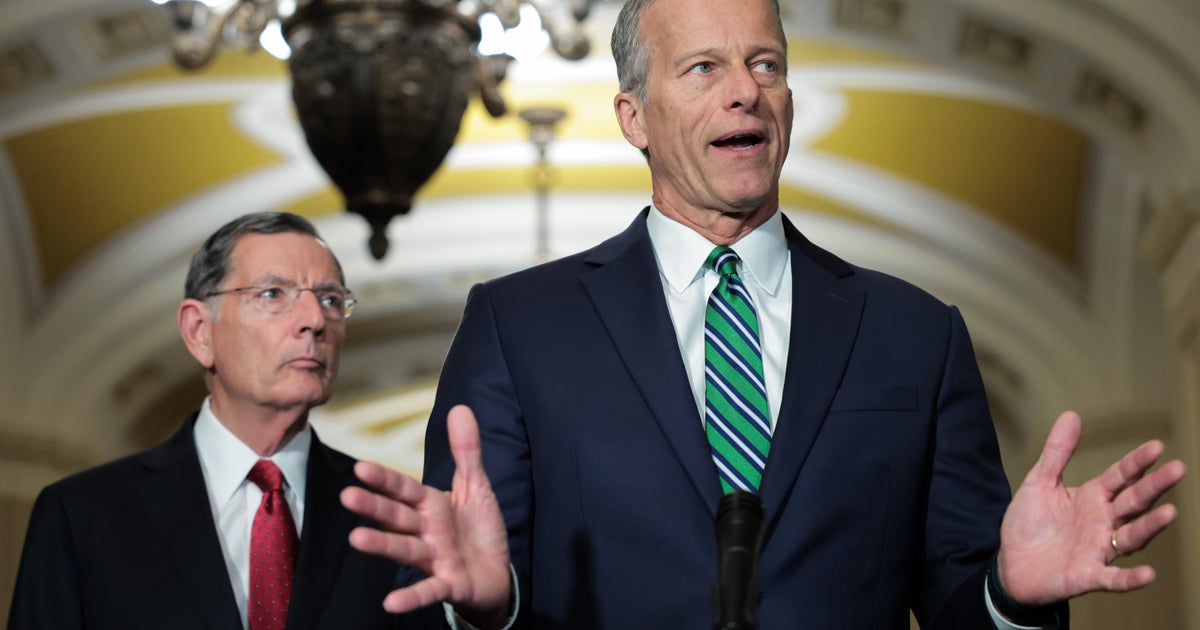
Earlier on Thursday, Senate Majority Leader John Thune urged Senate Democrats to support moving forward with the bill. Speaking on the Senate floor, he emphasized that this was the sixth iteration of the legislation, developed with input from both Republican and Democratic senators. He argued that senators seeking further changes should vote to advance the bill.
Kayla Bartkowski/Getty Images
“Once the bill is under consideration, amendments can be discussed on the floor,” Thune stated. “We have maintained an open and collaborative process on this bill thus far, and there’s no reason to halt that now.”
The South Dakota Republican championed the GENIUS Act, emphasizing its potential to bring “clarity” for innovators and contribute to making the U.S. a leading force in financial innovation and stablecoins. He described it as a crucial “first step” in incorporating digital assets into the U.S. financial system “by establishing a well-defined framework for stablecoins.” He acknowledged that this is “by no means the final say on digital assets,” and that he anticipates “continued Senate engagement in this domain.”
Prior to Thursday’s vote, Senate Democrats sought to postpone it, desiring more time to analyze the legislation. Senator Ruben Gallego, a Democrat from Arizona, requested unanimous consent to reschedule the vote for Monday and combine it with another vote scheduled for that day. However, the request was rejected.
Thune, who switched his vote to “no” in a move that allows Senate Republicans to reintroduce the legislation at a later time, criticized the Democrats’ opposition following the vote, saying, “I am uncertain what aspects of the process Democrats would alter, considering the extensive steps taken on this bill.”
“Democrats have received accommodations at every juncture,” he commented, adding, “candidly, I fail to comprehend the rationale.”