
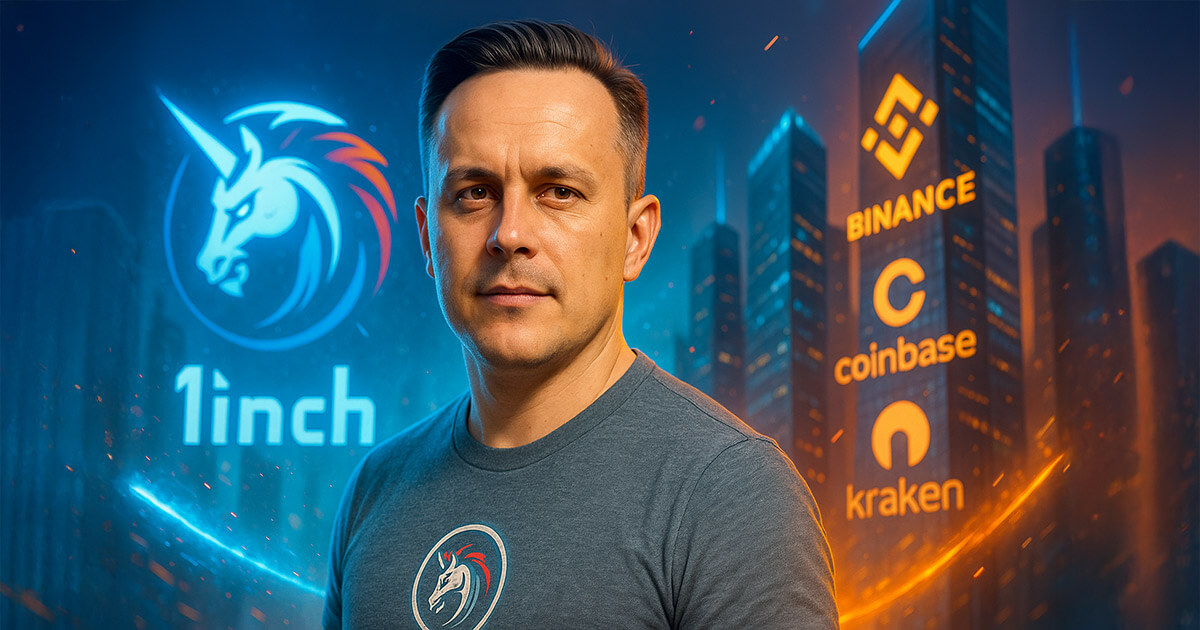

Welcome to Slate Sunday, CryptoSlate’s regular deep dive. Each week, we bring you detailed interviews, expert views, and insightful opinion pieces that go beyond the day’s news to explore the driving concepts and personalities shaping the crypto world.
When you ask Sergej Kunz, co-founder of 1inch, about the future direction of Decentralized Finance (DeFi), expect a response that goes beyond the standard platitudes about wider financial access or protection against unstable government currencies.
Kunz is known for his directness, and he approaches the future of DeFi with the focus and determination of a hunter. His vision sees DeFi becoming a smooth, peer-to-peer experience, so user-friendly that centralized exchanges become outdated.
1inch, a leading aggregator of decentralized exchanges (DEX) and a comprehensive DeFi ecosystem, recently updated its brand and integrated with the Solana blockchain. It also introduced native, decentralized swap functionalities across more than a dozen Ethereum Virtual Machine (EVM) compatible networks. Kunz explained with enthusiasm:
“We realized the need for expansion; the DeFi landscape is no longer solely based on Ethereum.”
This statement reflects the evolving landscape. Starting in 2019, 1inch focused solely on Ethereum, capitalizing on the initial surge of DeFi innovation. As Kunz recalls:
“Our journey began on Ethereum and solely on Ethereum. Subsequently, we incorporated additional EVM-compatible chains, including Binance Smart Chain, Polygon, and various Layer-2 solutions.”
Now, with support for 14 chains, including Solana since April, one thing is evident: the lines between DeFi ecosystems are increasingly blurred, and Kunz’s vision of seamless interaction between these systems is quickly becoming a reality.
“Our aim is to unify the DeFi space, connecting all chains, and now extending to non-EVM compatible chains. We plan to integrate Bitcoin and other blockchains, enabling cross-chain swaps, to bring all liquidity together in one place.”
This might sound ambitious, and it is. Kunz is not one to aim low. Why settle for fragmented liquidity when a single platform can unify it all?
1inch: Secure Swaps and Efficient Execution
Kunz’s intense focus on cross-chain functionality is matched by his dedication to security and optimal pricing. He emphasizes user control and upholding the fundamental principles of decentralized finance, like removing intermediaries.
“Our core offering is non-custodial swaps, meaning no one needs to place their trust in a third party. Our second advantage is providing the best possible execution using the largest available liquidity.”
Bringing together liquidity is more than just technical. It’s part of a long-term vision: to relegate centralized exchanges to a minor role in crypto history. As he asserts:
“In theory, with 1inch, there would be no need for centralized exchanges.”
Kunz emphasizes that 1inch’s strength lies in its user experience, providing a consistent interface across different ecosystems and chains.
How close is DeFi to providing that seamless, cross-chain experience that users familiar with Web2 expect?
“We’re almost there,” he says. “Currently, performing a cross-chain swap involves simply connecting your wallet, clicking a button, and confirming. Users no longer need to handle individual transactions themselves.”
Intent-Based Protocols: Addressing Real-World Problems
This ease of use is enabled by innovation. The 1inch protocol, created in 2022, aims to make DeFi fairer and combat “sandwich attacks,” a type of front-running that affects liquidity providers and traders. He explains:
“We call it an intent-based protocol for swaps.”
The term “intent-based protocol” has become increasingly popular. Uniswap X has discussed it, and Kunz points out that Uniswap X’s concept is based on 1inch’s work; it’s even referenced in their documentation.
“We can build a protocol that offers user orders to market makers and arbitrage traders, letting them compete with each other.”
Kunz compares 1inch’s approach to traditional exchanges like the Nasdaq, where orders are created and market makers fulfill them. The key difference is that orders are given directly to an open ecosystem of traders who compete to fulfill them quickly and efficiently. The results speak for themselves:
“We’ve seen instances where someone exchanging 12 million USDT for Ethereum received $135,000 more than they would have if they’d used a DEX directly.”
He shares his personal experience with sandwich attacks:
“I was sandwiched… front-run by a malicious exchange. I realized we needed to fix this.”
The intent-based protocol arose from necessity, he says with a smile:
“I addressed my own issue. Now, no one can sandwich you or manipulate liquidity.”
From DeFi to the Wider Crypto Ecosystem
The conversation shifts to stablecoins and user experience problems across different chains. Despite improvements, DeFi can still be difficult for new users to navigate, especially switching between networks and setting up wallets. Kunz responds that the ultimate goal is for users to not worry about networks or bridges.
“Users shouldn’t need to think about the chain… they should only be concerned with their USDC balance.”
Looking ahead, Kunz sees growth as the only certainty.
“We’re unifying DeFi liquidity… and then expanding to the entire crypto space. We’re integrating Bitcoin, allowing you to buy any sh*tcoin, memecoin, whatever coin, as well as real Bitcoin, receive it in your wallet, and sell it. The same applies to Litecoin and Ripple.”
1inch’s vision is clear: to expand beyond the “small DeFi space” into the wider Web3 world and, eventually, traditional finance. He elaborates:
“Many companies, including banks, are tokenizing real-world assets, but there’s no central marketplace to trade them. You have to go to each issuer, maybe a specific bank, to buy tokenized wine, for example. There are regulations to consider… Our plan is to offer our protocols and software service APIs to institutions, enabling them to exchange these assets securely and in a non-custodial manner.”
The Challenge to Centralized Exchanges
What’s next for 1inch in the near future? Kunz explains that the one-to-three-year plan is to “push forward,” integrate more chains, enhance cross-chain functionality, and create a smoother user experience. Finally, with a spark in his eye, he adds:
“To challenge, test, and compete with centralized exchanges.”
As we said, Kunz is ambitious.
While many leaders of Centralized Exchanges (CEXs) foresee a future where DeFi and CeFi coexist, the leading figures in decentralized finance have not forgotten being front-run.
With centralized exchange spot volume dropping nearly 28% in Q2 2025, CEXs should be paying attention. DeFi is ready to compete.