

Despite facing international economic penalties, a stablecoin called A7A5, backed by the Russian ruble and originating from Kyrgyzstan, has emerged as the leading stablecoin alternative to the U.S. dollar worldwide.
According to data compiled by CoinMarketCap and DefiLlama, A7A5’s market capitalization reached nearly $500 million on a recent Monday. This represents approximately 43% of the total market capitalization of stablecoins not pegged to the U.S. dollar, which stands at $1.2 billion.
In a statement posted on its Telegram channel on Saturday, A7A5 representatives asserted, “We have demonstrated that a nationally-backed digital currency can serve not only as a substitute for the dollar but also as a catalyst for global economic shifts.”
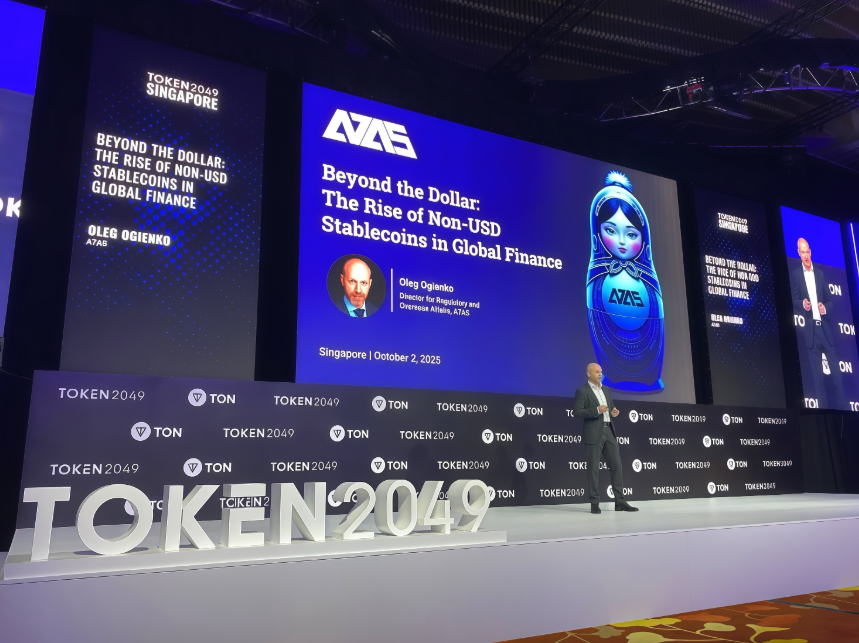
The project’s presence at Token2049, a prominent cryptocurrency conference in Singapore, garnered significant attention and sparked debate regarding its compliance with international sanctions and its expanding global reach.
A7A5: Sanctions Timeline
The A7A5 stablecoin was introduced in February, described as a “token secured by a diverse portfolio of fiat deposits held in reputable Kyrgyz banks.”
Designed to mirror the value of the Russian ruble on a 1:1 basis, A7A5 initially promised to distribute daily passive income equal to half of the interest earned on its deposits. The token was initially available on the Ethereum and Tron blockchain networks.
Shortly after its launch, analysts connected A7A5 to Grinex, a cryptocurrency exchange considered by many to be the successor to Garantex, a Russian exchange facing sanctions.
In mid-August, the U.S. Treasury Department announced sanctions against Garantex and associated entities, specifically naming Ilan Shor, a Moldovan businessman, as the owner of A7A5’s issuer, Promsvyazbank PSB, a Russian bank under sanction.
The United Kingdom swiftly followed suit with sanctions on several Kyrgyz banks, alleging that A7A5 was being used by Russia to circumvent Western financial restrictions.
A7A5 Records Significant Growth
Despite the widespread sanctions, A7A5’s market capitalization has generally remained within the $120 million to $140 million range.
On September 25th, A7A5 experienced a substantial surge in market capitalization, increasing by $350 million – a 250% increase in a single day. This propelled it to the position of the largest non-U.S. dollar stablecoin, surpassing Circle’s euro-pegged EURC (EURC), which was valued at $252 million at the time.
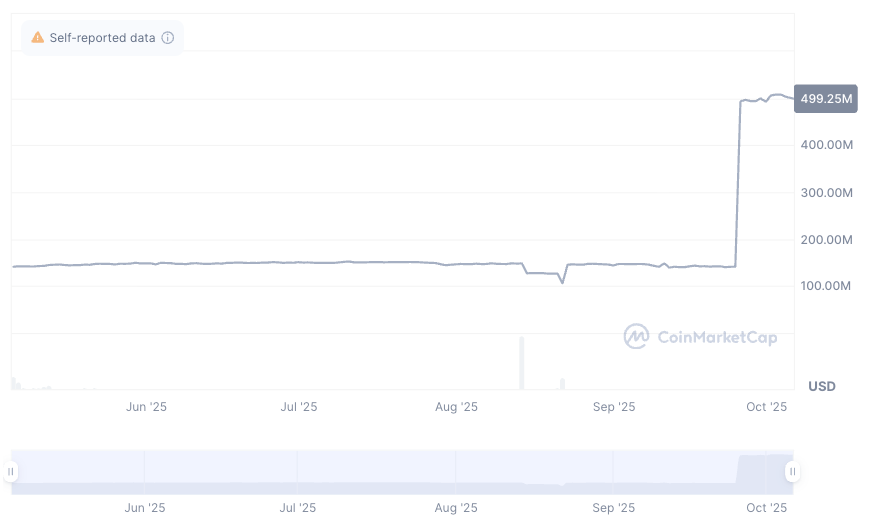
This dramatic increase in A7A5’s market value occurred just days before the project’s appearance at Token2049, where it maintained a booth and featured executive Oleg Ogienko as a speaker.
A7A5’s participation at the conference caused friction within the crypto space, with many individuals demanding enhanced regulatory compliance and the closure of loopholes at such industry events.
Some investigators claim that A7A5’s expansion is related to ties with China. According to a report released on Monday by the Centre for Information Resilience (CIR), a non-profit organization, “Trade with China has become the primary focus of A7’s activities.”
The CIR’s report stated that “78% of A7 transactions passed through Chinese jurisdictions based on figures provided by the company in August 2025.” The report also notes that the stablecoin is actively expanding into Africa, with offices located in Nigeria and Zimbabwe.
CIR concluded, “Further investigation is necessary to fully understand the movement of funds through the organization’s network, the possible role of financial institutions in facilitating its operations, and any links to Russian political interference schemes.”
Cointelegraph reached out to A7A5 for comment concerning the stablecoin’s growth, but did not receive a response before publication.
Related: All currencies will be stablecoins by 2030: Tether co-founder
Magazine: Hong Kong isn’t the loophole Chinese crypto firms think it is