
Bitcoin (BTC) has the potential to match half of gold’s market capitalization, according to Matthew Sigel, who leads Digital Assets Research at VanEck.
This prediction surfaces as both Bitcoin and gold, prominent stores of value, are experiencing significant price increases. This surge is being fueled by continuous inflationary pressures, an accommodating monetary policy, and a decline in the dollar’s value.
Sponsored
Sponsored
VanEck’s Vision for Bitcoin’s Future Beyond April 2028
Sigel indicated via a post on X (formerly Twitter) that this significant milestone for Bitcoin could be reached following the next halving event scheduled for April 2028.
“Our long-held view is that Bitcoin is poised to capture 50% of gold’s market capitalization after the forthcoming halving,” he stated.
Sigel clarified that gold’s value extends beyond its applications in jewelry and industrial uses. He highlighted that approximately 50% of gold’s value is derived from its function as a reliable store of wealth.
His argument suggests that younger investors, notably those in developing countries, are showing a growing preference for Bitcoin over gold as a means of preserving their assets. This shift in preference could lead to BTC gradually acquiring a portion of gold’s current market share as a safe-haven asset.
“Considering today’s record gold prices, this translates to an equivalent value of $644,000 per Bitcoin,” Sigel further commented.
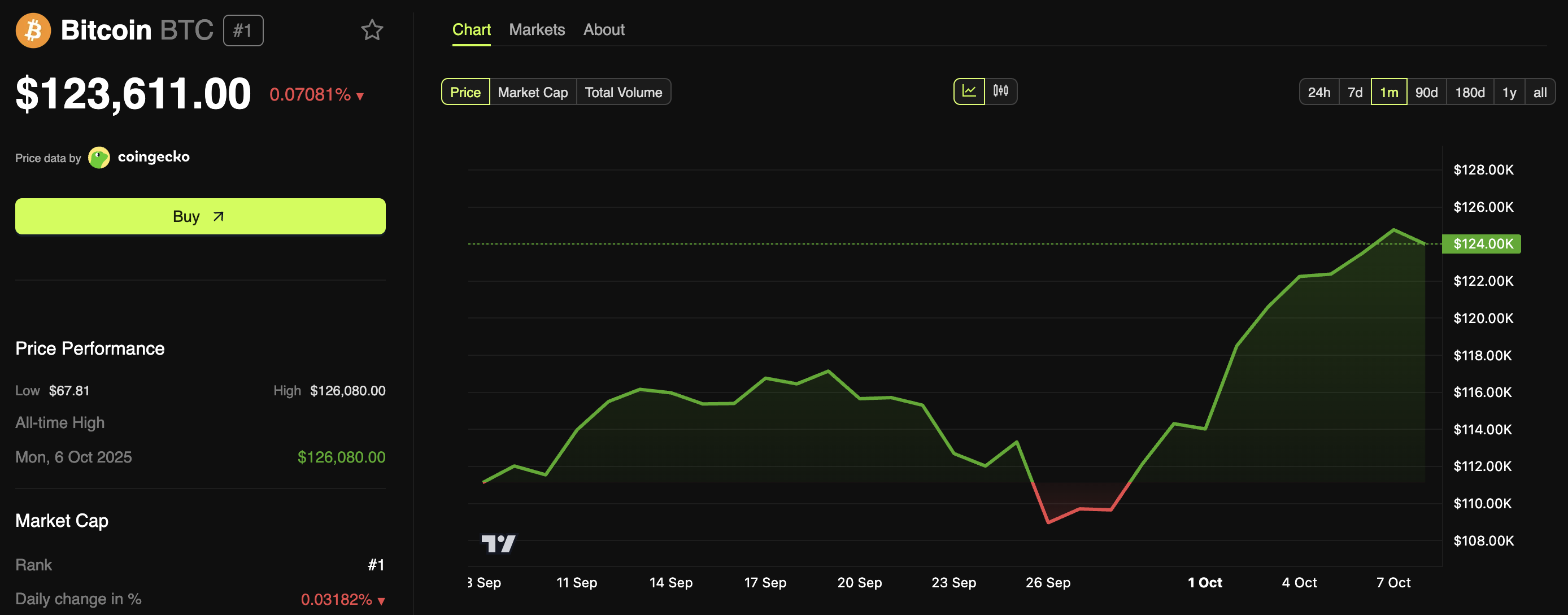
This projection coincides with increasing optimism in the broader financial markets. Recent reports indicated that Bitcoin surpassed the $126,000 mark, setting a new high point in October.
Even after a minor market correction, Bitcoin has maintained a strong value, trading around $123,611 at the time of reporting. Furthermore, analysis suggests that BTC has the potential to overcome its recent high and reach $130,100, provided it sustains support at $122,100.
Sponsored
Sponsored
Coin Bureau co-founder, Nic Puckrin, offers a more extensive and positive view. According to a statement shared, Puckrin considers a Bitcoin price of $150,000 by year’s end to be a realistic possibility. Other experts have even proposed an ambitious target of $200,000.
“With previous all-time highs surpassed, the principal risk for Bitcoin is consolidation within a narrow range. Price movement will be essential to validate the ongoing rally’s strength as the year concludes. I’m looking for BTC to move out of the $120k-$125k range, either upwards or downwards. A correction at this stage would be a constructive signal, provided the retracement doesn’t exceed the previous high. The last time Bitcoin set a new peak, it experienced a 13.5% downturn, which would imply a dip to around $109k this time. However, this would still signal a healthy correction, defined by increasing highs and lows. This would also confirm the $150k target is achievable by the end of the year,” he explained.
Simultaneously, gold’s value has continued its upward momentum, exceeding $3,975 per ounce to achieve a record high. This bullish market sentiment is not limited to traditional stores of value, as global stock markets also show significant gains, suggesting widespread investor confidence across various asset types.
Conversely, economist Peter Schiff interprets gold’s surge as a concerning sign of the Federal Reserve’s ineffective policies.
“With gold prices at a new high above $3,975, nearing $4,000, this clearly indicates a fundamental flaw in the Federal Reserve’s approach,” he stated.
He advocated for immediate interest rate hikes to curb inflation, even if they are unscheduled.
“The gold market signals that the upcoming economic downturn will be far more severe than the dot-com bubble’s collapse,” Schiff predicted.
He also downplayed Bitcoin’s recent gains, pointing out that it’s still 15% below its peak when evaluated against gold prices. He views the cryptocurrency’s rally as a “bear market rally” until there’s definitive evidence to suggest otherwise.
Recent analysis has also highlighted that the synchronized gains across stocks, precious metals like gold and silver, and Bitcoin indicate a weaker U.S. dollar, rather than a robust economy.