

In a potentially groundbreaking development, Bitwise and 21Shares, two prominent players in digital asset management, have updated their ETF applications related to Ethereum and Solana. This update hints at a possible fundamental change in how crypto-based exchange-traded products are handled within the U.S. financial system.
Revised S-1 forms, available on the SEC’s website, reveal that both Bitwise and 21Shares are exploring the option of staking the Ethereum and Solana holdings held within their respective funds.
If the SEC approves this revision, these ETFs could generate revenue through staking rewards. Staking rewards come from actively participating in the validation of transactions on proof-of-stake blockchains. Currently, crypto ETFs listed in the U.S. are limited to passive asset holding, preventing them from participating in the network’s consensus mechanism.
These amended filings, submitted recently, follow months of behind-the-scenes discussions between ETF providers and regulators aimed at achieving regulatory clarity regarding staking revenue. While the inclusion of staking language in the application doesn’t guarantee SEC approval, it does suggest the regulatory agency is seriously considering the concept.
Industry observers believe this could signal a loosening of the SEC’s stance on staking, especially given increasing pressure to allow ETFs to offer competitive yields mirroring those available through on-chain staking for both retail and institutional investors globally.
Potential Impact of Staking on ETH and SOL ETF Yields
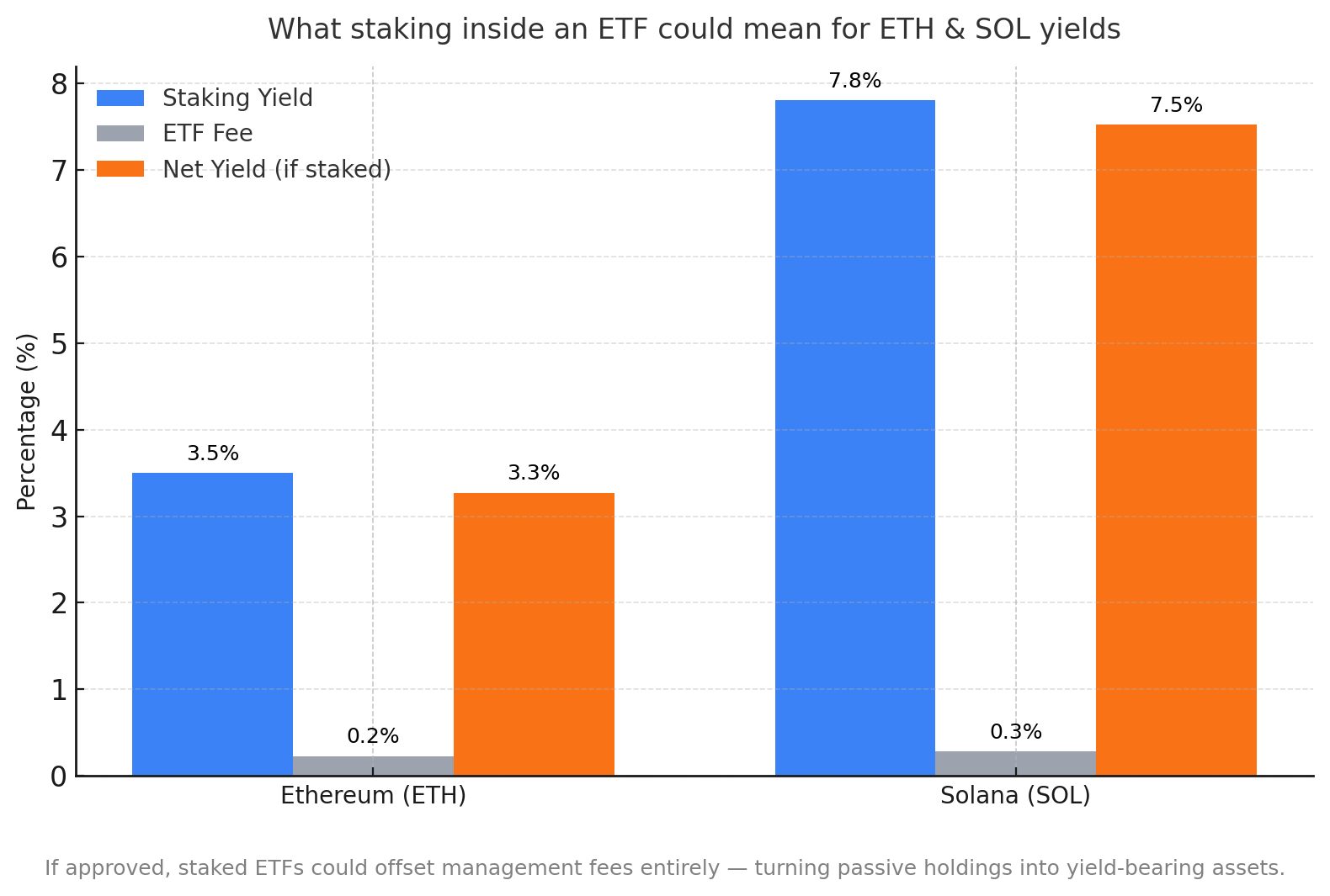
Currently, Ethereum staking rewards generally fluctuate between 3% and 4% annually, while Solana yields typically range from 7% to 8%. Given that ETF management fees typically range from 0.20% to 0.30%, staking income, if distributed to ETF holders, could potentially offset or even surpass the fund’s operating expenses.
This modification could significantly reshape competition within the ETF market. Rather than solely focusing on management fees and liquidity, fund providers might also compete on the basis of net yield after staking rewards, thereby introducing a new metric for investors to evaluate and compare crypto ETFs.
While the SEC has not yet publicly commented on these updated filings, their existence suggests that staking could transition from the decentralized finance (DeFi) ecosystem into regulated investment products, bridging the gap between on-chain incentives and traditional investment vehicles.