

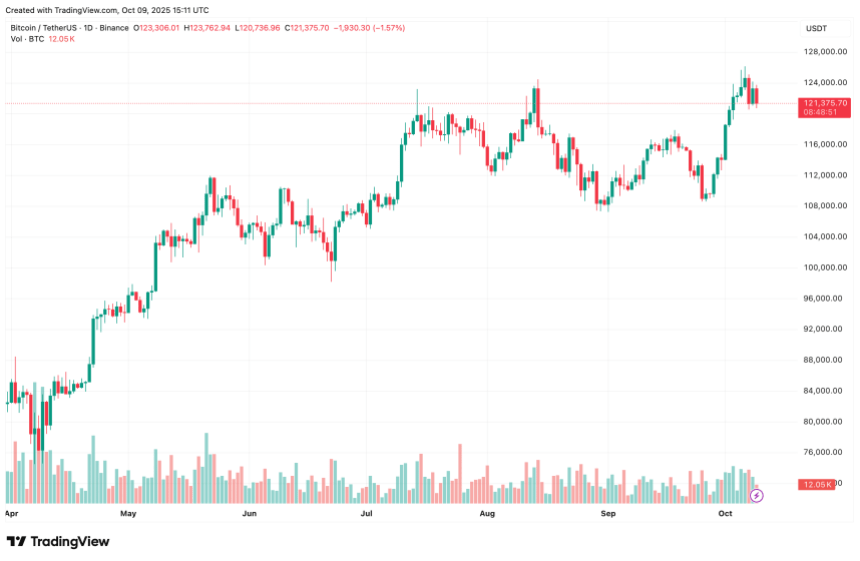
Bitcoin (BTC) is currently fluctuating around the $120,000 mark, experiencing a slight dip after recently reaching higher values. A noteworthy development is the shifting relationship between Bitcoin miners and the cryptocurrency’s price, which suggests evolving market dynamics.
Bitcoin Miner Activity Shows Inverse Correlation
Analysis from CryptoQuant, highlighted in a “Quicktake” by Arab Chain, reveals data sourced from Binance indicating a significant change in the correlation between Bitcoin’s price and the movement of Bitcoin from miners to the exchange over recent months.
Related Reading
The 30-Day Rolling Correlation metric, used to assess this relationship, has declined to levels unseen since March 2025. On October 3rd, it registered at -0.157, a low point not witnessed in over five months, and it has remained near -0.10 since then.
In essence, the 30-day rolling correlation tracks the synchronicity between two variables—in this case, Bitcoin’s price and miner outflows—over a 30-day period. A positive reading signifies that the two typically move in the same direction, while a negative reading indicates they tend to move in opposite directions.
Prior to this shift, the metric maintained a positive range of 0.1 to 0.5 throughout the second quarter of 2025. The transition from positive to negative correlation suggests that the recent increase in BTC value is not being fueled by miners sending their holdings to exchanges.
This diverges from earlier patterns where miners transferring BTC to exchanges significantly impacted price fluctuations. The current upward trend, instead, appears to be supported by greater interest from both individual and institutional investors, according to Arab Chain.
Historically, rising prices often prompted miners to transfer significant amounts of Bitcoin to exchanges for sale, resulting in a positive correlation—higher prices coincided with increased miner outflows.
Arab Chain posits that the weaker correlation signifies a “price independence” phase. Miners are choosing to hold onto their Bitcoin assets, rather than selling during price increases. This decreased miner selling pressure is often interpreted as a bullish signal for Bitcoin, because it tightens supply.
However, a return to a strongly positive correlation could signal a resurgence of selling, potentially leading to a price correction in the medium term. As it stands, the Bitcoin market exhibits a relatively healthy equilibrium between demand and available supply.
Critical Support Level for BTC
Following the dip into the low $120,000s, several cryptocurrency analysts are stressing the importance of Bitcoin maintaining a price above $120,600 to prevent further declines. However, opinions on Bitcoin’s future remain divided.
Related Reading
For example, entrepreneur Arthur Hayes has suggested that, a Trump presidency could drive Bitcoin’s value as high as $250,000 by the end of 2025. Currently, BTC is trading at $121,375, representing a 0.8% decrease over the last day.
Featured image from Unsplash, charts from CryptoQuant and TradingView.com