
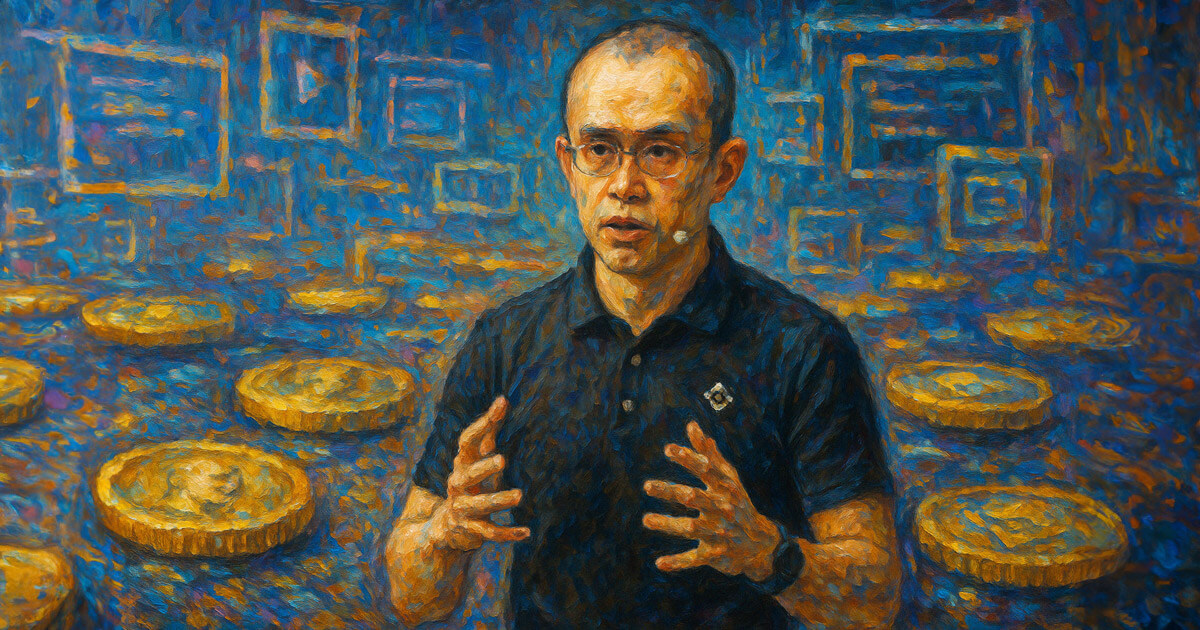

Former Binance leader Changpeng Zhao, often known as CZ, recently shared insights on the unforeseen rise of Chinese-themed memecoins on the BNB Smart Chain. He also explained why Aster’s strategy of hidden orders presents a key competitive advantage when compared to platforms like Hyperliquid.
During a conversation on October 10 with CounterParty TV, the past head of Binance revealed that the recent memecoin boom on BNB Chain started unexpectedly with a social media post related to the Mid-Autumn Festival. He also spoke about his investment philosophy, indicating a preference for decentralized exchanges (DEXs) that prioritize privacy over those with transparent operations.
The surge of tokens with Chinese themes on BNB Chain began when Zhao shared a message celebrating the Mid-Autumn Festival, inviting his followers to share their best memes.
The community responded enthusiastically, creating content centered around the moon and using Chinese-language symbols. This included creations like “Zhao Chang’e,” a playful twist on Zhao’s name referencing a famous female figure from Chinese folklore.
He commented:
“There wasn’t really a plan. It gradually developed organically. Anything I mention in a tweet tends to become a meme. Eventually, I decided to simply post freely without overthinking it.”
Over the past few weeks, five memecoins on BNB Chain have achieved market values between $100 million and $500 million, attracting interest from traders who typically use Solana. Zhao observed that BNB Chain traders tend to hold onto their assets longer, thanks to the chain’s focus on utility, which contrasts with the faster-paced, more speculative culture seen on Solana.
Zhao noted:
“They generally tend to hold for longer periods. They don’t experience immediate ups and downs.”
BNB versus Solana: Openness and Exclusivity
Zhao challenged the notion that BNB operates as a vertically integrated system, from initial project launch to listing on Binance. He argued that its ecosystem is actually more accessible than Solana’s.
He explained:
“Binance lists tokens from numerous blockchains, including memecoins. Trust Wallet provides support for BNB Chain, Solana, and other blockchains. Phantom, however, does not support BNB Chain. Similarly, Radium operates exclusively on Solana. Their ecosystems are, in reality, much more exclusive than ours.”
Zhao suggested that Solana’s strong focus on memecoins partly arose from actions taken by the SEC against utility tokens during the previous administration of Joe Biden.
Projects that launched tokens designed for practical use faced legal challenges related to securities laws. This prompted developers to focus on memecoins, which openly disclaim any practical purpose:
“Launching a project involving a utility token can easily trigger a lawsuit from the SEC. Memecoins, on the other hand, explicitly state that they have no intrinsic value or practical purpose; they are purely for entertainment.”
Aster’s Privacy Advantage over Hyperliquid
Zhao’s investment in Aster is rooted in his two decades of experience in trading, highlighting the importance of order privacy for professional traders. He argued that Hyperliquid’s transparent on-chain order book is a significant flaw that institutional traders cannot accept.
According to the former Binance CEO:
“Every trader on Wall Street I’ve spoken with emphasizes the need for their orders to remain unseen by others in real time. If someone knows your exact trading strategy, they can easily exploit it for their own gain, leading to your losses.”
Zhao publicly discussed the issue of privacy in June, which led to numerous project proposals that same day. Aster implemented hidden orders, prompting Binance Labs, along with other privacy-focused DEX projects, to invest in the platform.
The lack of privacy puts traders at risk of having their trading algorithms reverse-engineered and exploited. While Zhao acknowledged that Hyperliquid could introduce privacy features, he pointed out that exchanges compete on a wide variety of aspects beyond just single functionalities.
Beyond the necessity of privacy, Zhao emphasized the importance of how an exchange safeguards its users and rectifies mistakes.
Finally, Zhao also predicted that the trading volumes on perpetual DEXs will eventually rival those of centralized exchanges within a single market cycle. He envisions new users joining the crypto world via centralized platforms due to their familiar interfaces, before migrating to DEXs for a wider selection of tokens and access to early-stage projects.
Regarding his predictions:
“Looking ahead 20, 30, or even 50 years, everything will ultimately be on-chain. In the meantime, a large influx of traditional users will lead to improvements in CEXs. Over time, however, DEXs will gradually gain prominence.”