
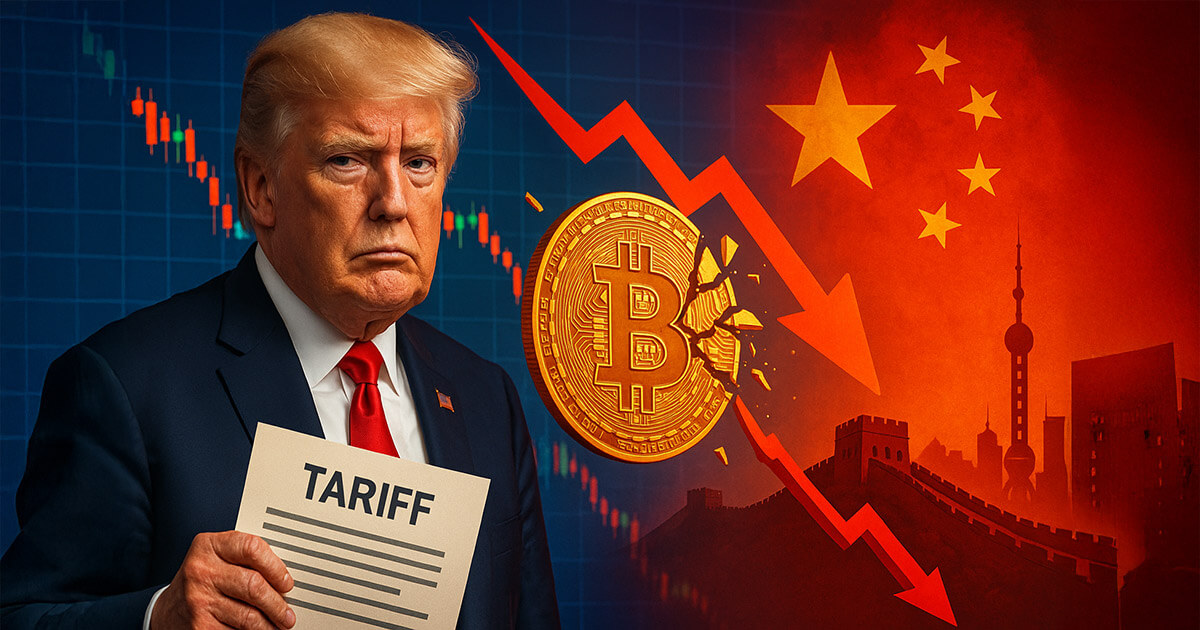

Bitcoin (BTC) experienced a significant dip of 7% as market anxieties intensified. This downturn was triggered by statements from former President Donald Trump, who suggested the U.S. might increase tariffs on goods from China in response to their new restrictions on rare earth element exports.
Over the previous day, the cumulative value of liquidated positions reached $9 billion. Bitcoin’s price briefly touched a low of $105,000 during this period of volatility.
In an extended statement shared via Truth Social on October 10th, Trump voiced concerns about China’s alleged efforts to dominate the rare earth element market. He then outlined potential plans for “a considerable rise in tariffs applied to Chinese goods entering the United States.”
At the time of this report, Bitcoin was trading lower, showing a 2.8% decrease and temporarily falling below the $118,000 support level. Data from Coinglass indicates that long positions worth almost $600 million were liquidated within four hours following Trump’s announcement.
The former President also called off a scheduled meeting with Xi Jinping during the APEC summit in South Korea, mentioning that he would “counter their actions financially” depending on China’s next moves.
Supply Chain Disruptions
Between October 9th and 10th, China amplified its control over rare earth element exports, broadening the licensing criteria to encompass more elements and technologies.
These regulations now extend to products made outside of China that include Chinese rare earth elements or utilize Chinese processing techniques, effectively expanding Beijing’s regulatory influence. Reports indicated that defense applications might face rejection, while semiconductor and AI-related uses would be subject to closer inspection.
The markets perceived these limitations as a jolt to the supply chain. Rare earth mining businesses located outside China saw stock price increases due to the anticipated tightening of supply, while tech and industrial stocks suffered due to possible shortages of essential materials.
European authorities expressed “serious concerns” about these developments, and Washington is weighing potential retaliatory measures.
Risk assets experienced broad selling pressure. The S&P 500 index dropped by 2%, and the Nasdaq fell by 2.7% as investors trimmed risk from their portfolios. Bitcoin’s established correlation with tech stocks amplified the crypto market decline alongside a broader aversion to risk.
Possible U.S. Reaction
China accounts for around 70% of the world’s rare earth element production and controls 90% of the processing. These elements are essential in producing batteries for electric vehicles, semiconductors, defense systems, and renewable energy technologies.
Trump’s statement painted the export restrictions as “menacing and antagonistic,” asserting that China intends to keep other countries “enslaved” using resource dominance.
Trump also noted that the U.S. also possesses “monopolistic advantages, considerably stronger and more extensive than China’s,” but had not used them until the Chinese actions prompted a response.
Trump also stated that the timing of China’s restrictions was concurrent with a Middle East peace announcement, thus hinting at possible cooperation between China and those geopolitical occurrences.
Bitcoin Market Data
As of 11:03 pm UTC on Oct. 10, 2025, Bitcoin holds the top position in market capitalization. Its price has decreased by 6.24% in the last 24 hours. Bitcoin’s market cap currently stands at $2.27 trillion, with a 24-hour trading volume of $123.6 billion. Discover more about Bitcoin ›
Crypto Market Summary
As of 11:03 pm UTC on Oct. 10, 2025, the entire crypto market is valued at $3.78 trillion, with a 24-hour trading volume of $333.8 billion. Bitcoin currently dominates the market with a dominance of 60.10%. Explore the crypto market ›