


Bitcoin Core, the software trusted by approximately
80% of all Bitcoin nodes, has launched its highly anticipated version 30.0.
The update,
released on October 11th, introduces optional encrypted connections for nodes, improved efficiency, fee optimizations, and multiple bug resolutions.
However, the change impacting OP_RETURN, Bitcoin’s inherent data embedding feature, has garnered the most attention.
OP_RETURN: What’s New?
OP_RETURN allows users to attach supplementary data, such as text, images, or digital signatures, to Bitcoin transactions without impacting their primary financial function. Previously, each OP_RETURN output was limited to 80 bytes of data, which restricted non-monetary applications.
The new release significantly expands this limit to 100,000 bytes. It also permits multiple OP_RETURN outputs per transaction to be relayed and processed by miners by default.
In practical terms, node operators running v30 can now handle transactions that embed larger, more intricate data, supporting applications from NFT-like content to application metadata, without the need for manual adjustments.
Developers highlight this change as fostering richer on-chain experimentation. One market observer
stated:
“OP_RETURN is meant to be utilized. Imagine the potential of an immutable, uncensorable record. History cannot be rewritten by conquerors. Humanity can record facts from their perspectives, at that specific moment. [This is] a boon for future historians and a significant step forward for humanity.”
On the other hand, some analysts express concerns it could lead to blockchain bloat and elevated fees if users flood the mempool with substantial data files.
Data from Mempool Research
indicates that inscriptions and OP_RETURN transactions presently represent 40% of all Bitcoin transactions, measured by count, 10% by fees, and 28% by weight.
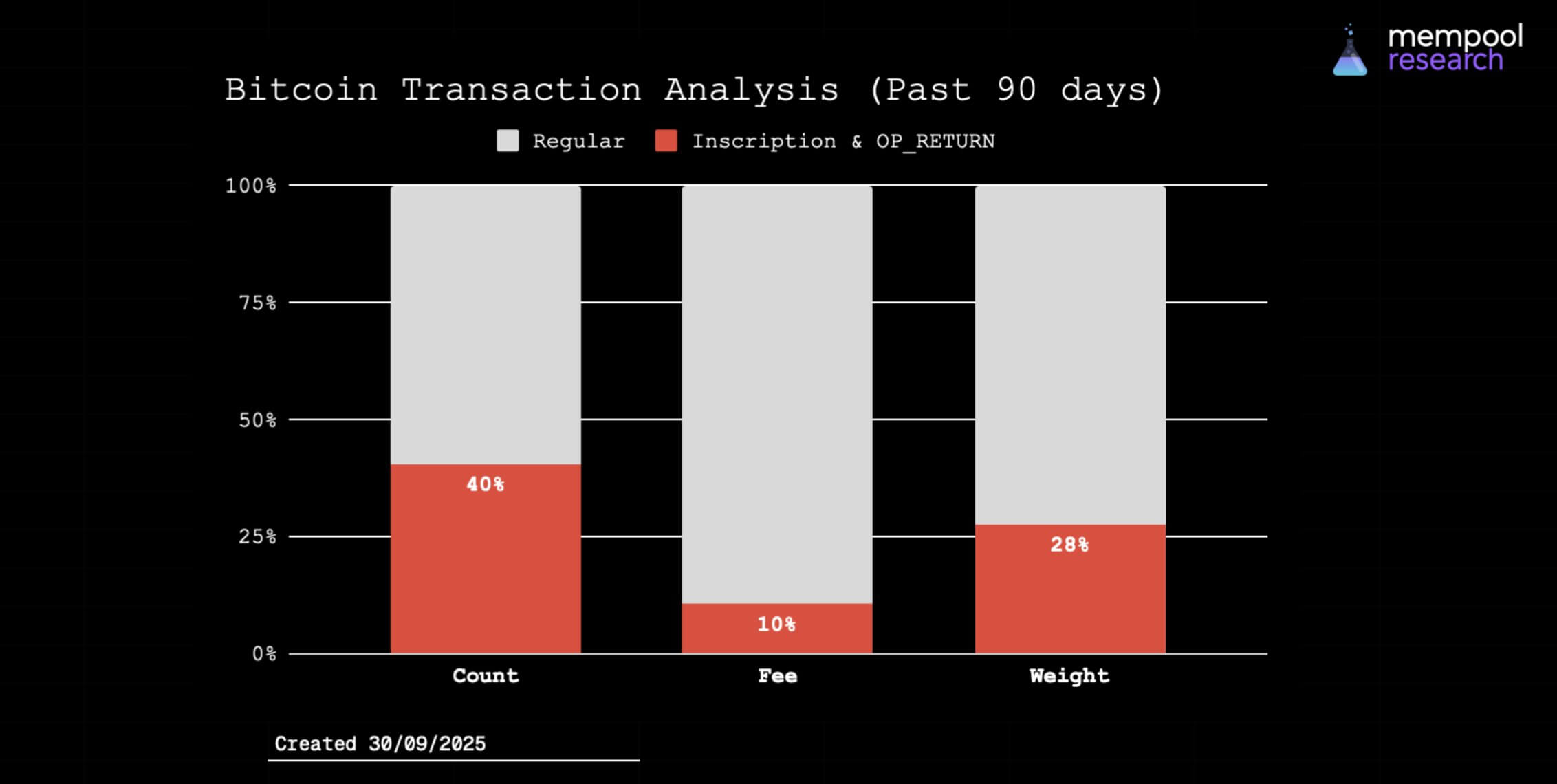
Given this trend, an increased adoption of data-intensive transactions could potentially increase Bitcoin’s average block size from its current 1.5 MB to as much as 4 MB per block – a transformation with the potential to significantly impact network economics.
Community Divided: Utility or Spam?
The implemented change has incited a vigorous debate within the Bitcoin developer and node operator communities.
Some view it as a normal step that brings Bitcoin closer to functionality similar to smart-contract platforms like
Ethereum. Others, however, believe it threatens Bitcoin’s fundamental purpose as a peer-to-peer financial system.
Prominent developer
Luke Dashjr criticized the adjustment, asserting that Core 30 “broke” the size control of the datacarrier and effectively deprecated it, leading to an increase in “spam outputs” per transaction.
In his opinion:
“Bitcoin is not intended for data storage beyond (at most*) 80 bytes (in OP_RETURN, however that’s not significant) associated with a financial transaction, or 95 bytes per block in the coinbase. That is insufficient for CSAM. Exploiting vulnerabilities, like with Inscriptions, is not a supported function; it’s misuse of script opcodes. It is not the act of data storage, but only harming Bitcoin through meaningless garbage scripts. Expanding OP_RETURN increases the size of supported data storage, making it sufficient to include CSAM.”
Accordingly, he
characterized v30 as “malware” and urged a “mass migration to Knots,” an alternative client with stronger policy enforcement.
Nonetheless, Blockstream CEO
Adam Back
argued that criticizing OP_RETURN changes equates to “attacking Bitcoin.”
Back says the update contains essential security and stability improvements from “some of the world’s top developers.”
What’s Next?
In the midst of this disagreement, certain community participants have proposed compromises at the policy level to address concerns regarding the update.
Nick Szabo, a well-known cryptographer,
suggested:
“Phase out using OP_RETURN for financial transaction functionality, moving forward; add functionality to prune the newer OP_RETURNs while retaining the older ones.”
Meanwhile, BitMEX Research
highlighted the concept of OP_Return2, a soft-fork solution that allows transactions to commit to hashes of up to 8 MB of external data without requiring full nodes to validate or store it.
According to the firm, this proposition could safeguard data integrity while reducing on-chain bloating.
However, researchers caution that miners may have limited incentive to include such transactions if fees do not offset the increase in complexity. They also point out that similar timestamping functions are already available at a lower cost.