


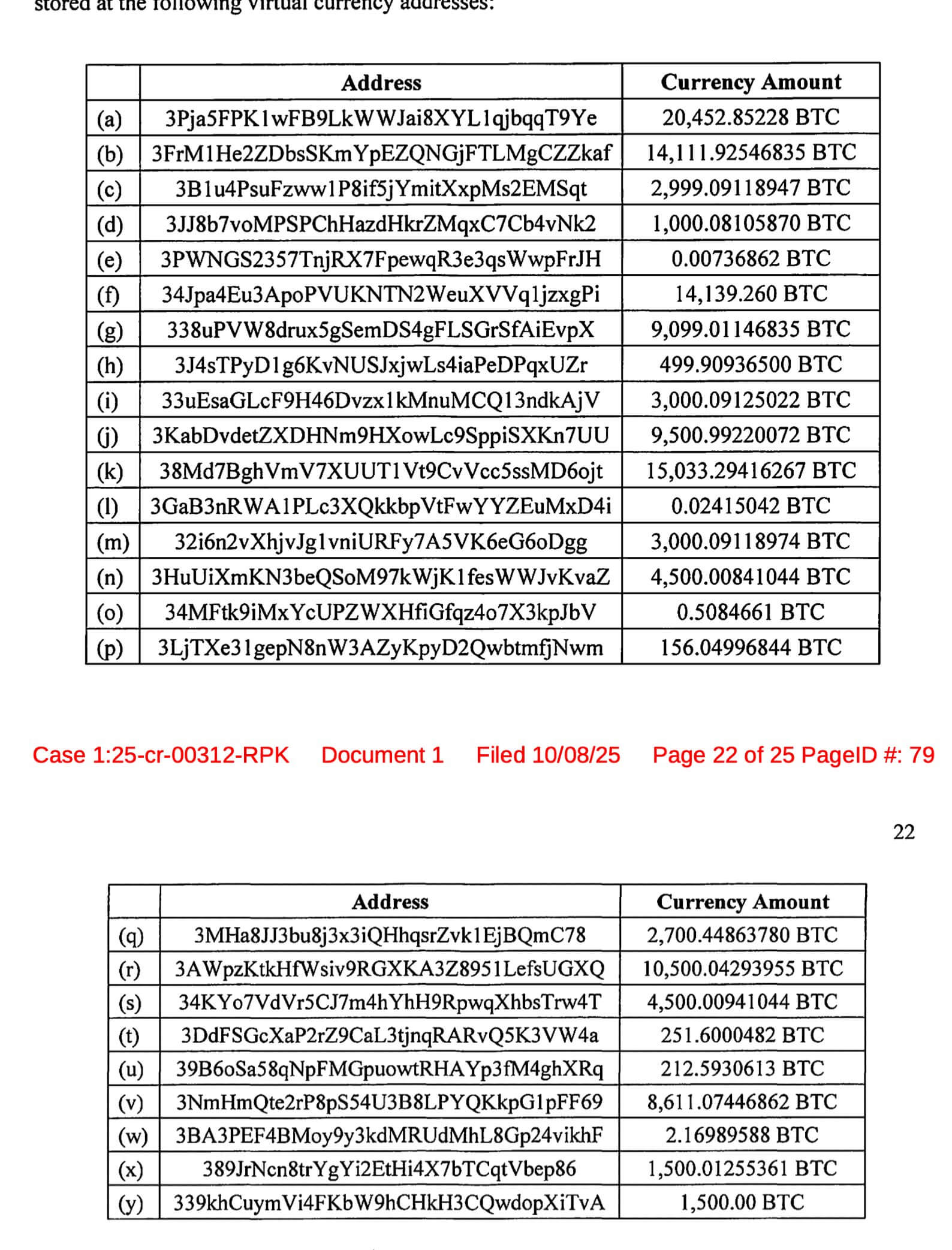
The United States government is in the process of seizing a massive amount of Bitcoin, totaling approximately 127,271 coins. This substantial sum, valued at around $14.2 billion, is believed by investigators to be the fruit of a sophisticated international scam dubbed “pig butchering,” allegedly orchestrated by Chen Zhi, a Chinese national.
Upon successful seizure, these Bitcoin assets are slated to become part of the U.S. Strategic Bitcoin Reserve, as stipulated by an Executive Order signed earlier in the year. However, the plan’s execution faces potential hurdles due to the current government shutdown and the absence of a clear, formalized policy. Moreover, a pressing deadline for ratification adds another layer of complexity.
The aforementioned Executive Order specifically declares:
“The Strategic Bitcoin Reserve will be funded with Bitcoin held by the Treasury Department, acquired through forfeiture proceedings related to both criminal and civil cases.”
The legal documents, filed on October 14th, reveal a wide-ranging criminal network that intertwines cryptocurrency investment fraud, human trafficking, and corruption within political circles.
Crypto fraud
According to the court filing, Zhi controlled the Prince Group, a key player in Cambodia’s unregulated digital finance sector.
This organization operated a network of fraudulent centers functioning also as unlawful detention facilities for trafficked workers. Reports indicate that thousands of individuals, tricked by deceptive job postings, were coerced into executing bogus cryptocurrency investment schemes under the threat of physical harm.
Under Zhi’s leadership, at least ten significant complexes were established, including locations tied to the Jinbei Hotel and Casino, the Golden Fortune Science and Technology Park, and Mango Park.
Official court documents show that Zhi personally maintained records detailing the operations of each site, referencing the Chinese term “sha zhu,” commonly known as “pig-butchering,” which describes elaborate scams that manipulate victims emotionally before defrauding them.
The U.S. government alleges that Zhi and other high-ranking executives used bribes and political leverage to avoid prosecution, even receiving advance alerts about planned law enforcement actions.
By capitalizing on these connections, the criminal enterprise maintained control over billions in illicit cryptocurrency transactions and solidified its position within Cambodia’s extensive underground economy.
Huione’s sanctions
In addition to the planned seizure of illegal assets, U.S. authorities, in cooperation with the United Kingdom’s Foreign, Commonwealth, and Development Office (FCDO), have also imposed sanctions on Zhi and associated entities.
According to the official press release, the Office of Foreign Assets Control (OFAC) has sanctioned 146 individuals and organizations linked to the Prince Group Transnational Criminal Organization (TCO), a Cambodia-based group directed by Chen Zhi. The TCO is accused of running hundreds of online investment scams targeting U.S. citizens and those of allied nations.
Furthermore, FinCEN has invoked Section 311 of the USA PATRIOT Act to officially isolate Cambodia’s Huione Group from the U.S. financial system, identifying it as a primary channel for laundering funds derived from cryptocurrency fraud and related cybercrimes.
U.S. officials have stated that Huione’s network played a crucial role in concealing billions of dollars stolen from investors globally.