


Ant Group is making a significant investment, anticipating that the future evolution of digital finance will unfold not within traditional banking systems, but on the
Ethereum blockchain.
On October 14th, the prominent Chinese financial technology enterprise behind Alipay, a payment network serving 1.4 billion users,
introduced Jovay. This innovative Layer-2 (L2) blockchain is constructed on top of Ethereum, designed to facilitate the large-scale on-chain movement of real-world assets (RWAs) for institutions.
What is Jovay?
Ant Digital, the blockchain division of Ant Group, characterizes Jovay as a “compliance-focused, AI-driven scaling network.” Its primary objective is to seamlessly integrate real-world data streams and value transfers into the realm of decentralized finance (DeFi).
The platform employs a unique dual-prover system, blending zero-knowledge and optimistic approaches. This design ensures both scalability and verifiable accuracy. Notably, it launches without its own native token, indicating a strategic emphasis on attracting enterprise and institutional adoption, rather than catering to retail speculation.
The potential impact is substantial. Alipay boasts 1.4 billion active monthly users and processes trillions in payment volume annually. If even a small portion of this activity transitions to Ethereum through Jovay, the network could evolve into a crucial infrastructure bridge within the global financial landscape.
According to Jovay’s technical
documentation, the network achieved impressive transaction speeds of 15,700 to 22,000 transactions per second (TPS) during its testnet phase. The goal is to reach 100,000 TPS by leveraging node clustering and horizontal scaling techniques.
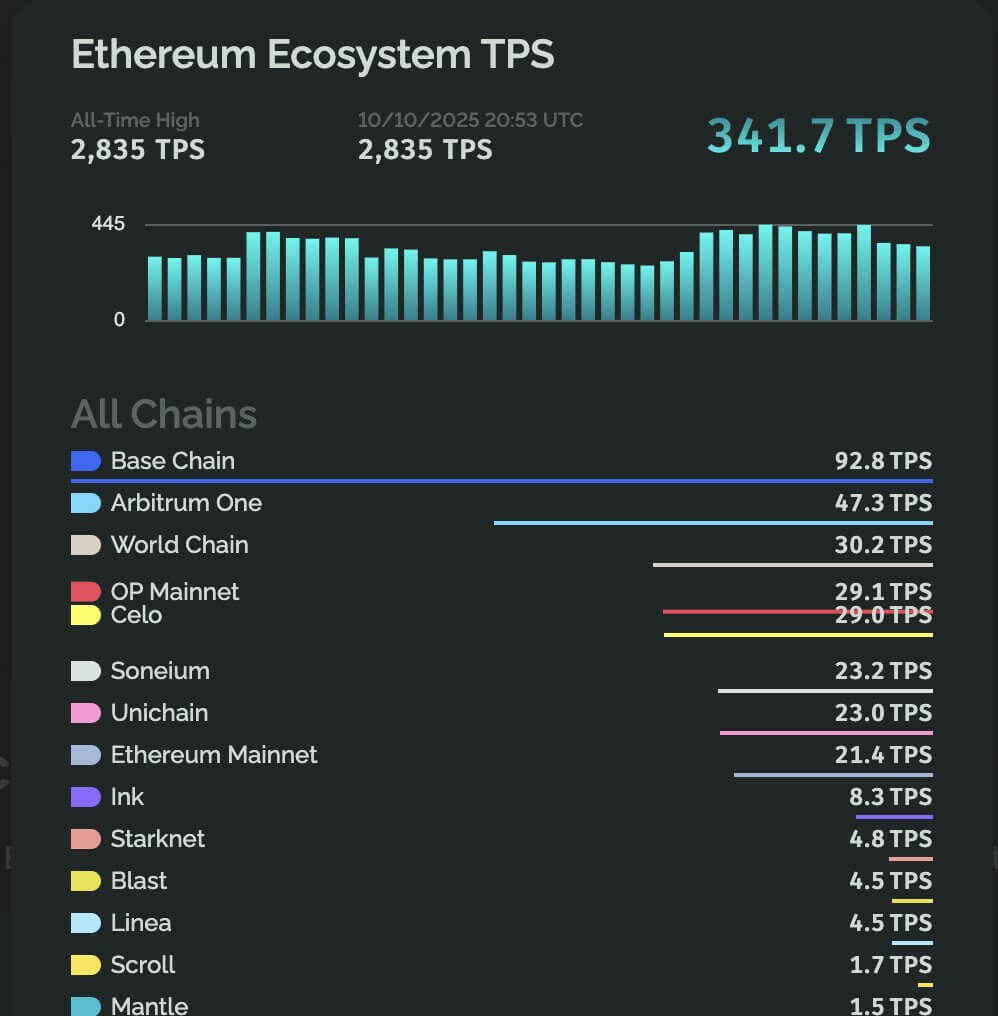
This level of performance would significantly surpass the current capabilities of the Ethereum Layer-2 ecosystem, which is currently led by Base, backed by Coinbase. Data from L2Beats indicates that Base handles approximately 93 TPS.
The RWA Thesis
Real-world assets (RWAs) have quietly become the fastest-growing segment within the Ethereum ecosystem. According to
RWA.xyz, tokenized assets such as treasuries, invoices, and funds on Ethereum now represent over $12 billion in value, marking an increase of more than 300% since the beginning of 2024.
However, the majority of this liquidity remains within specialized protocols that lack broad regulatory clarity.
Jovay’s model introduces a structured five-stage process: asset registration, structuring, tokenization, issuance, and trading. Each stage incorporates verification checkpoints and off-chain data confirmations, essentially providing regulators with a level of transparency comparable to traditional finance.
By integrating AntChain’s enterprise registry with Ethereum, Jovay has the potential to facilitate direct settlements between licensed institutions and on-chain liquidity providers.
For example, a bank issuing a digital bond on Jovay could achieve instant settlement with a DeFi counterparty without needing to expose sensitive internal data or breach any jurisdictional regulations.
Reflecting on this, Abbas Khan, a Founders Success Manager at the
Ethereum Foundation,
stated:
“This is more than just another startup experiment. It signifies that the next chapter of global finance is being built upon Ethereum…In China, Alipay transcends being merely an app; it serves as an essential infrastructure for everyday life, encompassing payments, loans, insurance, identity, mobility, and more. Now, Ant Group is bringing that comprehensive infrastructure onto the blockchain.”
The Macro Bet Behind Ant’s Blockchain Endeavor
Ant Group’s venture into Ethereum signals a fundamental change in how global fintech companies assess blockchain risk.
For several years, major corporations have preferred permissioned ledgers, such as Hyperledger, to mitigate volatility and avoid exposure to public blockchains. However, this approach is evolving as governments and other major financial organizations increasingly
experiment with public blockchains like Ethereum for their own strategic objectives.
By choosing to build Jovay on Ethereum rather than a proprietary network, Ant is effectively endorsing public infrastructure as a robust foundation for institutional finance.
Furthermore, this decision serves as a safeguard against technological isolation and promotes interoperability. Any asset created on Jovay can, in theory, access Ethereum’s extensive $100 billion DeFi ecosystem.
The economics behind the move are also compelling.
Reports have shown that the Coinbase-backed Base network has
contributed less than $5 million in blob and settlement fees to Ethereum’s Layer-1 validators since its launch in 2023. This translates to a 98% cost reduction compared to the validator expenses that a standalone chain would incur.
For Ant, this efficiency translates into more affordable settlements for its enormous user base.
Ethereum’s Quiet Triumph
The introduction of Jovay also reflects Ethereum’s gradual rise in institutional confidence. What was once perceived as a volatile experiment has matured into a reliable and neutral settlement layer that banks and fintech giants can utilize without sacrificing control.
Should Jovay achieve significant adoption, Ethereum’s share of tokenized finance could expand beyond its current RWA niche.
This would imply that each new asset class brought onto the blockchain, encompassing energy credits and local government bonds, will create fresh demand for ETH block space and liquidity routing.
As Khan pointed out, Ant’s move suggests that the next wave of a billion users won’t be drawn in by memecoins or yield farming.
Instead, they will arrive because their assets, savings, and credit instruments are seamlessly migrating onto compliant platforms that are built on the Ethereum network.