

Elon Musk recently reiterated his stance on Bitcoin’s energy consumption,
mentioning
that verification of its energy sources powering Bitcoin mining “cannot be faked”.
This echoes a
previous declaration
where he stated Tesla would potentially consider accepting Bitcoin for transactions again, contingent upon a significant portion of Bitcoin mining operations relying on sustainable and low-emission energy resources.
Despite current data suggesting the Bitcoin network may have met, or even exceeded, this “green” energy threshold,
Tesla
has yet to reinstate
BTC
as a payment option. What could be the reason?
Has Bitcoin Achieved the Green Energy Standard?
The
Cambridge Centre for Alternative Finance’s 2025 report
on the digital mining sector estimates that sustainable energy accounts for approximately 52.4% of the power consumed by Bitcoin mining activities surveyed.
Breaking down that figure, renewable sources like hydroelectric, wind, and solar constitute 42.6%, while nuclear energy and other low-carbon options contribute 9.8%. Simultaneously, there have been shifts in fossil fuel usage: natural gas has increased to 38.2% (from around 25% in 2022), while coal has decreased to 8.9% (from approximately 36.6%).
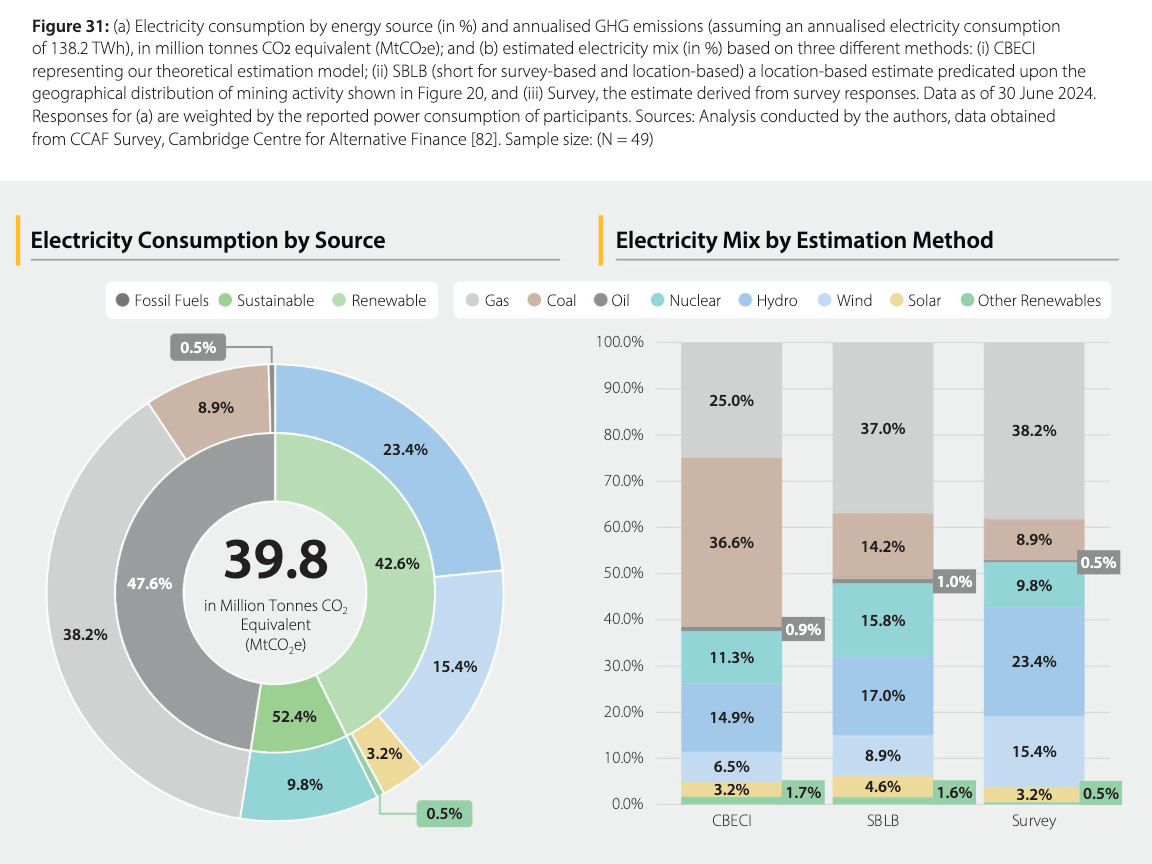
University of Cambridge Digital Mining Industry Report)
Based on the Cambridge report’s data from firms accounting for about 48% of the global Bitcoin mining capacity, Bitcoin may have surpassed Musk’s stated 51% sustainable energy requirement.
However, a deeper examination is necessary. The specific terms Musk has used vary. While he initially focused on renewables (50%), his more recent comments have shifted to “51% renewable” or “energy you can’t fake.” The Cambridge figures combine renewable and nuclear sources, making the percentage for strictly renewables (42.6%) lower.
Therefore, Bitcoin’s current standing may not align perfectly with Musk’s definition, depending on how strictly he interprets it.
Furthermore, the Cambridge study relies on surveys and captures only a portion of the mining landscape. Factors like off-grid operations, limited renewable energy availability, regional differences, and timing discrepancies (when renewable energy supply doesn’t match mining demand) add complexity.
Alternative models that analyze grid carbon intensity or trace energy sources often arrive at more conservative estimates regarding the renewable energy share. This discrepancy implies that even a seemingly successful “pass” of the 51% threshold remains debatable.
Why Hasn’t Tesla Re-Enabled Bitcoin Payments?
Even if Bitcoin meets Musk’s sustainability criterion, Tesla’s reluctance to accept BTC payments stems from several factors, both practical and symbolic.
The first concern is due diligence. Musk previously articulated that Tesla would reinstate payments only upon observing “reasonable (~50%) clean energy usage… and a trend toward increasing that number.” This suggests that he seeks sustained progress, not simply a single data point.
A single report indicating 52% sustainable energy might not fulfill his requirement for a confirmed and continuing upward trajectory in Bitcoin’s energy mix.
Another consideration is the precise definition of “sustainable.” Tesla would need to clarify whether the definition incorporates nuclear and low-carbon sources, or exclusively includes renewables like hydroelectric, wind, and solar power. The Cambridge data consolidates these categories, whereas Musk’s prior language primarily referenced renewable sources.
Without a universally accepted definition, a decision to recommence BTC payments runs the risk of being perceived as greenwashing.
Moreover, there are merchant and market-related risks. Accepting Bitcoin exposes Tesla to price fluctuations, complex accounting procedures, and possible regulatory challenges.
Even with immediate conversion of BTC receipts to fiat currency, price changes between order placement and payment settlement could create financial uncertainties that may outweigh the potential benefits for a car manufacturer working with relatively tight profit margins.
Brand perception introduces another dimension. Tesla’s reputation is closely tied to environmental responsibility, and any perceived decline in Bitcoin’s energy profile could trigger negative reactions from investors and environmentally conscious consumers. The company may opt for a cautious approach to avoid potential criticism if mining activity reverts to regions heavily reliant on fossil fuels.
Finally, operational integration must be taken into account. To reintroduce Bitcoin payments, Tesla would need to rebuild its wallet infrastructure, transaction processes, and conversion systems. This requires allocating engineering resources and securing internal approvals, which are substantial tasks for a global manufacturer juggling numerous product launches and software developments.
Taken together, these factors suggest that achieving the 51% renewable threshold alone is insufficient. For Musk, the decision appears to hinge on confidence, consistency, perception, and data. Until these factors are aligned, it seems unlikely that Tesla’s checkout page will offer cryptocurrency as a payment method.
Implications for Bitcoin Adoption
From a public relations perspective, Musk’s continued interest carries significant weight. If Bitcoin can demonstrate a commitment to a cleaner energy mix and major commercial entities like Tesla resume accepting it for payment, it would strengthen the narrative of Bitcoin as a sustainable cryptocurrency.
However, Tesla’s continued reluctance to accept Bitcoin, despite claims that the energy standard has been met, indicates that Musk views his promise as contingent, not automatic. The decision is as much about public image, risk management, and narrative control as it is about straightforward metrics.
Currently, the claim of “51%+ sustainable” status offers a strong response to critics of Bitcoin’s energy consumption, but without the resumption of BTC checkouts, it remains more of a symbolic victory than a practical one.