
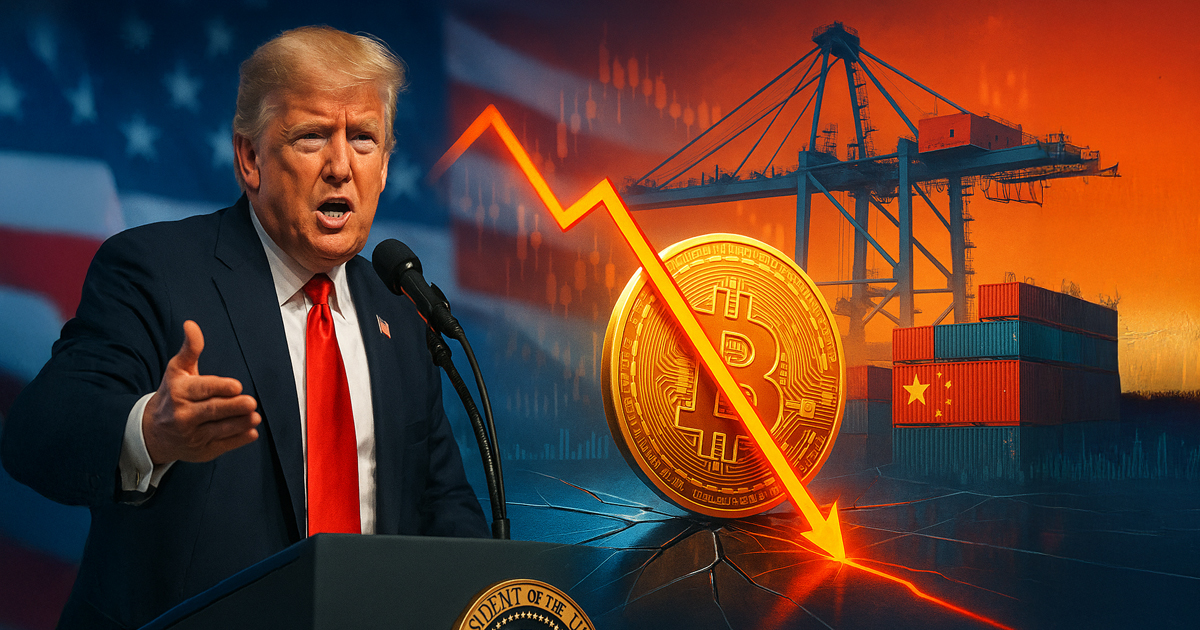

The resurgence of trade tensions, which previously caused instability in worldwide markets, now includes Bitcoin as a key component.
On October 15th, President Donald Trump publicly stated that the United States and China were engaged in a trade war, asserting:
“We are currently in a trade conflict. We have imposed total tariffs. Without these tariffs, we would be defenseless. They have historically used tariffs against us.”
This announcement followed a week of heightened unease after the President suggested imposing 100% tariffs on goods imported from China.
This threat marked the onset of a financial confrontation, generating widespread consequences across international economies.
Consequently, established stock markets experienced declines, while the value of digital assets decreased by approximately $20 billion within a single day.
Statistics provided by CoinGlass reveal that Bitcoin and Ethereum were the primary contributors to this downturn, thereby prolonging what had already become an atypical “red October” for the leading cryptocurrencies.
What Implications Does This Have for Bitcoin?
Tariffs operate as indirect taxes, making imported goods more expensive, increasing production costs, fueling inflation, and putting pressure on central banking institutions to maintain elevated interest rates for extended durations. This combination often reduces available capital for risk-based assets such as Bitcoin.
In 2018, similar announcements regarding tariffs instigated fluctuations that caused Bitcoin’s value to drop below $6,000. This pattern is being observed again in 2025.
Large-scale investors are progressively adopting defensive strategies by shifting investments into gold, Treasury bills, and short-term bonds.
Conversely, Bitcoin, still behaving like a high-beta macroeconomic asset, is negatively affected by this movement toward safer investments.
However, the current situation possesses an added degree of complexity.
Unlike the circumstances in 2018, Bitcoin has evolved from an instrument driven by individual investors to a regulated asset featuring significant ETF exposure and transparent derivative markets.
Despite this evolution, CoinShares‘ research director, James Butterfill, had previously cautioned in February that the immediate repercussions of tariffs would be “undeniably detrimental” for Bitcoin.
Butterfill clarified that tariffs hinder economic expansion, amplify inflation predictions, and provoke risk aversion. Given these market conditions, Bitcoin reacts to liquidity trends, resulting in short-lived instability.
Presently, numerous traders are increasingly convinced that the likelihood of Bitcoin maintaining its upward trend throughout this month is minimal.
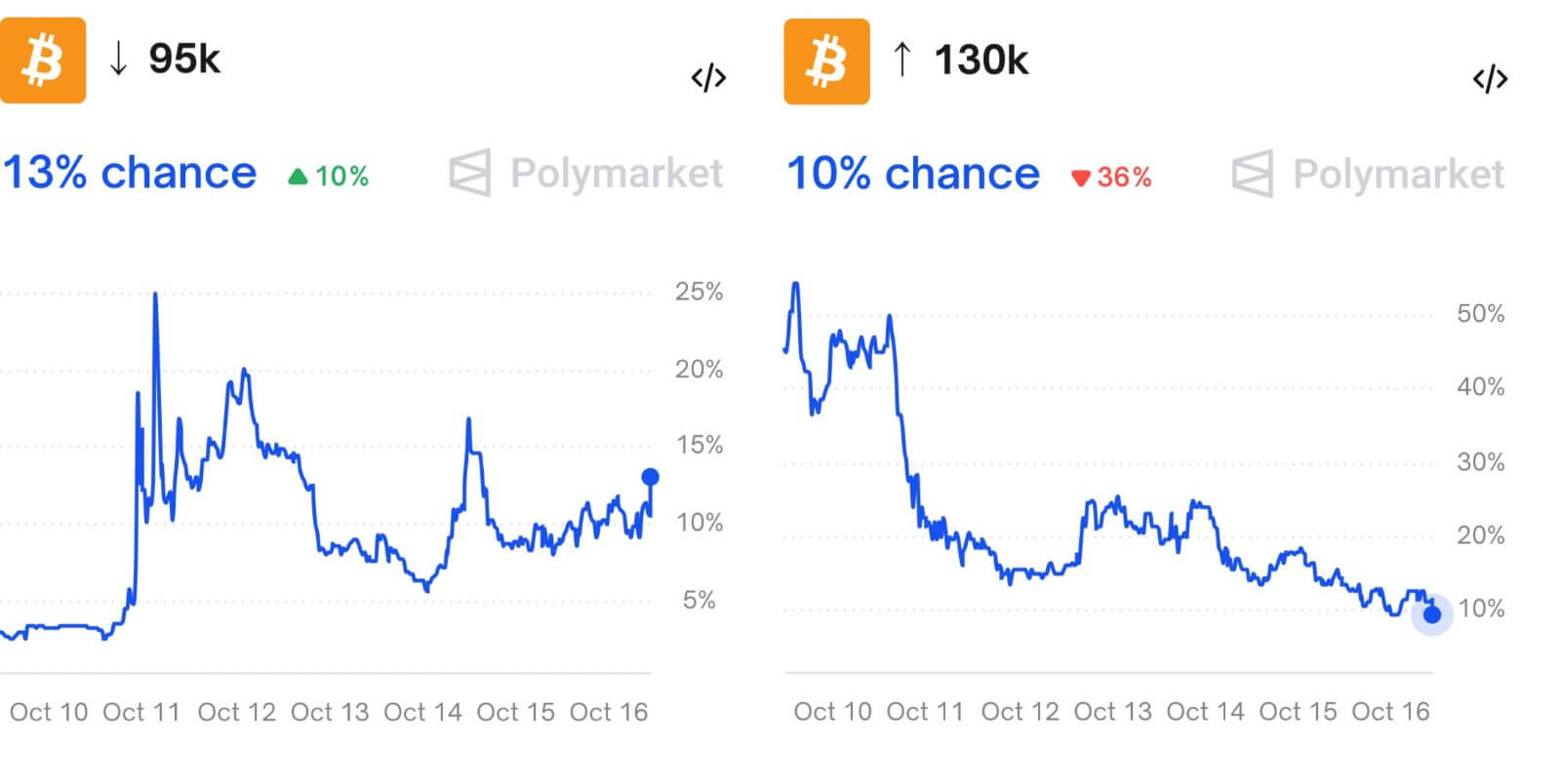
On Polymarket, the chances of Bitcoin reaching $130,000 by the end of the month have decreased below the probability of it falling back to $95,000, illustrating the influence of macroeconomic policy on digital asset sentiment.
However, Butterfill also noted that the leading cryptocurrency tends to recover quicker than traditional equities during periods of stagflation.
He stated:
“In the long run, Bitcoin’s utility as a safeguard could be reinforced, particularly if tariff strategies contribute to economic volatility.”
Structural Shift
Meanwhile, analysts from Bitunix informed CryptoSlate that President Trump’s declaration has increased the economic tensions between the two countries and redefined the global risk environment.
They explained that this has a dual effect: a short-term shock to liquidity and a medium-term change in how capital views decentralized assets.
In the short term, heightened uncertainty prompts institutions to reduce risk. Funds are reallocated towards cash and gold, triggering broad sell-offs in highly liquid markets like cryptocurrency.
According to the analysts, leveraged traders facing margin calls would exacerbate this cascade. Notably, this is exactly what caused the $20 billion liquidation event last week.
Beyond the initial disruption, a different calculation emerges. Should the trade war remain confined to tariffs and export restrictions, weakened global growth could negatively impact crypto demand.
However, Bitcoin could resurface as a geopolitical hedge if the conflict expands into financial settlement systems. In this case, the U.S. might impose restrictions on cross-border access to the dollar or payment systems, pushing investors to seek alternative solutions.
In such a scenario, digital assets would transition from “risk assets” to “alternative reserves.” As the Bitunix team elaborated:
“The decline in confidence in the US dollar system could strengthen Bitcoin’s reputation as a ‘de-dollarization’ tool and an ‘alternative store of value’ asset, providing structural support.”