
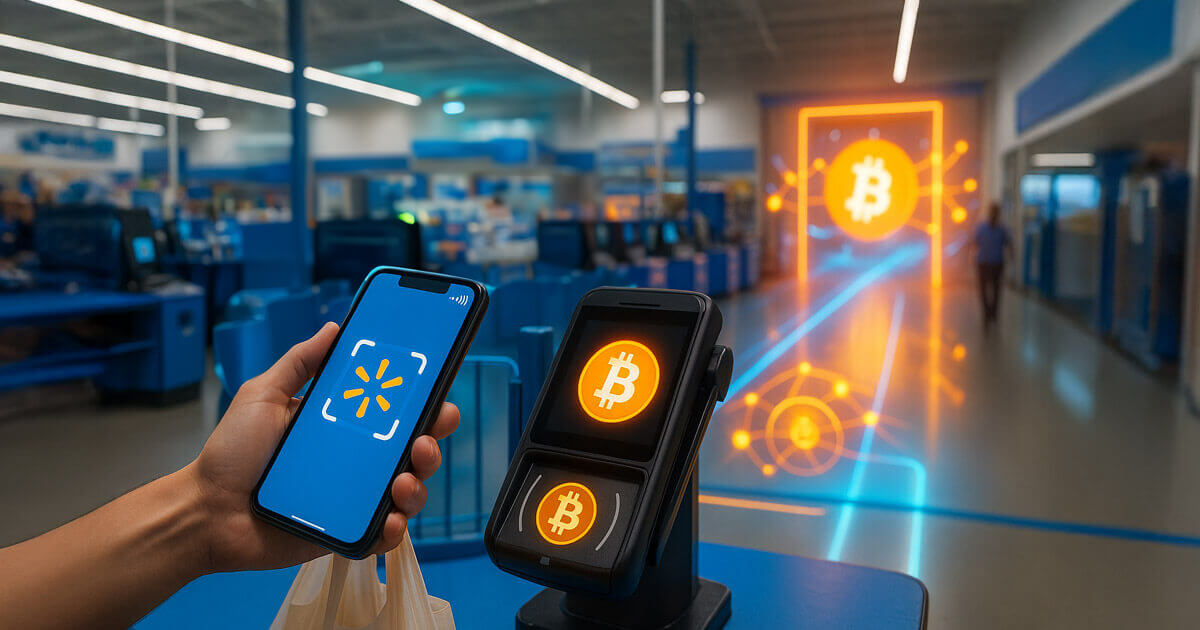

The landscape for crypto retail transactions is evolving rapidly, fueled by cost-effective merchant solutions and user-friendly applications that enable both buying and spending.
Walmart’s OnePay app is strategically positioned within this ecosystem. A recent collaboration with
Zero Hash
introduces the potential for Bitcoin and Ethereum trading directly within the app. This includes hosted wallets, person-to-person crypto transfers, and options for on-chain deposits and withdrawals, pending the activation of these features by the operator.
According to
Zero Hash documentation, Zero Hash entities would manage custody of the crypto assets. Execution of trades would be facilitated by an affiliated liquidity service. Pricing structures may incorporate a spread alongside platform fees.
A crucial factor is whether OnePay enables external crypto transfers. A “walled garden” approach keeps balances centralized in omnibus wallets. Conversely, an open model introduces a portion of daily transactions to public blockchains, making the activity publicly viewable.
OnePay’s Distribution Network is Key to Widespread Adoption
Synchrony Financial is in the process of issuing
Walmart credit cards
integrated directly into the OnePay application. This provides a built-in wallet feature that could later incorporate crypto funding and transfer capabilities, should this functionality be enabled.
Walmart’s extensive reach across U.S. households, as evidenced by company reports, translates to reduced acquisition costs for a payment application linked to retail spending. The calculations are straightforward: determine user eligibility, factor in feature enablement, consider purchase frequency, and calculate average transaction value.
Hypothetically, if 10 million users are eligible, half enable crypto features, 1% make monthly purchases, and the average purchase is $150, this could result in $1.7 to $2.5 million in daily Bitcoin purchases, depending on the distribution of assets.
Given that U.S. spot Bitcoin ETFs routinely see hundreds of millions in daily net inflows, OnePay’s potential contribution would be comparatively modest. However, the buying activity would originate from organic retail behavior, offering a contrast to the model-driven allocations of ETF investors.
Checkout Functionality is Already Active in Other Platforms
Shopify
and
Coinbase
are enabling merchants to accept USDC stablecoin on the Base network directly within Shopify Payments. This includes protocols for delayed transaction capture, refunds, and receipts, mimicking traditional card payment processes and bridging the gap between crypto and legacy systems.
Users can purchase up to $100,000 in crypto weekly and transfer it to external wallets. Coinbase introduced person-to-person crypto transfer capabilities in September, promoting the shift alongside
fee waivers
for its PYUSD stablecoin.
Cash App
supports
Lightning Network transactions and on-chain transfers within specified consumer limits. These developments transform crypto from a simple off-ramp to a two-way system that directly interacts with the mempool. In the case of stablecoins, they provide predictable denominations suitable for merchants.
Stable fees and latency rates make scenario planning straightforward. Ethereum’s average transaction fee is approximately
40 cents, while layer-2 fees for simple transactions range between 4 and 20 cents, according to
L2fees
dashboards.
Bitcoin’s Lightning Network facilitates near-instantaneous payments with minimal fees under normal conditions. Traditional on-chain confirmations take about ten minutes, but fluctuate based on network congestion.
This creates clear options for merchants: Lightning for Bitcoin, layer-2 solutions or stablecoins for the Ethereum ecosystem, and stablecoins for transactions that require fiat-like predictability.
Steak ‘n Shake serves as a real-world illustration. Company statements around the May 16th
Lightning Network integration
indicate a
10.7% increase in same-store sales during Q2, directly attributed to Bitcoin users.
Management reported a reduction of roughly 50% in processing costs compared to traditional card payments, and the initial adoption resulted in a significant
share of global Bitcoin transactions, according to
company reports.
The company’s official communications have not emphasized Ethereum acceptance, placing the asset choice and its public perception ahead of any purely technical considerations at the point of sale.
The primary technical question for retailers isn’t merely whether Bitcoin or Ethereum can process a payment, but rather which configuration minimizes refund complications, streamlines back-office reconciliation, and maintains positive unit economics.
A simplified model can illustrate how a OnePay rollout might interact with ETF-driven price fluctuations and on-chain activity. The following table estimates potential daily Bitcoin purchases based on various user adoption rates, not as predictions, but as benchmarks against the ETF figures monitored by traders.
| Eligible actives (U) | Crypto enabled | Monthly buyers | Average ticket | Estimated daily BTC buy (USD m) |
|---|---|---|---|---|
| 5,000,000 | 30% | 0.5% | $75 | 0.19 |
| 5,000,000 | 30% | 1.0% | $150 | 0.75 |
| 10,000,000 | 50% | 1.0% | $150 | 2.50 |
| 10,000,000 | 50% | 2.0% | $150 | 5.00 |
| 20,000,000 | 50% | 1.0% | $150 | 5.00 |
| 20,000,000 | 50% | 2.0% | $150 | 10.00 |
Whether those purchases are recorded on the blockchain hinges on the product’s overall scope.
Zero Hash documentation
indicates
that partner platforms can enable on-chain deposits and withdrawals. If OnePay launches without this capability, market makers will still need to acquire cryptocurrency to fulfill customer orders, but balances would remain off-chain within omnibus custody solutions.
If on-chain transfers are supported, withdrawals to self-custody wallets and exchanges would contribute to address activity and increase the load on Bitcoin’s mempool. For Ethereum, these withdrawals would route through layer-2 networks or bridge protocols, connecting retail buying to measurable network metrics.
Transparency in Pricing Will Influence User Behavior
Zero Hash indicates that its affiliated liquidity services can offer prices with a spread above benchmark rates, and platforms retain the option to impose their own fees.
Customers are highly sensitive to total transaction costs. Lower overall spreads, coupled with checkout rewards, are likely to encourage increased purchase frequency, while higher spreads may discourage repeat transactions.
KYC (Know Your Customer) tiers and rolling limits will dictate transaction ceilings. However, the primary constraints on network liquidity are the presence of external transfers, support for networks like the
Lightning Network, specific layer-2 solutions, and any waiting periods associated with card or ACH funding.
The focus for merchant integration is now shifting from raw throughput to streamlined operations. Shopify’s framework supports refund processes, partial transaction captures, and real-time receipt status, building on features developed by card systems over many years.
For Bitcoin, the Lightning Network mitigates confirmation delays, and merchants can later transfer funds to cold storage or settlement accounts. For Ethereum, layer-2 solutions and stablecoins lower fees and latency to levels acceptable for consumers, and stablecoins eliminate price conversion complexities for businesses dealing primarily in fiat currencies.
Public Perception Will Continue to Shape Which Assets are Accepted
Bitcoin generates community enthusiasm, leading to earned media coverage and rapid adoption, as illustrated by Steak ‘n Shake’s recent quarterly results. Ethereum provides a strong developer community and versatile options through layer-2 networks that can be cheaper and faster than the base layer.
Stablecoins offer a third alternative, positioning the decision as a choice of internet-native currencies rather than prioritizing a specific asset. The likely outcome for major retailers will be a blended approach: Lightning for Bitcoin enthusiasts, stablecoins for e-commerce and kiosks, and selective support for Ethereum through layer-2 solutions to satisfy fee and latency targets.
The fundamental question revolves around product options and back-end infrastructure, rather than the core technology. Today’s checkout systems can readily integrate Lightning, USDC on Base within Shopify Payments, and comparable infrastructures.
OnePay is poised to offer trading, custody, and transfers through Zero Hash by enabling specific settings, supported by its trust company
license. The performance of ETFs remains the benchmark against which to measure retail app flow when evaluating its impact on price.
The key to determining whether retail demand influences public blockchains is the availability of external transfers upon launch.