
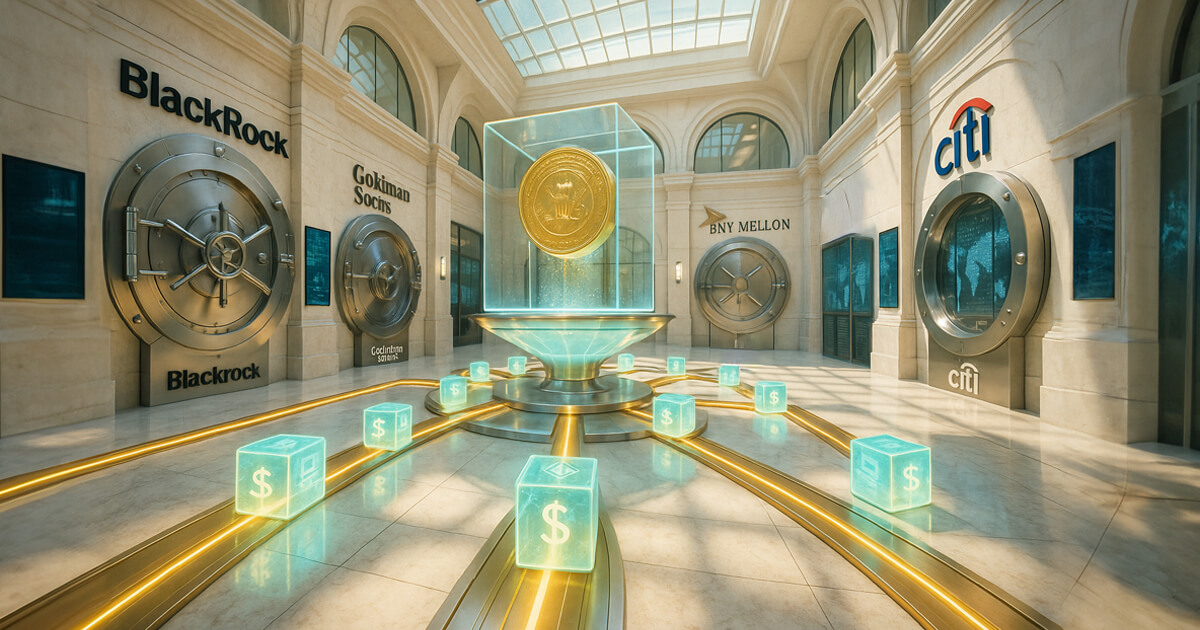

Leading financial institutions on Wall Street are subtly rebuilding the digital asset ecosystem, emphasizing tokenization and secure custody services.
An initial cautious approach to digital assets is evolving into a fundamental infrastructure transformation. Fund administration, cash handling, and transaction settlements are migrating to blockchain platforms, resembling established systems like BNY Mellon’s LiquidityDirect more than typical cryptocurrency exchanges.
Since the latter part of summer, major players like Goldman Sachs and BNY Mellon have launched operational tokenized money market funds live. Citi has strategically positioned itself as both a tokenization facilitator and custodian on the Swiss SDX exchange. BlackRock has reinforced its conviction that tokenized funds will eventually become a standard offering alongside traditional ETFs.
In just a few months, tokenized treasuries have grown into an $8.3 billion asset category. The wider scope of real-world assets (RWAs) now varies between $24 billion and $30 billion. However, the core competition lies not in the current figures but in securing custody of the next $100 billion in digital securities and ensuring seamless integration with conventional balance sheets.
The initial moves by banks reveal a common strategy. Goldman and BNY chose to tokenize money market funds, which represent the least volatile and most systematically crucial assets available.
Money market funds are considered among the safest and most easily convertible investment options in traditional finance. They invest in short-term government and corporate debts, providing institutions a secure place to hold capital while earning modest returns with very low risk. Tokenizing these holdings converts them into digital units capable of instant transfer and round-the-clock settlement.
For significant institutions, the value is practical rather than speculative. Corporate treasurers benefit from faster cash movement, asset pledging as collateral, and minimized disruptions caused by traditional banking hours.
Citi’s approach parallels this through private markets. By joining SDX, Citi now provides custody and tokenization services for regulated digital securities, acting as the infrastructure for issuers experimenting with tokenized bonds or equities.
The structure is similar to traditional custody, but settlements occur instantaneously, meaning payments and asset transfers happen simultaneously without the need for intermediaries.
BlackRock’s BUIDL fund illustrates how this can be expanded. This fund contains tokenized Treasury bills, represented as programmable tokens. Its assets have grown more than eightfold in 18 months. With total assets of $13.5 trillion and almost $100 billion invested in crypto-related funds, BlackRock possesses the scale to make tokenized products standard components of institutional portfolios.
The Silent Competition for Custody Revenue
While the early 2020s were characterized by crypto custodians learning about regulatory compliance, the mid-2020s see banks learning about blockchain technology. The participants may be different, but the economics are recognizable. Coinbase, Fidelity, and BNY already impose custody fees, ranging from roughly 0.05% to 0.15% of asset value, depending on the client’s size and risk assessment.
As tokenized cash and securities gain wider acceptance, these percentages start mirroring the fees associated with fund administration and collateral management, creating an overlap that previously did not exist.
In this model of tokenization, the appeal lies in enhanced efficiency rather than radical innovation. A tokenized Treasury or fund share can be transferred instantly between accounts and settled in real-time, reducing expenses for both clients and custodians. A conservative forecast projects tokenized Treasuries to remain between $6 billion and $8 billion if regulation slows and yields decline.
A moderate projection anticipates around $10-15 billion by mid-2026 as more banks integrate money-market products. An optimistic scenario suggests a range of $25-40 billion if tokenized cash accounts linked to ETFs become popular and if banks begin experimenting with repo markets for tokenized collateral.
Repos form the foundation of short-term lending within finance. Banks lend funds in return for secure collateral, such as Treasuries, with an agreement to reverse the transaction later. Tokenized repos would allow these transactions to be settled automatically on a blockchain, reducing operational delays and counterparty risks that presently require costly intermediaries.
This collateral connection transforms tokenization from a bookkeeping exercise into genuine financial infrastructure. Goldman and BNY’s tokenized money-market shares are already being transferred within secure, authorized environments.
The key question is whether these tokens can be transferred safely between different custodians. The joint Project Guardian initiative, led by the UK’s Financial Conduct Authority and Singapore’s Monetary Authority, is testing this concept, establishing shared standards for compliance verification across public and private blockchains.
If the project is successful, 2026 could witness the first bank-to-bank repo transactions completed entirely with tokenized assets.
Current systems still function within controlled environments. Networks such as Goldman’s GS DAP, SDX, and JPMorgan’s Onyx offer efficiency but lack interoperability. Regulators favor this model because all participants are known and verified. However, financial institutions are exploring ways permissioned systems can connect to public networks via cryptographic proofs to maintain compliance.
If this connection is established, custody revenues could expand to $300–600 million annually, assuming tokenized cash and Treasury products hold $25–40 billion in assets and charge service fees near 0.1–0.15%.
Policy Decisions Will Determine Custody Control
Regulatory policy will dictate the pace of this evolution. In Europe, MiCA has introduced consistent rules for custodians and crypto-asset service providers (CASPs). These rules outline how digital assets must be segregated, protected, and reported, enabling banks to offer tokenized funds across the European Economic Area without facing conflicting national requirements.
The UK and Singapore are developing similar frameworks through Project Guardian to standardize tokenization in asset and wealth management.
In the US, the accounting treatment presents a challenge. Under the revised Staff Accounting Bulletin 121, or SAB 121, banks holding crypto on behalf of clients were required to record those assets on their balance sheets as liabilities. This made large-scale custody economically unfeasible for systemically important banks (G-SIBs). If future guidance removes this requirement, these banks could hold tokenized assets without facing prohibitive capital requirements, unlocking the full balance-sheet potential of tokenization.
Until then, firms already established in ETF custody, such as Coinbase, Fidelity, and BNY, maintain a significant advantage. Coinbase’s $246 billion in assets under custody highlights the substantial flow that still occurs through crypto-native infrastructure. However, the influence of regulated fund structures is growing. As tokenized Treasuries and money-market products expand, the operational framework of banking starts to integrate with blockchain’s settlement mechanisms.
Money-market tokens might seem like basic infrastructure, but this infrastructure determines who controls the flow of capital. In this competition, the flow involves not only digital assets but the future structure of the balance sheet itself.