

The United States is currently facing its highest ever debt levels, leading some to propose an unconventional solution: not political shifts or tax increases, but Bitcoin.
The nation’s total debt has exceeded $38 trillion, now dwarfing the annual Gross Domestic Product by roughly 31%.
This rapid increase marks one of the most accelerated periods of debt growth in recent history. Analysis from The Kobeissi Letter highlighted that the US government has accumulated over $500 billion in additional debt within the past month, equating to roughly $23 billion each day.
The Kobeissi Letter further stated that, at the current rate, “the likelihood of US insolvency within a reasonable timeframe is virtually guaranteed.”
This warning raised concerns worldwide, emphasizing the unsustainable nature of current US government spending habits.
However, proponents of Bitcoin interpret this as a signal that traditional, government-backed currencies are reaching their limit of reliability.
The concept now being discussed in online cryptocurrency communities and policy circles involves a fundamental question: could Bitcoin eventually be used to alleviate the US national debt?
US Policy & Bitcoin
While the concept may initially sound like a far-fetched technological solution, it’s gaining traction amid increasing financial uncertainties.
During his recent election campaign, former President Donald J. Trump mentioned the potential for the US to resolve its debt obligations through Bitcoin. Reflecting this view, he approved the creation of a Strategic Bitcoin Reserve upon taking office and has promoted the advantages of this leading cryptocurrency throughout the year.
This initiative has gained significant support, with crypto-friendly Senator Cynthia Lummis asserting that establishing a Sovereign Bitcoin Reserve could “strengthen the dollar with a solid, verifiable asset.”
She believes that holding Bitcoin alongside traditional Treasury bonds could replicate the role of gold in providing stability, protecting against inflation, and potentially helping to reduce the national debt in the long term.
She stated:
“[BTC will] secure our debt with a hard asset + we can audit it to prove reserves at any time.”
This perspective, previously considered radical, is gaining traction in a world where fiscal expansion seems unending. But what Bitcoin price would be necessary if the US were to attempt using it to eliminate its debts?
Bitcoin’s Required Price Surge for US Debt Solution
The initial calculation seems straightforward: dividing the $38 trillion national debt by Bitcoin’s current circulating supply of 19.93 million BTC yields a value of approximately $1.9 million per coin.
At that valuation, Bitcoin’s total market capitalization would be equivalent to the entire US national debt.
However, this calculation doesn’t account for real-world conditions. The US government does not possess 19.93 million Bitcoin; it holds only a small portion.
According to data from Bitcoin Treasuries, the US currently holds around 326,373 BTC, representing approximately 1.6% of Bitcoin’s total supply, mainly obtained through asset seizures from criminal cases.
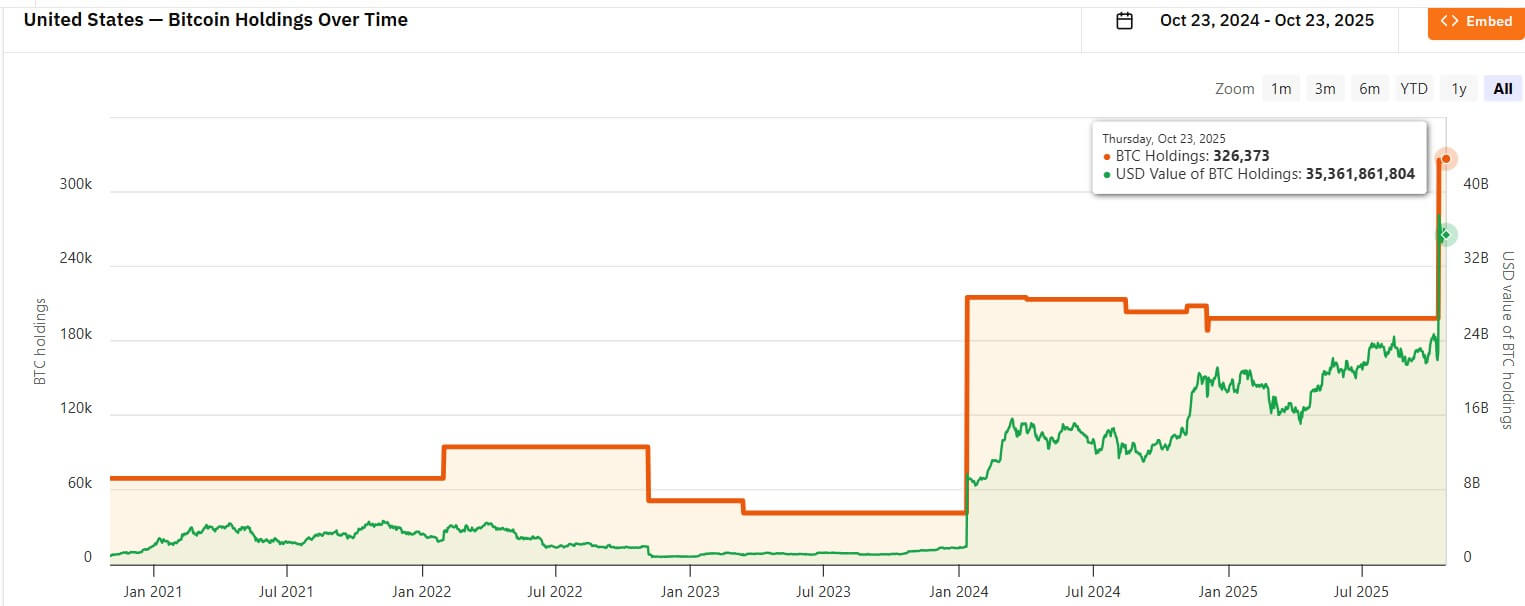
If the US government were to attempt to settle its debt using only this amount, the price required would be dramatically higher.
Dividing $38 trillion by 326,373 coins results in a price of approximately $116.5 million per Bitcoin. This is roughly 1,000 times its current market value, near $108,000.
At such a valuation, Bitcoin’s total market capitalization would reach roughly $230 trillion, more than double the world’s GDP.
Moreover, even if prices reached these levels, the practical limitations would prevent the complete elimination of the debt.
Bitcoin’s daily trading volume is around $60-$70 billion, according to data from CoinMarketCap. This is just a fraction of the $7.5 trillion in daily liquidity seen in global bond or foreign exchange markets.
Therefore, attempting to sell even a small portion of the Bitcoin supply to “repay” the national debt would likely trigger a collapse in demand and price.
Furthermore, the effective supply of Bitcoin available for trading is smaller than commonly assumed.
A report by Chainalysis suggests that about 20% of all mined Bitcoin, representing nearly 4 million BTC, are permanently inaccessible due to lost keys or destroyed wallets.
This leaves approximately 16 million BTC in active circulation. Adjusting for this reduces supply significantly, raising the hypothetical “debt parity” figure to over $2 million.
Insights from the Numbers
While Bitcoin cannot realistically wipe out the US debt, this exercise reveals a crucial truth about contemporary finance.
It illustrates that governments can create liabilities at a pace that exceeds the market’s ability to generate credible collateral. Each new loan increases the gap between what money represents and what it measures.
This imbalance explains why Bitcoin continues to be relevant in both policy discussions and investment strategies. Its design, with a capped supply of 21 million BTC, stands in contrast to a financial system built on perpetual expansion. Scarcity, once considered a relic of the gold standard, has become a highly valued attribute in currency.
Each trillion added to the US debt reinforces Bitcoin’s narrative of finite supply versus infinite credit. This also helps explain the increasing interest from institutional investors through spot ETFs, corporate investments, and even speculative discussions of sovereign reserves.
For investors, Bitcoin has evolved from a niche asset to a macroeconomic hedge against a world where the value of the dollar, the fundamental unit of measurement, feels increasingly unstable.