

As July 2026 arrives, the cryptocurrency market finds itself in a precarious position, reminiscent of the aftermath of the FTX bear market. Bitcoin is currently hovering around $60,000, having momentarily dipped below that threshold. Meanwhile, ETH▲$1,761.17 sits close to $1,600, and SOL▲$82.41 has retreated to the high-$70s. Factors such as ETF outflows, macroeconomic pressures, diminishing retail interest, and a shift towards AI-focused investments have all contributed to eroded confidence. This raises an urgent question: are we on the brink of another crash in the crypto sector?
In summary, while the market is under significant strain, it hasn’t yet hit a definitive collapse point. The bearish outlook is compelling enough to warrant attention, but there remains a bullish case that isn’t completely extinguished. The future trajectory of Bitcoin will depend on its ability to maintain levels between the high-$50,000s and low-$60,000s, the stabilization of ETF outflows, and whether macroeconomic conditions pivot in favor of risk assets.
Related: How VELVET Became Top Crypto Gainer in June 2026 — VELVET Price Forecast
Contents
The Bearish Perspective: Causes for Potential Crypto Crash

One of the most compelling arguments for an upcoming crash is the evident loss of momentum for Bitcoin, particularly at the critical support level.
Earlier in 2026, the $70,000 mark was seen as a major consolidation point. However, as Bitcoin tumbled towards $60,000, the overall market sentiment has weakened considerably. A prominent asset’s failure to maintain significant levels can dampen enthusiasm across the market.
Citi recently downgraded its projections, reducing its 12-month forecast for Bitcoin from $112,000 to $82,000, and lowering Ether’s estimate from $3,175 to $2,240, attributing the changes to negative ETF flows and a decline in investor enthusiasm. Their bearish outlook places Bitcoin at approximately $53,000 and Ether at around $1,094.
While these figures aren’t catastrophic, they certainly indicate that the market is not in a phase of aggressive buying.
ETF Outflows: The Major Red Flag
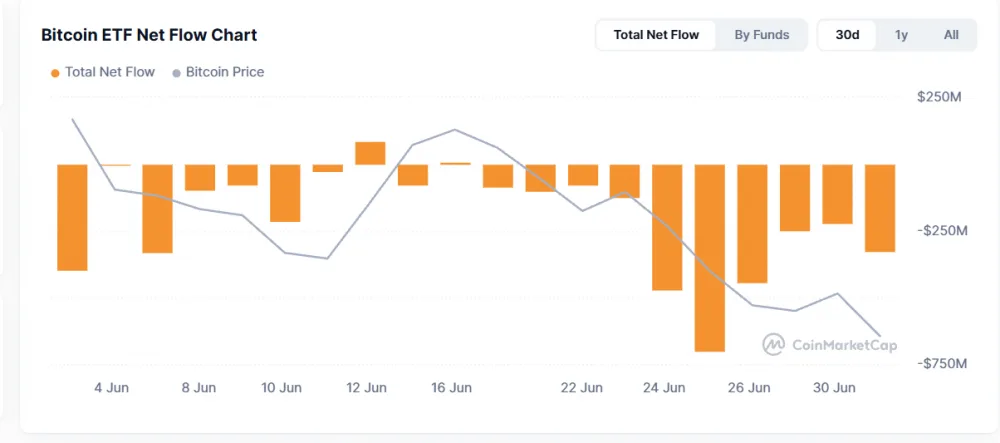
A crucial update for July 2026 is the substantial outflows from ETFs.
Bitcoin ETFs were expected to foster a more robust and institutional market. While they had a positive impact during the bullish phase, this current environment is putting that structure to the test. If these ETFs continue to experience capital outflows—having already shed about $7 billion in May and June—it would mark a significant loss for Bitcoin’s post-2024 demand engine.
Source: CoinMarketCap
The bearish interpretation suggests that ETF investors are no longer viewing every dip in Bitcoin as a buying opportunity. Some are reducing exposure or waiting for more favorable market conditions. This creates a perilous feedback loop: weakness in prices leads to further outflows, exacerbating price declines. If this cycle persists, a more significant downturn becomes probable.
Ethereum’s Weaker Position Compared to Bitcoin
Ethereum appears to be in a more vulnerable situation. ETH is currently priced near $1,600, significantly lower than the previously anticipated support range of $2,000–$2,200.
Although Ethereum continues to exhibit strong fundamentals and serves as a vital blockchain infrastructure, it faces challenges in realizing value. The growth of Layer-2 solutions does not automatically bolster ETH prices. While reduced transaction fees benefit users, they may dilute ETH’s revenue potential.
This ongoing weakness in Ethereum is crucial for the larger market, as further declines towards the $1,400 range could signal distress across various altcoins.
Altcoins Already in a Bear Market Phase
An additional case for a potential crash is the realization that numerous altcoins have already plunged significantly beneath the surface.
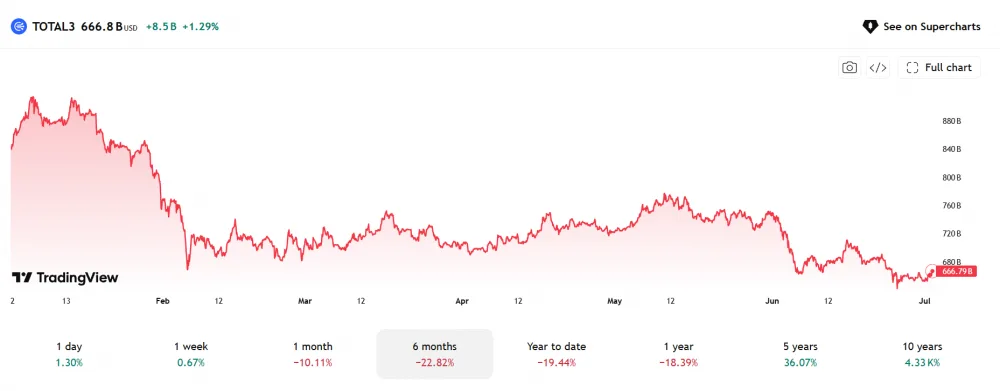
Although Bitcoin has experienced a notable decline from its 2025 peak, many alternative cryptocurrencies have faced even harsher conditions. The overall liquidity in the market has dwindled, and traders are less inclined to buy every dip. Capital is now consolidating in Bitcoin, stablecoins, and a select few narratives. During the first half of 2026, the total cryptocurrency market cap, excluding BTC▲$62,630.00 and ETH, has plummeted by 22.84%, now sitting at $666.58 billion as of July 2, 2026.
Source: TradingView
This behavior is characteristic of the latter stages of market cycles. In healthy environments, liquidity expands outward; in times of fear, it retreats inward.
Thus, referring to a “crypto market crash” can be somewhat misleading. For many altcoin investors, the crash has already unfolded. The critical question now is whether Bitcoin will experience a similar breakdown or stabilize before the fallout escalates.
Related: CLARITY Act Blocked Before July 4: Senate Delay Sparks Uncertainty — What Happens Next?
Challenges from Macroeconomic Conditions
The crypto landscape in July 2026 is adversely influenced by a challenging macroeconomic environment characterized by sustained interest rates, a strong dollar, diminished appetite for risk, geopolitical uncertainties, and stiff competition from AI-related stocks.
Arthur Hayes has posited that the next significant bullish run for Bitcoin hinges on fiat liquidity and could gain momentum as investment flows shift away from an overheated AI sector. While this presents a positive long-term perspective, it also highlights the immediate concern: if liquidity continues to be redirected towards AI investments and away from crypto, Bitcoin might remain under pressure.
Crypto enthusiasts often assert that Bitcoin serves as independent money, yet the market has consistently reacted by treating it like a high-risk asset.
Corporate Treasury and Bitcoin Risk
Another issue for July involves corporate treasury operations heavily invested in Bitcoin. Strategy, a notable player in the corporate BTC space, has faced scrutiny as Bitcoin’s price dipped below its average holding price. Even minor sales or monetization actions can negatively impact market sentiment because these entities were seen as consistent buyers.
The risk does not stem from a mass sell-off of Bitcoin by all treasury companies. That perspective is overly simplistic. Instead, the concern lies in the uncertainty surrounding what was once a reliable source of bullish sentiment. If these treasury firms halt their buying activities, hedge their exposure, or sell small amounts to manage their finances, it could eliminate an important psychological support for the market.
The Bullish Perspective: Reasons It Might Not Lead to a Crash

The argument against an impending crash begins with the same data that bears utilize: Bitcoin is close to the $60,000 mark.
This level has attracted interest from significant analysts. Geoffrey Kendrick of Standard Chartered has asserted that Bitcoin might have already reached a cycle low of around $59,000, partly due to an anticipated easing in ETF-related selling pressure after completing one-time liquidity events.
Related: Can Bitcoin Crash to $20K in 2026? What Could Trigger a Historic Crypto Market Collapse
This forms the crux of the bullish narrative: the market is indeed suffering, but it has also been oversold. If ETF outflows decrease, Bitcoin could stabilize in the range of $58,000–$62,000, potentially rebuilding toward the mid-$60,000s before attempting a more substantial recovery.
However, this would not signify the onset of a new bull market—it would be a process of finding a bottom. It may be dull, challenging, and rife with false movements—essentially, the market acting as it typically would.
Institutional Investors Hold Steady
Bitwise’s Chief Investment Officer, Matt Hougan, has offered an essential counterpoint: institutional ETF holders have not panicked. ETF outflows have been less than the total inflows accumulated during the previous market cycle, even after major price drops.
This development is significant because the crypto landscape has evolved. Previously dominated by leverage, unregulated exchanges, and retail investors’ emotional responses, the current market features increased institutional participation, better ETF structures, and more regulated financial products. While this doesn’t eliminate volatility, it may minimize the chances of a chaotic collapse.
Of course, it’s important to note that ETF investors are still capable of selling more. That said, they haven’t all abandoned ship yet.
Bitcoin Remains Above Key Support Levels
Another justification for refraining from declaring a crash is that Bitcoin has so far avoided breaching the most significant downside targets analysts are monitoring.
Galaxy Research has highlighted the possibility that Bitcoin could still decline towards $40,000–$46,000, while Citi’s pessimistic estimate rests around $53,000. Although these figures are troubling, they set a clear risk framework. As of July 2, Bitcoin remains above these thresholds.
This indicates that the current market is not in freefall. A crash would only occur if support fails, liquidity dries up, ETF outflows accelerate, and forced selling spreads. Until then, the market remains fragile yet uncertain.
Solana: Under Pressure but Resilient
At present, Solana’s price is hovering in the high-$70s, which is disappointing for those who invested during the 2025 surge. Nonetheless, SOL is still among the few prominent assets with a distinct use case, being applicable in high-speed trading, consumer applications, and rapid payment transactions.
Even so, this doesn’t shield it from downward trends. Should Bitcoin fall below $58,000, Solana will likely follow suit. Conversely, if the market stabilizes, Solana has the potential to bounce back more quickly than its slower-moving counterparts due to its strong development and user narrative.
Read more: Bitcoin and Ethereum in Crisis: Can Solana Become the Main Global Payments Network in 2026?
In essence, SOL is not the market’s stable asset but rather a signal of risk appetite. If Solana begins to outperform while Bitcoin stabilizes, it would serve as one of the earliest indicators that fear is starting to wane.
What Would Signal Another Crash?
The likelihood of another crypto crash increases significantly if several factors align:
- Bitcoin fails to maintain the $58,000 support and cannot quickly reclaim $60,000.
- ETF outflows persist throughout July rather than showing signs of slowing.
- Ethereum drops below the $1,500–$1,600 range.
- Solana declines beneath the low-$70s without any buyer intervention.
- Capital continues to flow into AI and major-cap stocks at the expense of crypto.
- Regulatory progress in the U.S. remains stagnant.
- Corporate treasury firms selling Bitcoin or ceasing their role as structural buyers.
Currently, multiple risks are aligning, though not all have simultaneously materialized.
What Would Counter the Crash Narrative?
The crash narrative would diminish if Bitcoin manages to reclaim $61,000–$62,000 and sustain that level, ETF outflows begin to slow, Ethereum stabilizes above $1,600, and Solana remains above the low-$70s.
A more decisive signal would be if Bitcoin regains the mid-$60,000s while volumes are rising. This would suggest that the recent dip below $60,000 was merely a capitulation spike rather than the initiation of a new downward trend.
Ultimately, the most significant bullish factor would be stability in ETF flows. If the outflows cease, the market can refocus on potential growth rather than being preoccupied with forced selling.
An additional booster would be positive macroeconomic news, such as lowered rate expectations or decreased pressure on the dollar.
Divergent Analyst Opinions: Crash, Bottom, or Reset?
The analyst community is notably split at this juncture.
Citi places a cautious outlook, adjusting BTC and ETH price targets downward while warning about subdued ETF flows and legislative delays that compromise market stability. In contrast, Galaxy Research warns of potential for Bitcoin to drop to the $40,000–$46,000 range should pressure persist, validating the viewpoint that another crash remains an option.
On the other hand, Standard Chartered’s Geoffrey Kendrick aligns more closely with those anticipating a market bottom, suggesting that Bitcoin might have hit a cycle low around $59,000 if ETF selling reduces. Arthur Hayes maintains a constructively bullish stance but frames the next surge around liquidity and a gradual exit from AI investments. Matt Hougan’s perspective regarding institutional holders further raises the idea that while the market is wounded, it is not entirely broken.
Thus, the real division is not solely between bulls and bears; it’s about timing. Bears believe that the market is still in the process of re-evaluation, whereas bulls argue that most of the damage has already occurred.
Final Assessment: Is Another Crash on the Horizon?
The cryptocurrency market stands at a crossroads, but the inevitability of another crash is not assured.
The bearish argument is compelling: ETF outflows, shattered support levels, Ethereum’s weakness, cautious institutional movements, a shift towards AI, and macroeconomic pressures all underscore a market still vulnerable to declines. Bitcoin prices under $58,000 would considerably strengthen the crash narrative, with Ethereum under $1,500 providing additional confirmation. Likewise, Solana declining beneath the low-$70s would suggest rapidly diminishing risk appetites.
However, the bullish counterarguments are equally credible. Bitcoin is currently trading at levels that some analysts see as a potential bottom. Institutional investors have not yet completely capitulated, and much bad news might already be factored into the market. If ETF outflows begin to stabilize and Bitcoin reclaims the $61,000–$62,000 marks, July could transition into a month of stabilization rather than the beginning of a significant decline.
Should buyers manage to defend the present price levels, the crypto market may establish a foundation for a recovery later in 2026. Conversely, failure to do so could result in a rapid, painful decline. The market currently rests on tenuous ground—while it has yet to break, the existing cracks cannot be overlooked.
FAQ
Is another crypto crash coming in July 2026?
While another crash remains a possibility, it is not yet confirmed. Key levels to monitor include Bitcoin around $58,000–$60,000, Ethereum at $1,500–$1,600, and Solana near the low-$70s.
What is causing the current weakness in the crypto market?
Primary factors include ETF outflows, diminished appetite for risk, macroeconomic pressures, regulatory delays, movements towards AI-centric assets, and declining confidence as Bitcoin fell from the low-$70,000 level.
What are analysts currently saying about Bitcoin?
Citi has revised its 12-month Bitcoin target to $82,000, whereas Galaxy Research has warned of potential declines to $40,000–$46,000. Conversely, Standard Chartered’s Geoffrey Kendrick seems more optimistic, suggesting that Bitcoin might already be near a cycle low.
Is Ethereum in a worse position than Bitcoin?
Currently, yes. Ethereum is trading near $1,600, which is below the earlier support range of $2,000–$2,200. While its long-term prospects are solid, the token requires stronger demand from ETFs and improved liquidity.
What would indicate that the market is in recovery?
The most promising early recovery signals would include Bitcoin reclaiming the $61,000–$62,000 range, slowing ETF outflows, Ethereum stabilizing above $1,600, and Solana maintaining a position above the low-$70s.