
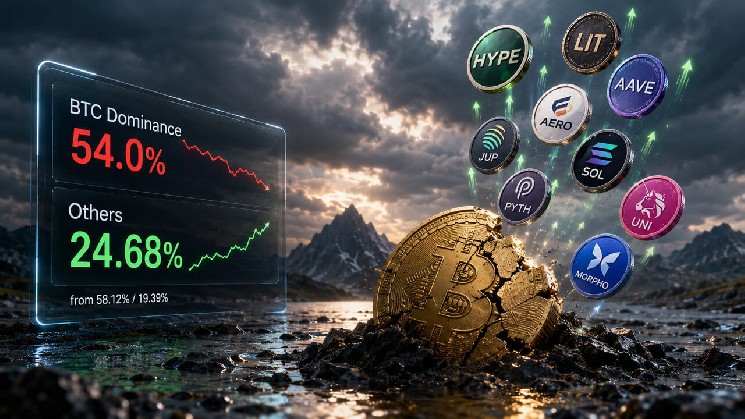
The dominance of Bitcoin fell to a one-month low of 54%, decreasing from 58.12%, as reported by CoinGecko’s dominance table.
During the same period, the “Others” category, which includes all cryptocurrencies outside of Bitcoin, Ethereum, and stablecoins, saw an increase from 19.39% to 24.68% of the total market capitalization of cryptocurrencies.
$BTC dropped below $58,000 last week but rebounded to reach an intraday high of $63,976.16. Meanwhile, the Fear & Greed Index improved from 12 to 24 this week, although it remains in the Extreme Fear zone.
Over the past year, Bitcoin’s dominance has decreased from 63% to 56%, while stablecoins have nearly doubled their market share, increasing from 7% to 13%.
This recovery is focused on tokens that generate actual protocol fees, engage in buyback or burn activities, are a part of Solana’s on-chain trading ecosystem, or are integrated into institutional distribution channels. Investors are adopting a more selective approach to altcoins, contrasting with the broad “everything pumps” mentality of previous market cycles.
$HYPE saw a modest gain of just 24% over the last month, marking the smallest growth among top assets, yet it has nearly doubled its value for the year, trading near $71. This token has played a significant role in the recent selective altcoin surge.
The trading activity directly correlates with token demand, as Hyperliquid’s Assistance Fund allocates over 97% of its fees toward token buybacks.
Top Performers
Lighter has emerged as the highest gainer in this segment, increasing by 83.85% over the last month, as traders search for the next standout perp exchange akin to Hyperliquid.
According to DefiLlama, Lighter’s 30-day perpetual volume is close to $40 billion. The protocol commenced the burn of repurchased $LIT after the close of Q2, following a similar buyback strategy implemented by $HYPE.
Aave and Aerodrome are sharing a similar trajectory from different areas within DeFi. Aave surged 59% following the launch of Aavenomics 3.0, which directly linked $GHO and protocol revenue to an automated $AAVE buyback scheme.
Aerodrome experienced an 82.3% increase owing to an anticipated merger with Velodrome and the introduction of a “Predictive Allocation” upgrade designed to replace weekly gauge voting with more efficient liquidity routing on Base.
Uniswap saw a 31.3% rise, driven by a bullish outlook wherein Standard Chartered set a $100 price target for the token by 2030. Additionally, discussions surrounding $UNI‘s fee-switch-and-burn feature are still ongoing.
In Solana’s market segment, Jupiter increased by 57.2% following a proposal to boost its buyback rate to 70% of fees while also expanding into lending and on-chain equities.
Solana itself has risen by 32.74%, benefitting from this momentum, while Jito experienced a 45% gain, tapping into Solana’s MEV and staking flows.
Pyth surged 46.5% after a deal on June 30 to distribute Nasdaq’s TotalView order-book data through its network, closely followed by an integration with Arc’s testnet in early July.
Morpho increased by 21.8% thanks to institutional interest, as Standard Chartered began coverage with a target of $60 for 2030. Additionally, Robinhood selected Morpho vaults to enhance its Earn product using USDG balances.
Zcash rose 25.2% based on its unique developments, particularly its Tachyon quantum-readiness roadmap introduced on June 30, along with an upcoming Ironwood mainnet upgrade set for July 21 that aims to enhance supply verification and shielded-pool functionalities.
Drivers of Change
The initial catalyst behind this activity is on-chain revenue. Protocols like Hyperliquid, Lighter, and Aave have begun directing their trading fees or protocol income into buyback and burn strategies, providing a direct price support linked to user activity.
The second factor is institutional engagement, exemplified by Nasdaq’s partnership with Pyth and Robinhood’s implementation of Morpho vaults, connecting these tokens directly to regulated financial environments.
If the buyback model becomes more widespread, tokens lacking a fee or burn mechanism will need to implement one to attract investment. Traders are already favoring protocols that can demonstrate revenue generation, thereby raising the standards for new market entrants as well.
The bullish outlook assumes that Bitcoin will maintain its value while its dominance dips further, potentially reaching the 50%-52% range, with the “Others” category surpassing 27%. Following this trend could pave the way for an “Altcoin Season.”
Capital flowing into $HYPE, $LIT, and $AAVE is extending to secondary assets that are still in search of their own triggers. Dominance below 53% and “Others” exceeding 25% would signal that this trend is taking shape.
The bearish scenario suggests that Bitcoin could regain its share, pushing dominance back above 56% while “Others” recede below 22%. Even a slight uplift in Extreme Fear could prompt high-beta altcoins to retract their recent gains.
A pullback in Bitcoin, thin liquidity over the weekend, or a poorly received token unlock might trigger such a retreat. Moreover, if meme coins surpass revenue-generating tokens, or if the Fear & Greed Index remains close to Extreme Fear despite rising prices, it would further solidify the bear case.
The decline in Bitcoin’s dominance highlights a limited selection of tokens that have effectively turned revenue generation into a marketable attribute, with traders willing to invest accordingly.
$LIT, $AAVE, $AERO, $JUP, $PYTH, and Morpho are all testing the limits of how this model can extend beyond a singular exchange token.
The coming month will reveal whether the business model becomes the standard for participating in this rally, or if the trend reverts to prioritizing speculative tokens lacking any underlying fees.