
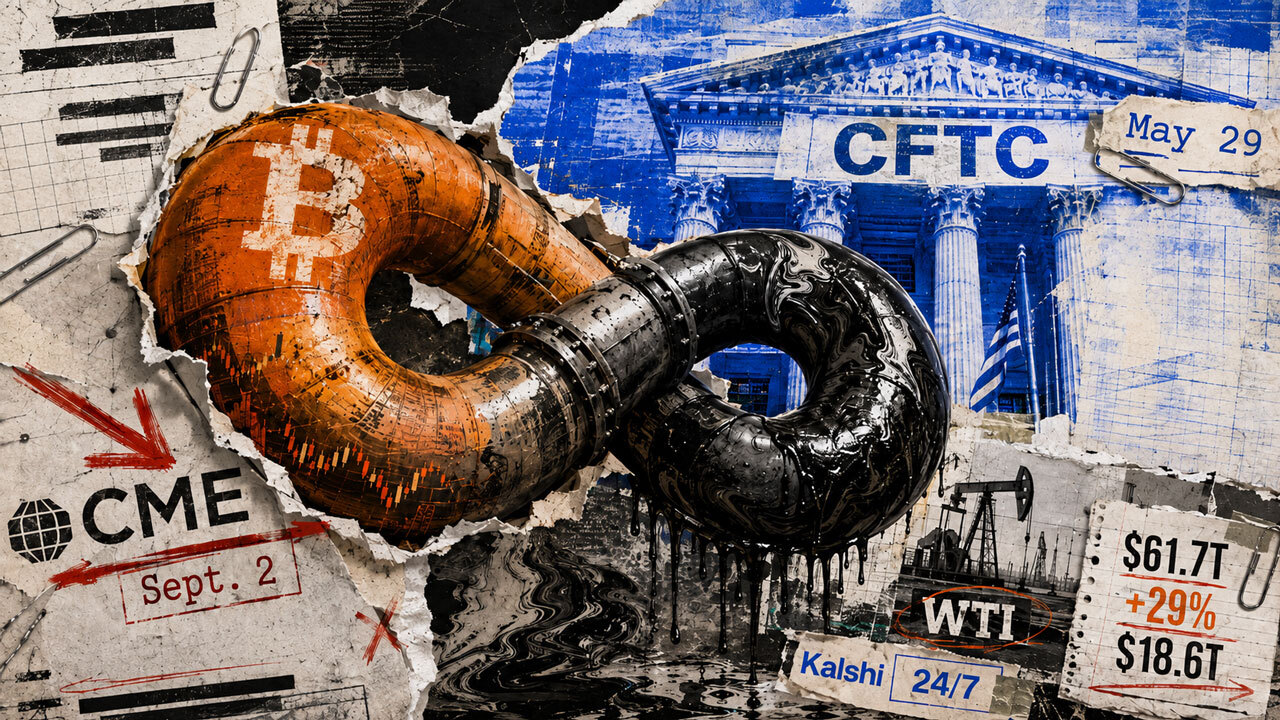
On September 2, the Commodity Futures Trading Commission (CFTC) requested that a federal court dismiss the Chicago Mercantile Exchange’s (CME) lawsuit challenging Kalshi’s Bitcoin perpetual contract.
The crux of the legal dispute is whether a contract that possesses no set expiration fits within the parameters of the U.S. futures market. The regulator contends that before the court addresses this matter, CME must demonstrate an injury that can be remedied.
The CFTC asserts that CME has the opportunity to introduce a similar digital commodity product, thus any competitive disadvantage resulting from CME’s choice not to participate cannot be attributed to the regulator.
This foundational argument transforms the focus from a single Bitcoin contract to a larger examination of how perpetual futures might gain traction in the regulated U.S. marketplace.
According to Bloomberg, Coinbase is exploring a regulated pathway for specific contracts linked to pricing on Hyperliquid. Reports suggest that Kalshi is also preparing to seek approval for a West Texas Intermediate crude oil contract.
These instances illustrate a contract format that, having been popularized in offshore crypto markets, is now gradually making its way into the U.S. regulatory landscape, one venue and asset at a time.
Data from CryptoQuant indicates that global trading volume for crypto perpetual futures reached approximately $61.7 trillion in 2025, reflecting a 29% increase from the prior year. Spot trading during the same timeframe totaled $18.6 trillion.
The outcome of the CME case may influence how much of this trading activity U.S. exchanges can engage in under the CFTC’s futures framework.
CFTC Affirms CME’s Opportunity in Bitcoin Perpetuals
On June 18, CME filed a lawsuit against the CFTC, aiming to overturn the agency’s approval of KalshiEX’s Bitcoin perpetual contracts, which was granted on May 29. CME argued that a contract that lacks a fixed expiration should be viewed as a swap rather than a future, as defined by the Commodity Exchange Act.
According to the CFTC’s motion, the relief CME is seeking would not effectively address the exchange’s claimed competitive harm.
The agency further mentioned that CME is permitted to offer similarly structured digital commodity perpetuals, suggesting that any disadvantages faced by CME are self-imposed due to its decision not to engage with the opportunity.
If the court classifies Kalshi’s product as a swap, it wouldn’t necessarily eliminate competing products from the marketplace, as another venue could offer one under that classification. In the agency’s eyes, even a favorable ruling for CME on this matter would fail to resolve the alleged injury.
CME has until October 2 to contest the dismissal motion. A ruling on the standing could leave the distinction between futures and swaps ambiguous.
The CFTC’s policy established on May 29 defined designated contract markets as those eligible to list similarly structured perpetuals related to Bitcoin and digital commodities that possess robust, active, and continuous spot markets. Other products would be evaluated on a case-by-case basis under Regulation 40.3.
This approach accelerates the approval process for qualifying digital commodity products while outlining a separate review pathway for other asset classes, an important distinction as markets transition from crypto to more traditional assets like energy.
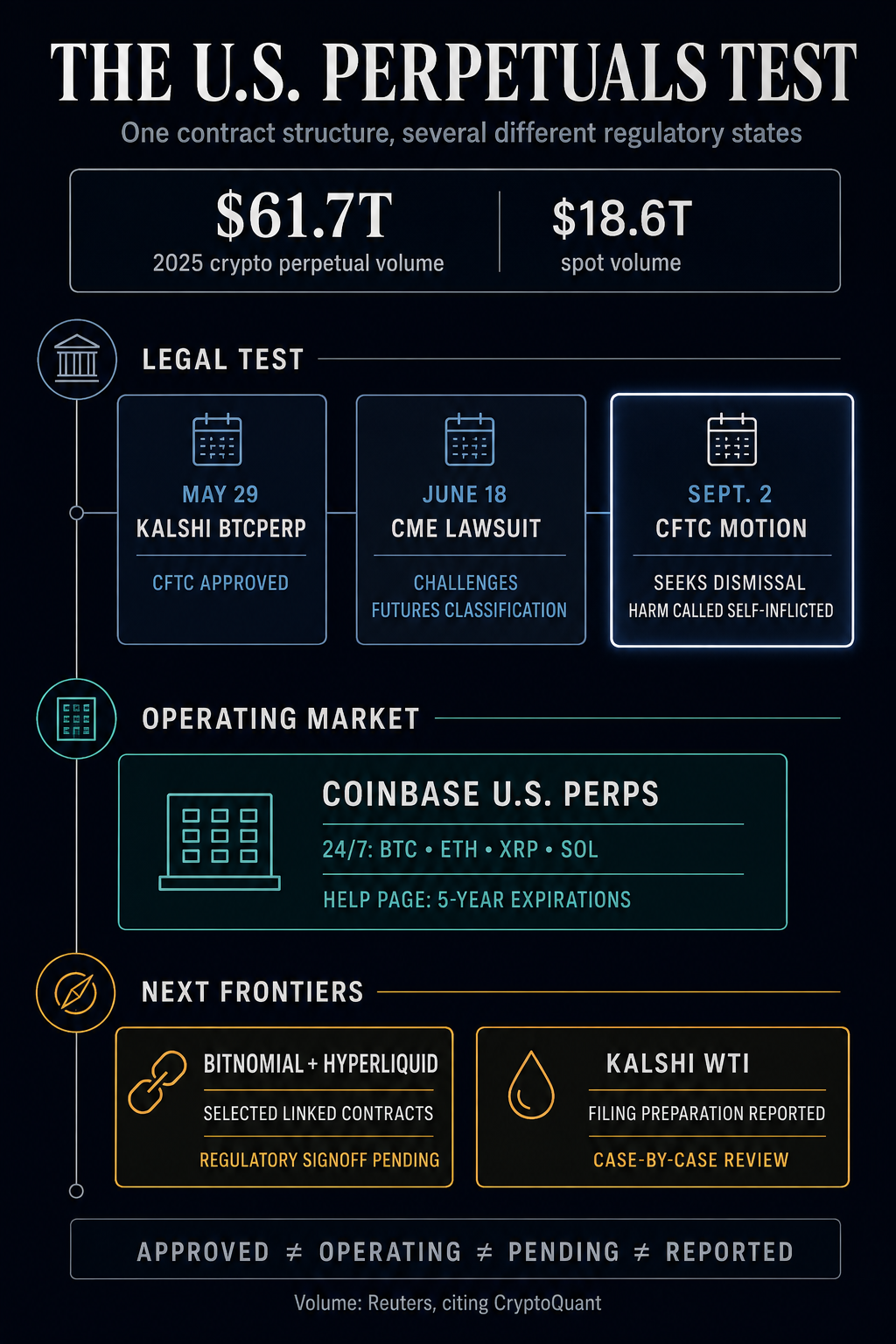
Coinbase’s derivatives marketplace features U.S.-specific perpetual futures available for 24/7 trading, encompassing various contracts linked to Bitcoin, Ethereum, XRP, and Solana.
The term “perpetual” encompasses various contract designs in the emerging U.S. landscape. Coinbase’s official documentation describes these contracts as having five-year durations, permitting ongoing trading and exposure, while a truly expiration-free contract involves different stipulations.
A letter from CFTC staff in June provided conditional relief for requests from Coinbase Derivatives and Bitnomial to remove expiration clauses from existing digital commodity perpetual contracts that were set to expire on June 30.
Regulated U.S. perpetual-style crypto futures are transitioning from theoretical policy frameworks to functioning market structures, despite variations in expiration mechanics among contracts. CME’s lawsuit questions the agency’s methodology underlying these changes as competing exchanges adapt one of the largest trading formats in crypto.
Hyperliquid to Explore On-Chain Connections
Reports indicate that Hyperliquid and Payward are in discussions concerning a setup for registered U.S. users. Bitnomial, a regulated derivatives platform owned by Payward, aims to offer select contracts associated with token prices on Hyperliquid.
In August, Payward acquired Bitnomial, thus enhancing its U.S. derivatives exchange and clearing capabilities.
President Donald Trump highlighted a political initiative on August 19, indicating his administration’s efforts to establish a U.S. framework for Hyperliquid during a White House technology event.
A validated structure would serve as an experiment to bridge a registered domestic venue with token prices generated in an on-chain environment. The integrity of the market, surveillance mechanisms, and the precise relationship between the venues will hinge on the approved design.
Polymarket’s international platform showcases live leveraged crypto perpetual markets, while Polymarket U.S. operates separately. The global product highlights the rapid expansion of crypto-native venues and provides an international perspective.
Oil Ventures into Traditional Futures
In June, the CFTC sought public feedback regarding 24/7 trading and perpetual contracts for storable energy commodities, including crude oil. This consultation initiated an active review within a traditional futures market.
Kalshi is reportedly preparing to file with the CFTC for a perpetual contract linked to West Texas Intermediate crude oil, potentially to be submitted next week.
A proposal for WTI would proceed through the CFTC’s case-by-case evaluation process, addressing the practical distinctions between a crypto contract based on cash references and a market built around a tangible commodity that has established delivery systems.
The consideration of perpetual contracts in a conventional commodity framework, where CME is a major player, brings this new structure closer to the heart of traditional derivatives competition.
A swift ruling by the CFTC on standing could enable the agency’s framework to remain intact without a definitive judgment on the futures-versus-swaps question. This outcome might encourage other exchanges to propose similar products, following the relevant listing or review procedures.
Continued litigation on the substantive issues will place the statutory classification problem before the courts. A decision on whether a no-expiration contract qualifies as a future would delineate a clearer legal boundary, while the duration before a ruling could complicate product development.
Approval for selected Bitnomial contracts related to Hyperliquid prices would test the efficacy of the on-chain link, whereas acceptance of a WTI perpetual would signify the model’s extension into conventional commodities.
The CFTC presently defends its stance in court while exchanges explore its boundaries, with perpetual-style offerings moving into the regulated U.S. space.
The future of this regulatory landscape will hinge on whether CME has standing, how a court characterizes the Kalshi contract, which venues can comply with the CFTC’s stipulations, and whether regulators permit the model to expand from digital commodities into on-chain pricing and physical products.