
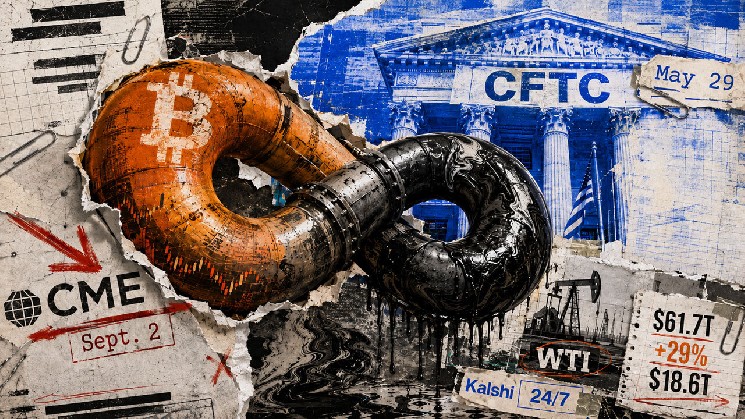
On September 2, the Commodity Futures Trading Commission (CFTC) urged a federal court to reject CME’s legal challenge regarding Kalshi’s Bitcoin perpetual contract.
The core of this lawsuit revolves around whether a contract lacking a defined expiration can be classified within the US futures framework. Before addressing that matter, the CFTC asserts that CME must demonstrate an injury that the court is capable of remedying.
The CFTC has indicated that CME is permitted to introduce a similar digital commodity product, suggesting that the exchange cannot hold the regulator accountable for any competitive disadvantages stemming from its decision to abstain.
This preliminary argument transforms a dispute over a single Bitcoin contract into a broader examination of how perpetual futures may permeate regulated US markets.
Bloomberg reported that Coinbase is exploring a regulated pathway for certain contracts associated with pricing on Hyperliquid. Meanwhile, Kalshi is preparing to request approval for a perpetual contract based on West Texas Intermediate crude oil.
These developments illustrate a contract framework initially embraced by offshore cryptocurrency markets as it progressively integrates into the US regulatory landscape, one venue and asset class at a time.
According to CryptoQuant, global trading volume for crypto perpetual futures reached approximately $61.7 trillion in 2025, marking a 29% increase from the previous year, with spot trading during that period amounting to $18.6 trillion.
The CME case could greatly influence the extent to which US exchanges are able to engage in these activities through the CFTC’s futures regulation.
CFTC Asserts CME Can Compete in Bitcoin Perpetuals
On June 18, CME initiated a lawsuit against the CFTC, aiming to overturn the agency’s May 29 endorsement of KalshiEX’s Bitcoin perpetual contracts and the accompanying policy statement. CME contended that a contract without a set expiration date should be classified as a swap rather than a futures contract per the Commodity Exchange Act.
The CFTC’s motion emphasizes that the relief sought by CME does not sufficiently address the claimed competitive disadvantage.
The agency further stated that CME could list similarly structured digital commodity perpetuals, suggesting that any perceived disadvantage from CME opting not to do so is self-imposed.
A court’s decision declaring Kalshi’s product as a swap would not inherently eliminate competitive exposure from the market, since another platform might classify it differently. In the agency’s perspective, a win for CME on this issue would still not resolve the alleged harm.
As it stands, CME has until October 2 to respond to the motion for dismissal. A ruling on this matter could leave the distinctions between futures and swaps inadequately addressed.
The CFTC’s May 29 policy characterized designated contract markets as those capable of listing comparable perpetuals related to Bitcoin and other digital commodities that have robust, active, and continuous spot markets. Products outside this category are subjected to case-by-case evaluations under Regulation 40.3.
This framework facilitates a quicker approval process for qualifying digital commodity products while establishing a separate evaluation pathway for other assets. This distinction is important as trading venues shift from cryptocurrencies to established futures markets based on energy and other commodities.
Coinbase’s derivatives market page promotes US perpetual-style futures available round-the-clock, with contract families linked to Bitcoin, Ethereum, XRP, and Solana.
The term “perpetual” encompasses various contract mechanics within the evolving US market. Coinbase’s official documentation explains that the contracts in question have five-year expirations, thereby offering long-term exposure that is continuously traded, while a literal expiration-free contract would necessitate different conditions.
A June letter from CFTC staff granted conditional relief for Coinbase Derivatives and Bitnomial to remove expiration terms from existing digital commodity perpetual contracts that had expired on June 30.
Regulated US perpetual-style crypto futures have transitioned from a policy notion to an operational category, even though specific expiration mechanics vary across contracts. CME’s lawsuit contests the agency’s approach that facilitated this change as competing venues adopt one of crypto’s predominant trading models.
Hyperliquid to Explore On-Chain Integration
Reports indicate that Hyperliquid and Payward are negotiating a structure for registered US users, with Payward’s subsidiary Bitnomial planning to offer selected contracts based on token prices from Hyperliquid.
In August, Payward finalized its acquisition of Bitnomial, thereby integrating its US derivatives exchange and clearing operations.
On August 19, former President Donald Trump signaled political support, mentioning that his administration was exploring a US route for Hyperliquid during a White House technology event.
An approved structure would examine a link between a registered domestic venue and token prices established in an on-chain market. Aspects such as surveillance, market integrity, and the relationship between venues would depend heavily on the design approved.
Polymarket’s international site showcases live leveraged crypto perpetual markets, contrasting with Polymarket US, denoting how rapidly crypto-native platforms are expanding, offering a global perspective.
Oil Brings New Structures to Traditional Futures
In June, the CFTC invited public feedback on 24/7 futures trading and perpetual contracts for storable energy commodities, including crude oil. This inquiry highlights the structure currently under review in a traditional futures market.
Kalshi is reportedly readying a filing with the CFTC for a perpetual contract linked to WTI crude oil, potentially making the request within the week.
This WTI proposal would follow the CFTC’s case-by-case evaluation process, which must address practical differences between a cash-referenced crypto contract and a market designed around a physical commodity with established delivery systems.
The potential adoption of perpetual contracts in a traditional commodity market, where CME currently has a stronghold, brings the new structure closer to the center of existing derivatives competition.
A swift CFTC ruling in favor of standing could maintain the agency’s framework without definitively addressing the futures-versus-swaps distinction. Other exchanges might interpret this outcome as encouragement to propose similar contracts, subject to the relevant listing or review criteria.
Ongoing litigation regarding the underlying merits would put the statutory classification issue before the court. A judgment determining whether a no-expiry contract can be recognized as a future would delineate clearer legal boundaries, while the time before a ruling could complicate product planning.
Regulatory approval for selected Bitnomial contracts connected to Hyperliquid prices would put the on-chain relationship to the test. Approval of a WTI perpetual contract would signify the integration of this structure into traditional commodities.
The CFTC is currently defending its strategy in court while exchanges assess the boundaries of this framework, as perpetual-style offerings make their way into the regulated US market.
The upcoming phase hinges on whether CME has legal standing, how a court interprets the Kalshi contract, which venues can satisfy the CFTC’s requirements, and whether regulators allow the model to extend from digital commodities into on-chain pricing and physical markets.