
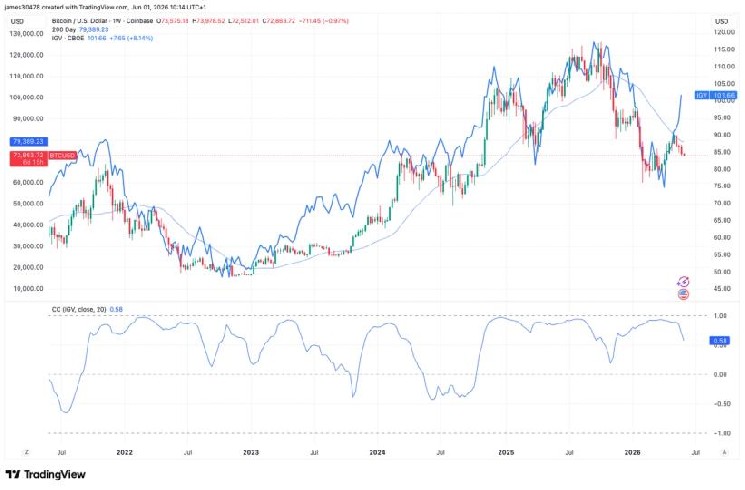
For much of the last five years, Bitcoin and technology stocks, particularly in software, have exhibited a close correlation, with Bitcoin seen as a high-risk tech asset.
The iShares Expanded Tech-Software Sector ETF (IGV) has been a reliable indicator for the software landscape. Recently, however, this correlation seems to have weakened.
Since mid-May, a noticeable divergence has emerged between Bitcoin and IGV. While IGV has increased by approximately 12%, Bitcoin has depreciated by about 10%, marking one of the largest disconnects observed between these assets in recent times.
In October 2025, both Bitcoin and IGV reached peak values before experiencing substantial declines: Bitcoin dropped nearly 50%, while IGV saw a decrease of around 37%. This downturn in the software sector was primarily fueled by escalating concerns that artificial intelligence could undermine conventional software business models. The narrative surrounding the “SaaS apocalypse” gained traction, leading to widespread selling pressures on software companies like Oracle (ORCL), Microsoft (MSFT), and Palantir (PLTR).
Since early April, IGV has mounted a remarkable comeback, climbing 36% and reclaiming its 200-day moving average—a technical measure reflecting the average closing price over the prior 200 trading sessions, commonly used to identify long-term trends. By Friday, IGV was closing in on 98, and pre-market trading on Monday showed it around 104.
In contrast, Bitcoin is currently priced near $73,000, approximately 10% below its 200-day moving average, which stands at $79,388.
The 20-day rolling correlation between Bitcoin and IGV has decreased to 0.58. Similar low correlation levels were noted in October 2023 when Bitcoin was priced near $25,000, before it escalated to $70,000 over the next six months. This pattern repeated during the summer of 2024, just before Bitcoin surged towards $100,000 after President Trump’s election win.
Historically, these phases of low correlation don’t persist for long. Bitcoin typically either aligns again with software stocks, or the recovery of IGV is merely temporary. As it stands, the latter seems less probable given IGV’s robust momentum and its resurgence above the 200-day moving average.