
The on-chain sell-side risk for Bitcoin has dropped to below half of its peak observed in August, indicating a reduction in potential selling pressure. However, a significant amount of older coins continues to be held at acquisition prices that exceed the current market value.
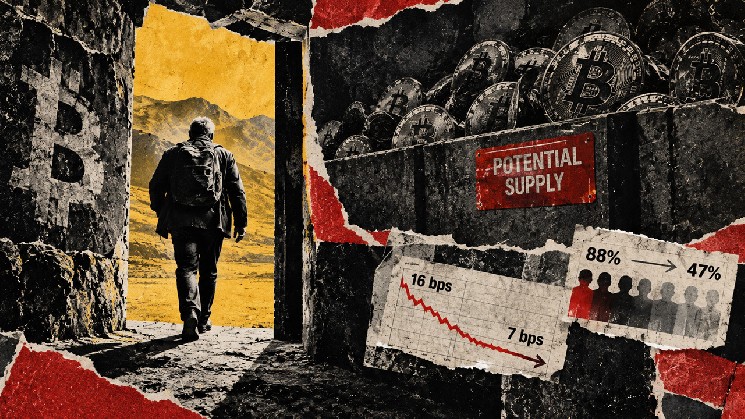
A report from analytics company Glassnode dated September 9, based on on-chain data collected until September 7, reveals that the Sell-Side Risk Ratio stands at 7 basis points per day on a seven-day average, a decrease from 16 basis points during the peak in August.
Long-term holders are now responsible for 47% of realized profits, down from 88% in August’s peak. This indicates that older holders are contributing less to the total market profits, although this statistic does not reflect their overall share of Bitcoin sales.
The Sell-Side Risk Ratio is calculated by adding on-chain gains and losses and dividing this sum by the realized capitalization. This provides insight into potential selling pressure by measuring value realization relative to that capital base.
A ratio that falls below half its previous level does not imply that the volume of Bitcoin traded on exchanges has been halved.
Furthermore, Glassnode has indicated that the surge in realized profits on September 3 was less than half the magnitude of the spike seen in August. These profit spikes are separate from the weekly risk measurement. Together, these insights suggest a more subdued profit realization and a shift in the types of holders cashing in.
The report highlights approximately 1.07 million BTC that were purchased between $83,000 and $86,000, nearly all owned by long-term holders, with that block seeing little change over the past month.
These holdings represent potential future supply, while the realization data illustrates the recent behaviors of holders.
Related Reading
Bitcoin’s potential $80,000 breakout faced with $47 billion more profitable supply
Exchange Demand Presents Another Challenge
Recent reports pointed out a negative flow of Bitcoin on exchanges as of September 8. Despite some improvement, the cumulative volume delta (CVD) remains negative, indicating that aggressive selling on exchanges continues to surpass aggressive buying.
CVD measures the balance of trades executed, while sell-side risk evaluates on-chain profit and loss realization in relation to realized capitalization. A decrease in the latter does not necessitate a positive shift in the former.
Bitcoin holders are currently realizing less in terms of profits and losses relative to their capital base, and the larger block of older coins largely remains in holding. Considering this entire block as immediate selling pressure could lead to an overestimation of the situation.
For any sustained upward movement, it is essential for buyers to absorb the actual supply that becomes available in the market.