
- XRP approaches the crucial support level of $1.30 as uncertainty in the macroeconomic landscape impacts the entire cryptocurrency sector.
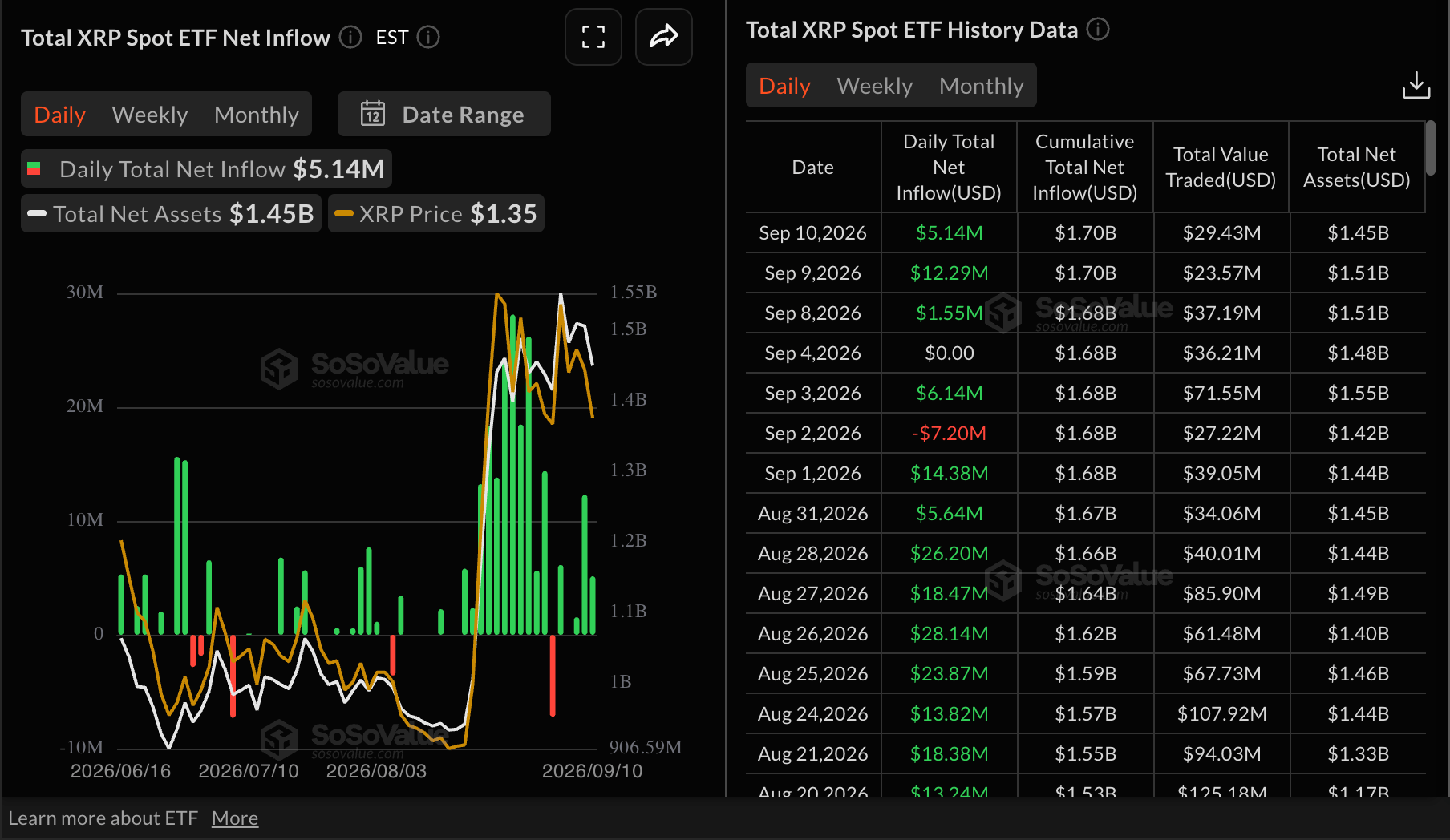
- XRP spot ETFs listed in the US attracted $5 million in inflows on Thursday, failing to provide the momentum necessary for a rebound.
- The 200-day Exponential Moving Average (EMA) has turned into a resistance barrier for XRP, as decreasing momentum indicators impact its price movement.
On Friday, Ripple (XRP) dipped below $1.33, marking a third consecutive day of losses. The cryptocurrency is closely aligned with the overall downturn in the crypto market, as investors remain vigilant amidst growing macroeconomic uncertainty, particularly with the upcoming release of the United States Consumer Price Index (CPI) and the Federal Reserve’s monetary policy meeting scheduled for next week.
“The CPI data being released this afternoon and the FOMC meeting next week will be crucial in determining whether investors are right to challenge policymakers or if those in power will react with more force than the market anticipates,” noted analysts from Crypto Finance in a recent statement.
Increased Capital Inflows for XRP
On Thursday, US-listed spot Exchange-Traded Funds (ETFs) reported an inflow of around $5 million, marking a three-day bullish trend. Data from SoSoValue indicates that overall inflows have reached $1.7 billion, while average net assets under management stand at $1.45 billion, suggesting a continued appetite for risk. Persistent ETF inflows may help cushion XRP against volatility stemming from macroeconomic factors and increase the odds of a rebound in the near future.
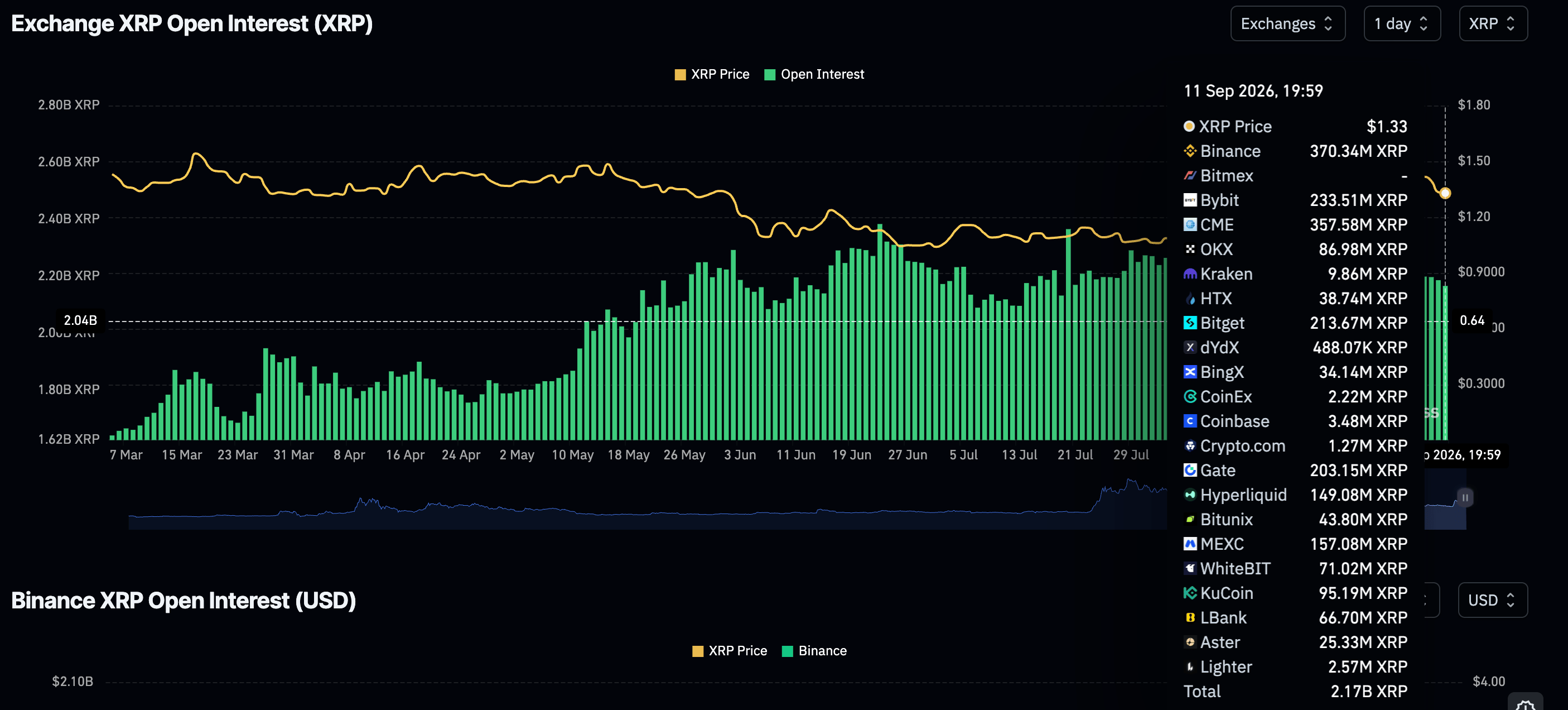
Despite these inflows, retail interest appears to be weak, underscored by perpetual futures Open Interest (OI) at 2.17 billion XRP on Friday, down slightly from 2.19 billion the day prior. This dip in OI contrasts with increased demand observed in August, which peaked at 2.78 billion. A continued decline in demand could hinder XRP’s ability to achieve a meaningful recovery in the short to medium term.
Technical Review: XRP Faces Ongoing Challenges
XRP is currently trading at $1.32, remaining below the 200-day EMA which sits at $1.36, as well as the Parabolic SAR at $1.57, indicating a bear bias in the near term. However, prices are still above the 50-day EMA at $1.27 and the 100-day EMA at $1.25, suggesting some underlying demand may persist. The Relative Strength Index (RSI) at over 49 reflects neutral momentum, while the Moving Average Convergence Divergence (MACD) remains below zero, highlighting diminishing bullish pressure.
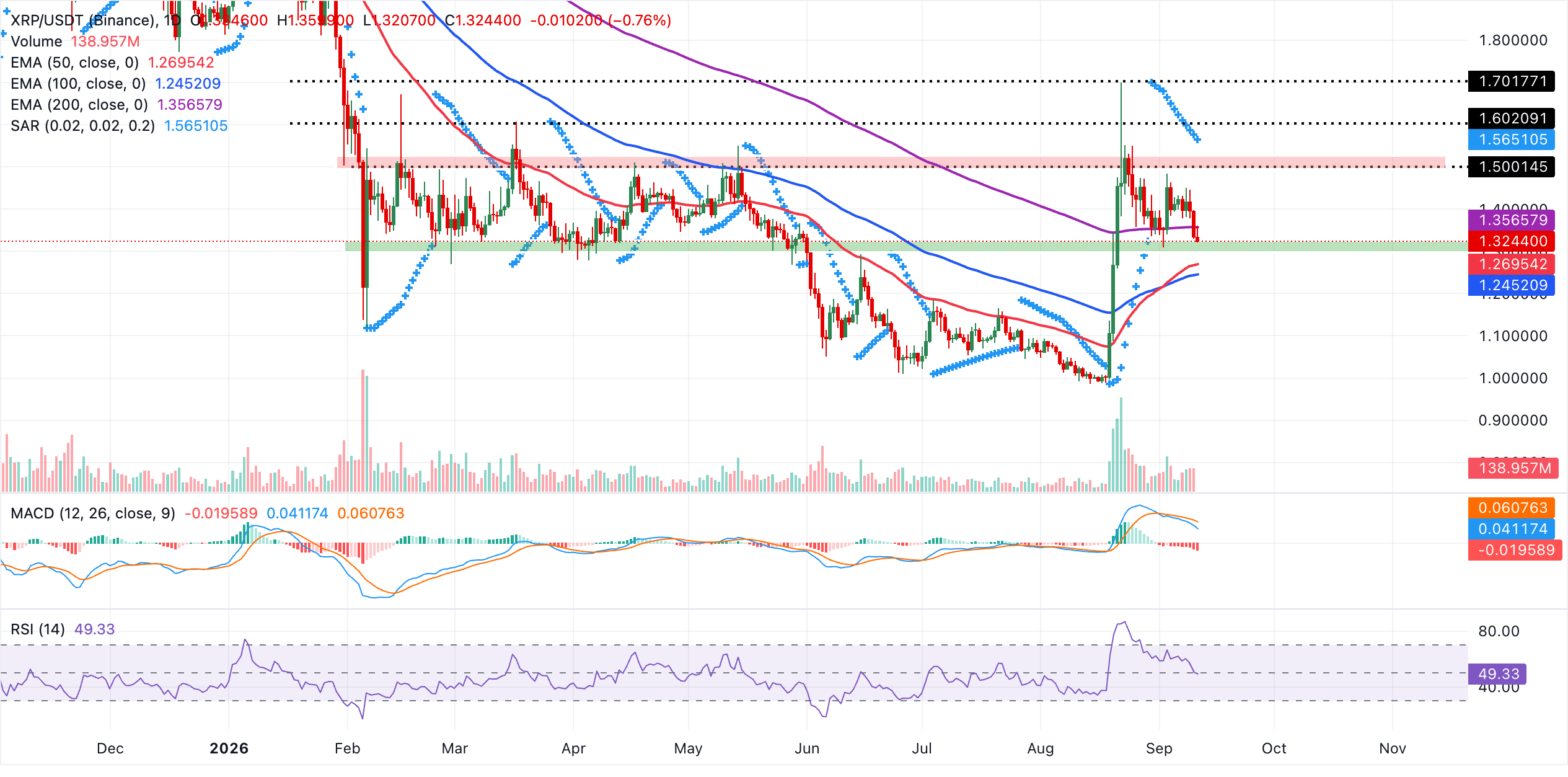
The initial resistance level is identified at the 200-day EMA around $1.36, with a stronger hurdle at the Parabolic SAR near $1.57. A daily close above the 200-day EMA would be essential to alleviate the current downward pressure. On the downside, immediate support is seen at the 50-day EMA at $1.27, followed by the 100-day EMA near $1.25. A sustained drop below these levels could pave the way for a deeper corrective trend.
(This technical analysis was supported by AI technology. Learn more.)
Frequently Asked Questions about Crypto ETFs
An Exchange-Traded Fund (ETF) serves as an investment product that tracks the price of an underlying asset. ETFs can follow not only individual assets but also a collection of assets and sectors. For instance, a Bitcoin ETF tracks the price of Bitcoin. ETFs enable investors to gain exposure to specific assets.
Indeed. The US Securities and Exchange Commission approved the first Bitcoin futures ETF in October 2021. So far, seven Bitcoin futures ETFs have been sanctioned, with over 20 awaiting regulatory approval. The SEC notes that the cryptocurrency sector is still emerging and vulnerable to manipulation, leading to delays in the approval of crypto-related futures ETFs in recent years.
Yes, the SEC approved the listing and trading of several Bitcoin spot Exchange-Traded Funds in January 2024, facilitating access for institutional investors and mainstream audiences to trade the primary cryptocurrency. This decision was hailed as a transformative moment within the industry.
The primary advantage of crypto ETFs is the ability to gain exposure to cryptocurrencies without needing to own them, thus lowering the risk and expense associated with holding assets. Other benefits include a gentler learning curve and enhanced security for investors, as ETFs manage the safekeeping of the underlying asset holdings. However, a notable disadvantage is that investors do not have direct ownership of the asset—commonly expressed in crypto as “not your keys, not your coins.” Additionally, the costs associated with holding crypto can be higher since ETFs may charge management fees. Finally, although investing in ETFs mitigates the risks of holding the asset directly, price fluctuations in the underlying cryptocurrency will generally still affect the ETF’s value.
Disclaimer: This content is for informational purposes only. Past performance is not indicative of future results.