

The rise of Ethereum layer-2 solutions has been remarkable in recent years, driven by significant advancements in rollup technology that have simplified and reduced the cost of launching new chains. Rollups function by processing transactions outside of Ethereum’s primary blockchain. They aggregate numerous transactions, subsequently posting the condensed transaction data back to Ethereum for finalization and security. This approach enables applications to facilitate quicker transactions and lower fees while maintaining Ethereum as the main trust source.
This innovation led to a surge of networks utilizing various infrastructure solutions, including Optimism’s OP Stack, Arbitrum Orbit, and zkSync. However, while establishing a chain has become simpler, luring in users has proven to be a greater challenge.
“The market is saturated with too many general-purpose layer twos, which frankly don’t offer a logical product—there’s no justification for having so many iterations of the same concept,” Fisch remarked.
The statistics reinforce this perspective. Currently, the activity within Ethereum’s layer-2 ecosystem is highly concentrated among just a few networks. According to DefiLlama data, Base and Arbitrum together represent over 80% of the total value locked (TVL) in layer-2 decentralized finance (DeFi).
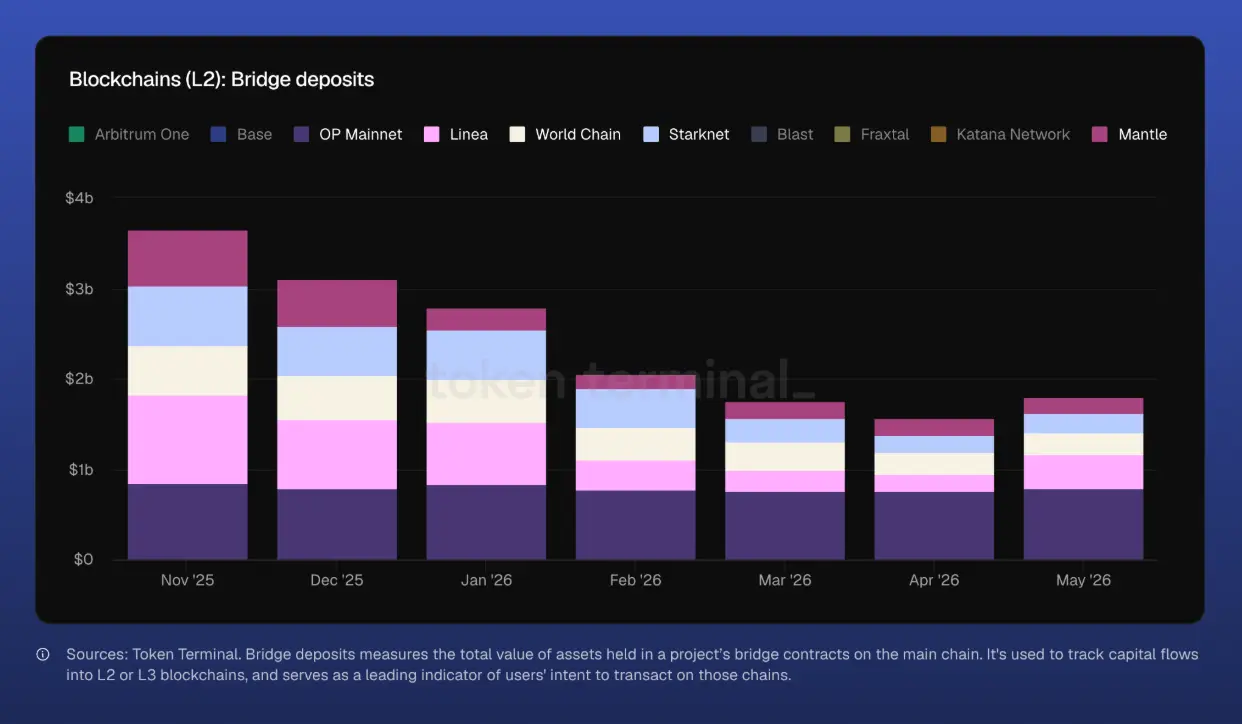
This concentration has become even more evident as smaller chains battle to keep liquidity. In the last half year, networks like Linea, World Chain, Starknet, and Mantle have experienced dwindling bridge deposits. For instance, Linea’s deposits plummeted from $976 million in November 2025 to $367 million in May 2026—a decrease of over 60%.
“I believe only a select few L2s that meet clear financial needs will be able to survive in the long run,” stated Alice Hou, a former research analyst at Messari, in a conversation with CoinDesk.