
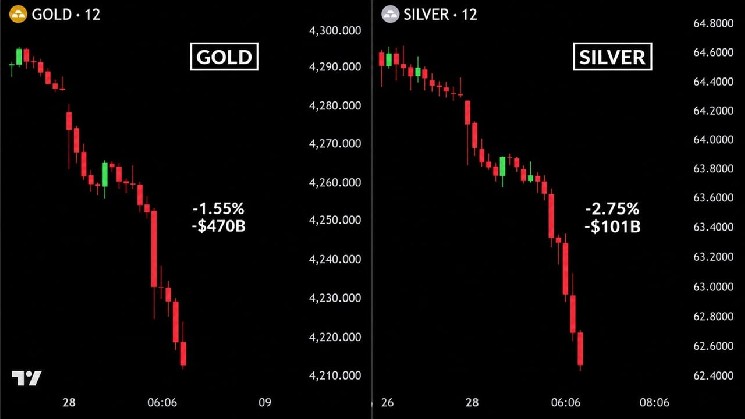
What’s Behind Gold’s Decline Amid War Threats?
This past weekend should have provided some support for gold prices. However, Iranian Foreign Minister Abbas Araghchi shared with NBC that Tehran is prepared for a “doomsday” scenario in case of an attack, following reports that President Donald Trump is considering resuming airstrikes on the nation after the midterm elections.
Interestingly, the surge in geopolitical tensions seemed to bolster oil prices rather than metals. Brent crude oil saw a rise of 2.52%, reaching $107 per barrel, which contributes to inflation. This uptick in inflation influences interest rate forecasts, with the CME Fedwatch tool indicating a 68.1% likelihood of a 25 basis point increase by the Federal Reserve in October.
The U.S. Dollar Index also rose to 101.39, marking a two-month high, while the yields on 10-year and 30-year Treasury notes settled at 5.20% and 5.51%, respectively.
Additionally, since gold does not generate interest, any rise in yields increases the holding cost for investors. Peter Schiff echoed this sentiment, stating:
Gold and silver are being pressured by escalating bond yields. The influence of these rising yields on the economy, government deficits, and inflation is, in fact, advantageous for gold and silver. Now is the time to invest.
According to Bitcoin.com News, bond yields reached a 24-year peak last week, with Schiff, Bill Ackman, and Arthur Hayes providing various insights into the reasons behind this trend.
Is Bitcoin Aligning with Gold?
This is where the bullish sentiment for bitcoin meets a challenge. Proponents have often labeled it as “digital gold,” anticipating that it would attract capital when traditional safe havens falter. However, Monday’s performance did not reflect this anticipated shift.
Bitcoin actually fell to an intraday low of $82,780, representing a 2.7% decline during the same timeframe that metal prices were dropping. At the time of writing, $BTC was trading above $83,000.
Moreover, tokenized gold, such as PAX Gold (PAXG), mirrored this downward trend, decreasing from approximately $4,276 to $4,186 during the session. Consequently, crypto traders holding gold-backed tokens experienced similar losses to those trading traditional futures.
In amidst these fluctuations, U.S. spot bitcoin exchange-traded funds (ETFs) attracted $2.39 billion last week, marking the highest weekly inflow of 2026. Furthermore, $BTC approached $85,000 over the weekend; however, this momentum waned once yields began to rise.
Bitwise highlighted a recurring trend where institutional investors regard bitcoin as a safe haven akin to gold, yet treat it like a tech asset in terms of allocation. Thus, when yields spike, both gold and tech stocks lose their appeal, causing bitcoin to trend alongside the tech sector.