
On October 1, XRP stabilized around $1.50 following Ripple’s release of 1 billion XRP, valued at approximately $1.49 billion. However, significant inflows from ETFs and the growing adoption of the XRP Ledger have yet to enable the token to breach the $1.54-$1.56 resistance zone.
Summary
- XRP remains around $1.49 as Ripple releases one billion tokens from escrow on October 1.
- Diverse U.S. spot XRP ETFs attracted $121.4 million in September, while XRP remains under the $1.50 resistance.
- CSD BR has begun reflecting BTG Pactual fund documents on the XRP Ledger while maintaining official ownership records.
- The XRPL’s LendingProtocolV1_1 amendment introduces closed-ended vaults and cash-basis accounting but still demands ongoing validator consensus.
- XRP’s RSI is above 50, and the Aroon Oscillator remains positive, though momentum has slightly declined.
According to CoinGecko, XRP is currently trading between $1.48 and $1.50, with variations noted in the last 24 hours that had it fluctuating between approximately $1.48 and $1.54, resulting in a market cap exceeding $93 billion.
This latest pricing positions XRP in the middle of a short-term trading range that emerged following its rebound in September. Buyers have consistently defended the $1.46-$1.48 level, while efforts to surpass the $1.54-$1.60 range have faced challenges.
Post-Unlock XRP Supply Increases
Onchain Lens reported that Ripple unlocked 1 billion XRP from escrow contracts just after midnight UTC on October 1, performing four separate transactions for 400 million, 300 million, 200 million, and 100 million XRP.
Whale Alert also tracked a transaction for 300 million XRP at precisely 00:00:02 UTC, estimating a value of about $446.6 million at the time, with XRP trading near $1.49. Previous XRP Ledger tracking indicated that four Ripple escrow accounts, totaling 1 billion XRP, were set for release on October 1.
It’s essential to note that the escrow release doesn’t imply that all 1 billion tokens will be sold. Ripple has a history of reallocating part of its monthly allocation back into new escrow contracts, while the remaining tokens might stay in company wallets or be used for operational needs.
Crypto news coverage discussed the nuances of Ripple’s previous 1 billion XRP unlock on September 1, revealing on-chain data but lacking clarity on how many tokens would eventually enter the trading markets.
Prior to the October transactions, XRP struggled to maintain levels above $1.50. This new unlock further adds to the supply available for traders to consider, although there’s no concrete evidence that the entire $1.49 billion value has been listed on exchanges for sell.
Continued ETF Interest Fails to Elevate XRP Beyond Resistance
Interest from institutional traders remains robust, particularly regarding U.S. spot XRP ETFs. Data from SoSoValue indicates that these products garnered $121.4 million in September, leading to total inflows of around $1.79 billion since their inception.
XRP’s price has seen a decline from the high of around $1.66 on September 23, now sitting near $1.49, which has reduced the market valuation of tokens held by these funds.
A prior analysis noted that XRP’s ETF demand and its ongoing struggle with the $1.55 resistance could mean that while inflows were significant, the price action has not reflected this activity. ETF purchases represent one layer of demand, and factors like exchange selling, derivatives trading, Ripple allocations, and actions from existing holders can contribute to the sales side of the market.
Hugo Philion, co-founder of Flare, expressed his frustration over XRP’s subdued response following new institutional news related to Brazil. He referred to the market’s reaction to the announcement as “lunacy.” His statement reflects personal sentiment and does not imply a direct demand increase for XRP due to the Brazilian project.
Integration of XRPL Within Regulated Brazilian Market Infrastructure
On September 29, Ripple announced that CSD BR had begun utilizing the XRP Ledger to enhance the record-keeping and auditing process for Brazilian financial assets, starting with shares of investment funds from BTG Pactual.
CSD BR oversees registration, depository, and settlement operations for assets totaling over BRL 22 trillion. In the initial phase, shares from BTG Pactual funds are being tokenized under XRPL’s Multi-Purpose Token standard and mirrored on the public ledger. Meanwhile, existing CSD BR systems continue to function as the official reference for ownership and registration.
The project does not involve moving BRL 22 trillion into XRP or imply direct token purchases. Ripple’s description characterizes XRPL as a supplementary record-keeping layer that authorized players can utilize to verify CSD BR’s records.
Crypto news has previously highlighted how CSD BR’s integration with XRPL represents a significant operation in a regulated context rather than just a proof of concept. Future phases may progress to issuing and trading native assets, such as Brazilian real estate or agricultural receivables.
CSD BR stated that existing procedures will remain intact during the mirroring stage as the firm assesses the technology under live conditions. Ripple’s release mentioned that the success of subsequent phases hinges on successfully validating the initial stage.
Advancements in XRPL Lending Infrastructure
Developers on the XRP Ledger are concurrently working on enhancing the network’s native lending capabilities. The XRP Ledger Foundation has issued version 3.4.0 in September, featuring LendingProtocolV1_1, which introduces functionalities for closed-ended vaults and cash-basis accounting.
Ripple’s technical guidelines describe that closed-ended vaults will operate through subscription, investment, and redemption periods. Cash-basis accounting will recognize interest as borrowers make payments rather than at the loan’s initiation.
As of now, mainnet lending is not operational. The foundational LendingProtocol and SingleAssetVault amendments still need to undergo validator voting and require ongoing network consensus for activation.
Recent analyses have similarly pointed out that simply having released the software does not make the LendingProtocolV1_1 accessible. Validator permission is a distinctly separate requirement.
The planned system intends to use off-chain underwriting for assessing borrowers, while recording fixed-term loans and pooled vault assets directly through XRPL protocol features. While activation could provide new ledger functionalities, it does not guarantee a corresponding increase in demand for XRP.
Will XRP Break Past $1.54?
A review of the daily chart displays XRP’s 14-period RSI at 55.70, down from the average of 59.27. The RSI stays above the neutral threshold of 50, although it has eased from the peaks reached in September.
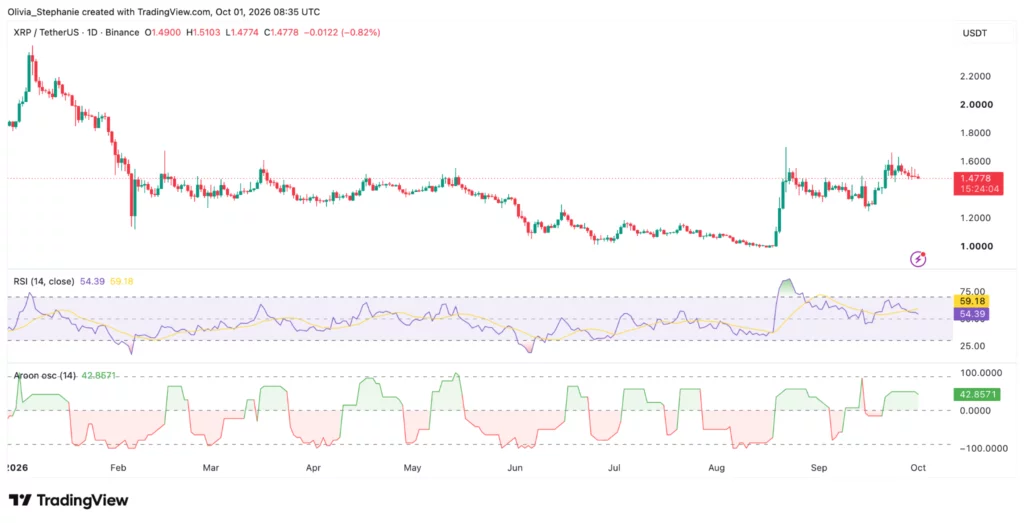
The Aroon Oscillator is also sitting in positive territory at approximately 42.86. When combined with XRP’s lateral trading near $1.50, it suggests an ongoing upward trend, albeit with diminishing momentum.
Analyst Ali Martinez identified $1.54 as a critical breakout point within a symmetrical triangle forming on the hourly chart. An hour-end close above $1.54 would validate his breakout theory, potentially leading to an expected move of around 10% towards $1.70, with $1.70 being his projected target.
In a contrasting view, analyst EGRAG Crypto discussed a broader scenario suggesting that XRP could be undergoing a macro retest after an earlier breakout. He noted that $1.64 marks the first significant level, and a weekly recovery above $1.92 would offer stronger validation of this structure. EGRAG acknowledged the possibility of XRP forming another low, a higher low, or continuing its sideways movements.
Short-term, the 1.54-1.56 range marks the primary resistance area. A sustained uptrend through that zone would direct focus back towards $1.60 and the September peak around $1.66, with immediate support found around $1.46-$1.48.
A fall below $1.46 could weaken the current consolidation phase and shift focus to lower support levels. As long as XRP maintains above this threshold with the RSI over 50, it will likely stay within its current trading band until clearer movements from buyers or sellers occur.
Disclosure: This article is not meant to provide investment advice. The content presented on this page is strictly for educational purposes.