

Concurrently, the bands on CryptoQuant’s Bitcoin Accumulation Trend chart have started to tighten, resembling a pattern that preceded two significant price surges in 2025.
This development provides yet another positive indicator for a market that has managed to regain several essential pricing levels. However, the rarity of past occurrences makes the pattern less definitive.
Historical contractions suggest a cautious optimism
According to CryptoQuant, the latest contraction mirrors two trends in 2025, which were followed by considerable price increases, offering traders a hopeful comparison as Bitcoin enters October.
The Accumulation Trend evaluates the buying and selling behaviors of various Bitcoin holders, giving insights into whether supply is being accumulated or sold off. Historical instances of the chart’s bands narrowing have aligned with shifts in market dynamics.
One notable contraction took place between April 17 and April 20, 2025, when Bitcoin hovered around $84,000. Following this, $BTC surged toward $109,000. Another contraction was observed between March 5 and March 8 before a distinct upswing.
While these occurrences are too infrequent to make reliable predictions, they highlight the significance of the current situation, especially as Bitcoin’s overall market framework has shown improvement concurrently.
Bitwise reported this week that Bitcoin has regained major cost-basis thresholds indicative of a shift toward riskier investing. These include the short-term holder cost basis near $73,000, a true market mean around $77,000, and the estimated average cost basis for spot ETF investors near $83,000.
Bitcoin has also decisively moved through Bitwise’s $85,000 short-term holder realized-price range, pushing the market into an area where maintaining gains has historically been more challenging.
Investors near breakeven pave the way to $100,000
The elimination of the $85,000 sell wall sets Bitcoin on a direct path toward another potential supply source: investors nearing breakeven after experiencing prolonged losses.
CryptoQuant analyst Darkfost estimates that $BTC holders who bought their assets 18 to 24 months ago have an average cost basis of approximately $88,350. Meanwhile, the six-to-12-month cohort has a cost basis around $89,200 and has remained in a losing position for nearly a year.
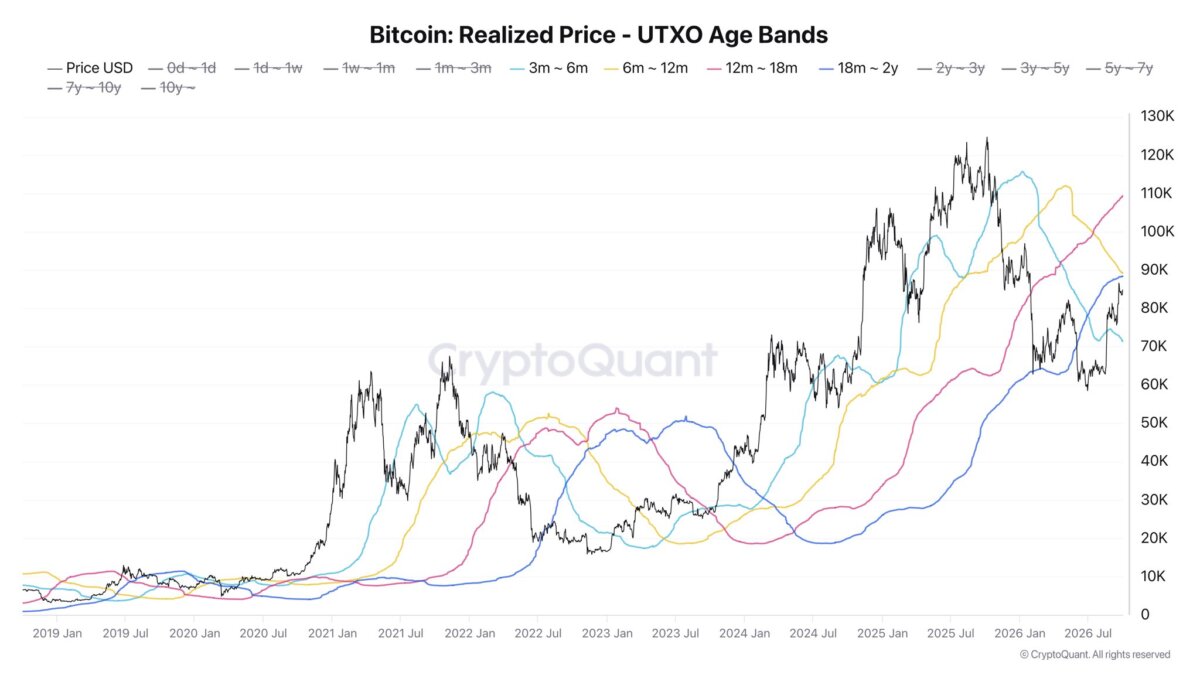
While some investors purchased above these averages and others below, as the market nears their cost bases, multiple holders must make a new decision after sustained losses.
Some may seize the opportunity to sell near breakeven, while others could choose to hold or buy more to reduce their average purchase price. The extent to which returning supply is absorbed by buyers will significantly influence whether the rally can extend past $90,000.
Additionally, Bitwise’s valuation ranges present another challenge in nearly the same zone.
The firm’s next reference level for short-term holders is approximately $90,000, or 1.5 standard deviations above the realized price, followed by the two-standard-deviation level near $95,000. Historically, Bitcoin has only traded above these thresholds about 3.8% and 1.7% of the time, respectively, in Bitwise’s past data.
Additionally, a separate Fibonacci analysis conducted by the asset manager identifies levels near $92,000 and $100,000, further intensifying the concentration of technical and on-chain indicators in this area. Bitwise referred to the region between $90,000 and $100,000 as the next key point where multiple structural indicators converge.
Options traders are also aligning their positions similarly. Data from Deribit reveals around $2.1 billion of Bitcoin call options at the $90,000 strike, $2.4 billion at $95,000, and $1.8 billion at $100,000.
This concentration of calls indicates a strong demand for upside exposure as Bitcoin inches closer to these strike prices.
The impact on the spot market will depend on expiration timelines and dealer hedging practices, but the current positioning illustrates that traders are committing substantial capital to a move within the same $90,000 to $100,000 range underscored by on-chain valuation metrics.
Renewed leverage as macro pressures ease
Bitcoin is approaching this supply zone with increased speculative interest, bolstered by Friday’s US employment report that provided a new macro boost for risk assets.
Bitcoin’s open interest dipped to roughly $52 billion as September ended, but derivatives activity has started recovering, rising to about $56.2 billion in the first couple of days of October, according to CoinGlass data.
This near $4.2 billion uplift coincided with Bitcoin’s rise from approximately $83,500 to just above $87,000.
This rebound suggests that traders are rebuilding their exposure after trimming positions at the end of September. With open interest increasing alongside Bitcoin’s price, new positions are being opened, although this figure alone doesn’t specify whether traders are long or short.
Open interest for Bitcoin ended September close to its lowest point in a year, allowing for speculative activities to revive without immediately reverting to previous extremes. Nevertheless, rising funding costs could make long positions pricier to manage and increase their exposure if a rally reverses.
The macro landscape appeared to improve on Friday after US employers added only 29,000 jobs in September, considerably below economists’ predictions of 90,000. The unemployment rate also ticked up from 4.1% to 4.2%, and revisions lowered August’s payroll growth.
This report dampened expectations that the Federal Reserve would raise interest rates again during its October meeting, leading to lower Treasury yields and a boost for US equities. Following the data, futures markets placed the probability of an increase in October under 20%.
This alleviates one immediate threat to Bitcoin’s upward movement, though the more challenging examination lies within the crypto market itself.
A consistent movement past $90,000 would bring Bitcoin into territory that Bitwise already identifies as historically elevated relative to recent investor cost bases. Taking a step toward $95,000 would push it into a category that’s exceeded on less than 2% of the days in the firm’s historical data, compelling buyers to manage both resurgent holder supply and increasingly costly leveraged positions.
If Bitcoin fails to break through this barrier, focus may shift back to the $83,000 mark, where Bitwise identifies the average ETF investor cost basis and the first major downside level that bulls must defend.