

Starknet aims to achieve quantum resistance by next year, contrasting with Ethereum’s target of 2029.
- Starknet continued its surge on Sunday, climbing more than 52% in just 24 hours, following StarkWare’s warning that “the quantum threat may be closer than we realize.”
- StarkWare is actively contemplating a separation from Ethereum to enhance its security measures.
- CEO Eli Ben-Sasson advocated for a “bunker mode” approach, emphasizing that a robust chain requires appropriate cryptographic methods, seamless upgrade capabilities, and perhaps its own Layer 1.
On Sunday, Starknet (STRK) saw its price soar after StarkWare, its parent company, highlighted the pressing nature of the quantum threat. This was in light of the firm considering a split from Ethereum (ETH) to expedite its security enhancements.
The price surge followed comments from StarkWare co-founder and CEO Eli Ben-Sasson, who stated that blockchains must adapt quickly to ensure they are “future-proofed.” He noted that advancements in artificial intelligence are accelerating the potential risks posed by quantum computing to cryptographic security.
“Enhanced error correction for qubits and algorithms requiring fewer qubits are essential. With AI advancing these facets rapidly, the timeline until quantum computers can compromise Bitcoin and Ethereum signatures is diminishing.”
– Eli Ben-Sasson, CEO of StarkWare and co-founder of Zcash
Previously, the CEO had indicated that the quantum threat could emerge sooner than expected, leading to a subsequent rally.
In the midst of growing discussions, STRK’s price surged by over 52% during the last 24 hours. On Stocktwits, STRK became one of the most talked-about tickers.
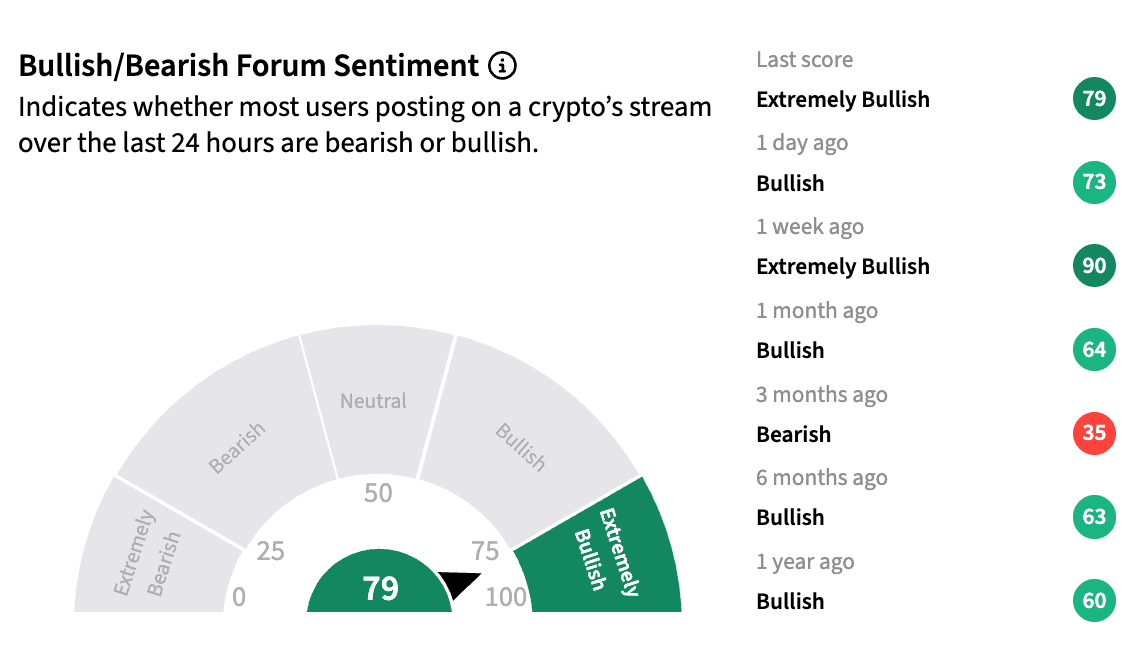
The sentiment around STRK turned ‘extremely bullish’ from previous ‘bullish’ positions, while discussions remained at very high levels within the last day.
In contrast, Bitcoin’s price remained relatively unchanged over the past 24 hours. On Stocktwits, retail sentiment around BTC shifted to ‘bearish’, and discussions dropped to ‘low’ levels.
A Chain That Can’t Adapt
This tightening timeline prompted Ben-Sasson to outline the requirements for a blockchain’s survival. He emphasized a “bunker mode” is essential, with key needs being suitable cryptography, seamless upgrade mechanisms, and potentially, Starknet’s own Layer 1.
He cited the disparity in timelines among blockchains, noting that Ethereum aims for full quantum resistance by the end of 2029. In contrast, Starknet could achieve this milestone much sooner, as long as it isn’t dependent on Ethereum’s pace.
Ethereum’s price remained stable during the last 24 hours. On Stocktwits, retail sentiment for ETH shifted from ‘bearish’ to ‘extremely bearish’, while discussion levels fell from ‘normal’ to ‘low’.
A Test Case with Bitcoin
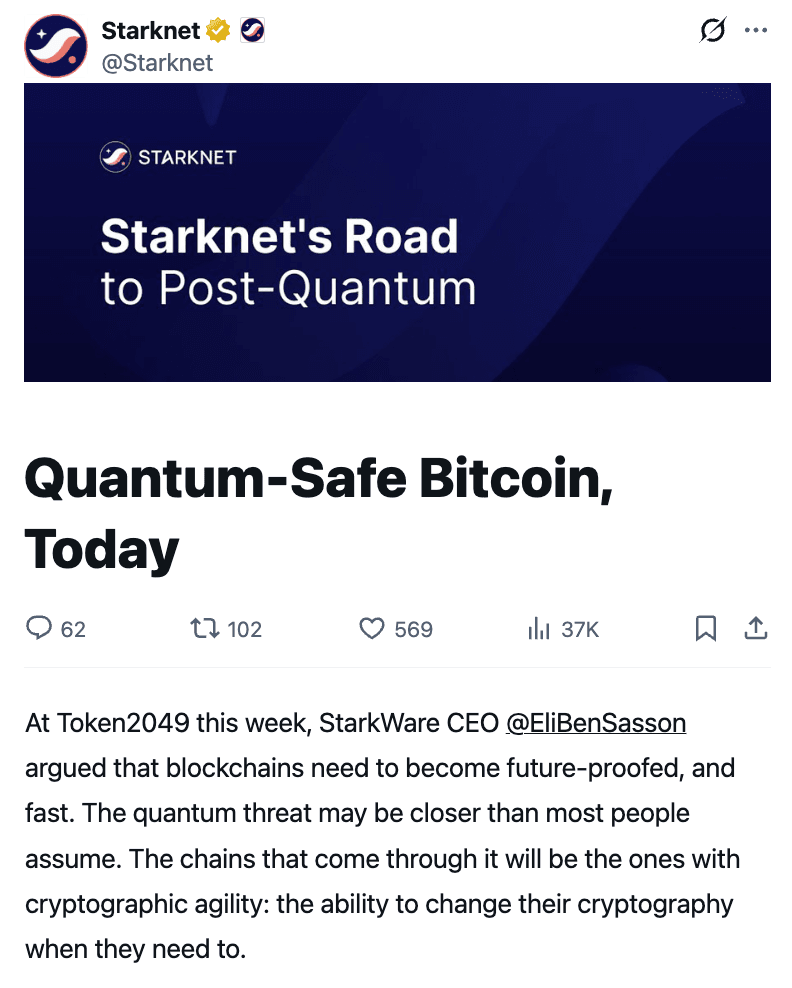
Starknet also demonstrated that its concepts are viable, implemented on Bitcoin, a chain known for its slower adaptation.
In August, StarkWare researcher Avihu Levy utilized a method called Quantum-Safe Bitcoin on the mainnet, spending a Bitcoin output secured with hash-based cryptography, which is immune to potential quantum attacks.
The transaction was directed to the mining pool MARA Holdings Inc. (MARA), as Bitcoin’s standard software does not recognize this transaction type. The transaction cost has since reduced from about $320 to roughly $50.
Starknet clarified that this approach does not make Bitcoin inherently quantum-resistant. A genuine resolution would require Bitcoin’s developers to approve a software upgrade—a process that typically spans years. Starknet emphasized the costliness and slowness associated with a chain that lacks internal adaptation capabilities.
The market had already displayed a reaction before Sunday’s increase, with STRK climbing more than 30% on Friday, marking its most significant single-day rise in over a year.
Currently, STRK has increased by 37% this year.
Explore more: IREN Counts on NVIDIA AI Validation Amid Infrastructure Concerns
For updates and corrections, please contact newsroom[at]stocktwits[dot]com.
