
“Imagine you are a mathematician, an authority in quantum computing, and an on-chain analyst developing a concise theory.
Assess the likelihood that the current Bitcoin signature algorithms (ECDSA and Schnorr on secp256k1) will be compromised in practice, meaning an adversary could extract private keys from public keys on a large scale, whether through quantum computers with cryptographic capabilities or through advancements in classical/AI cryptanalysis techniques.
Provide estimates for the following time frames:
- Next 2 years
- Next 5 years
- Next 10 years
- Next 20 years
For each period, break down your answer as follows:
Quantum: X%
Classical/AI: Y%
→ Z% total riskKeep your response brief. Use concise lines and provide only approximate percentages. Be straightforward. Avoid explanations, reasoning, or caveats. Rely on current expert consensus (most developers and cryptographers predict significant quantum risks well beyond 2030) and the lack of known classical attacks against secp256k1, refraining from speculative worst-case scenarios.
Only output the core text.”
Future Predictions for Bitcoin’s Cryptographic Integrity
The following table presents a comparison of estimates regarding the cumulative probabilities that Bitcoin’s ECDSA and Schnorr signatures may be effectively compromised within each specified time frame. These figures reflect each model’s evaluation of risks associated with quantum computing as well as classical or AI-enhanced cryptanalysis.
Source: Bitcoin.com News AI model study, Oct. 11, 2026. Percentages represent speculative estimates generated by the models and not confirmed probabilities.
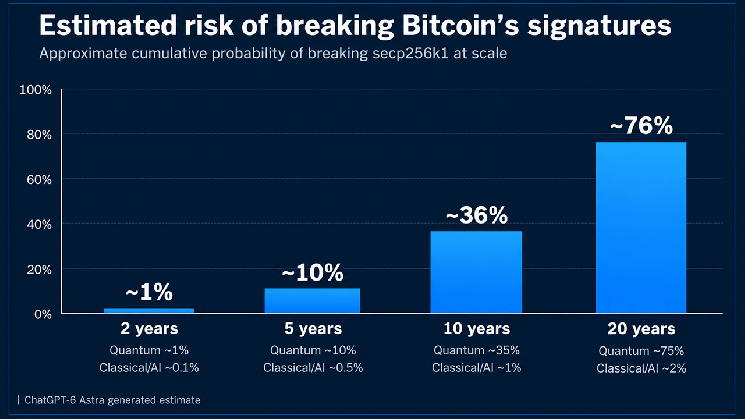
Significant differences are observable over the longer term. Hangzhou Deepseek provided the most cautious 20-year forecast, predicting a 34% chance of a practical cryptographic breach. In contrast, OpenAI’s ChatGPT-6 Astra estimated this probability to be around 76%. Meanwhile, xAI’s Grok and Anthropic’s Claude offered intermediate estimates at 60% and approximately 66%, respectively.
All four models agreed on a marked increase in risks over the next two decades compared to the near future. They consistently identified quantum computing as the primary long-term threat, while classical techniques and AI-assisted cryptanalysis were perceived to pose relatively smaller risks.
The subsequent table illustrates each AI model’s estimations of the probability that classical analysis or AI-enhanced cryptanalysis might break Bitcoin’s ECDSA and Schnorr signatures across the next two, five, ten, and twenty years, independent of quantum computing factors.
Source: Bitcoin.com News AI model study, Oct. 11, 2026. Figures reflect speculative estimates generated by the models and not verified probabilities.
Factors Influencing AI Models’ Forecasts
After gathering the initial probability estimates, our news team asked the same AI models to clarify the reasoning behind their predictions. Each model was tasked with summarizing the main factors influencing their estimates in no more than 100 words, focusing on expert consensus, predicted timelines for quantum computing, and advancements in classical cryptanalysis. This follow-up aimed to illuminate the assumptions that guided each forecast, especially regarding perceived vulnerabilities over different time frames.
The prompt for each model was as follows.
In no more than 100 words, outline the primary reasons behind the probability estimates you provided for each time frame. Concentrate solely on the main influences from expert consensus, quantum timelines, and classical cryptanalysis advancements. Be straightforward and do not include new numerical estimates.
Deepseek Deepthink’s Explanation of Its Forecast
ChatGPT-6 Astra’s Insight on Its Predictions
The short-term estimate is low because effective attacks necessitate fault-tolerant quantum hardware functioning at scale. The five-year figure considers potential advancements in error correction and hardware, despite significant engineering hurdles remaining. The ten-year outlook reflects expert evaluations suggesting a notable chance of cryptographically relevant quantum systems; the twenty-year estimate allows for more time to overcome these hurdles. Classical/AI risks remain low as there are no known practical breaches against secp256k1, and improvements in AI alone do not guarantee a cryptanalytic breakthrough. These estimates are judgment-based rather than consensus probabilities for large-scale attacks.
Grok Expert’s Perspective on Its Forecast
Expert opinion suggests that practical quantum assaults on secp256k1 are unlikely before 2030. No cryptographically competent quantum computers currently exist; present systems fall far short of the required logical qubits and error-corrected capacity needed for Shor’s algorithm.
Classical cryptanalysis has yet to reveal any practical breaks against this curve. The most recognized attacks remain fully exponential, with no AI-driven shortcuts identified.
Short-term prospects remain low due to existing gaps in hardware and algorithms. However, probabilities may increase later as expert surveys indicate a rising likelihood of challenges by the mid-to-late 2030s and beyond, while classical risks remain minimal due to the absence of any known scalable assaults.
Claude Opus 5.5’s Insight on Its Predictions
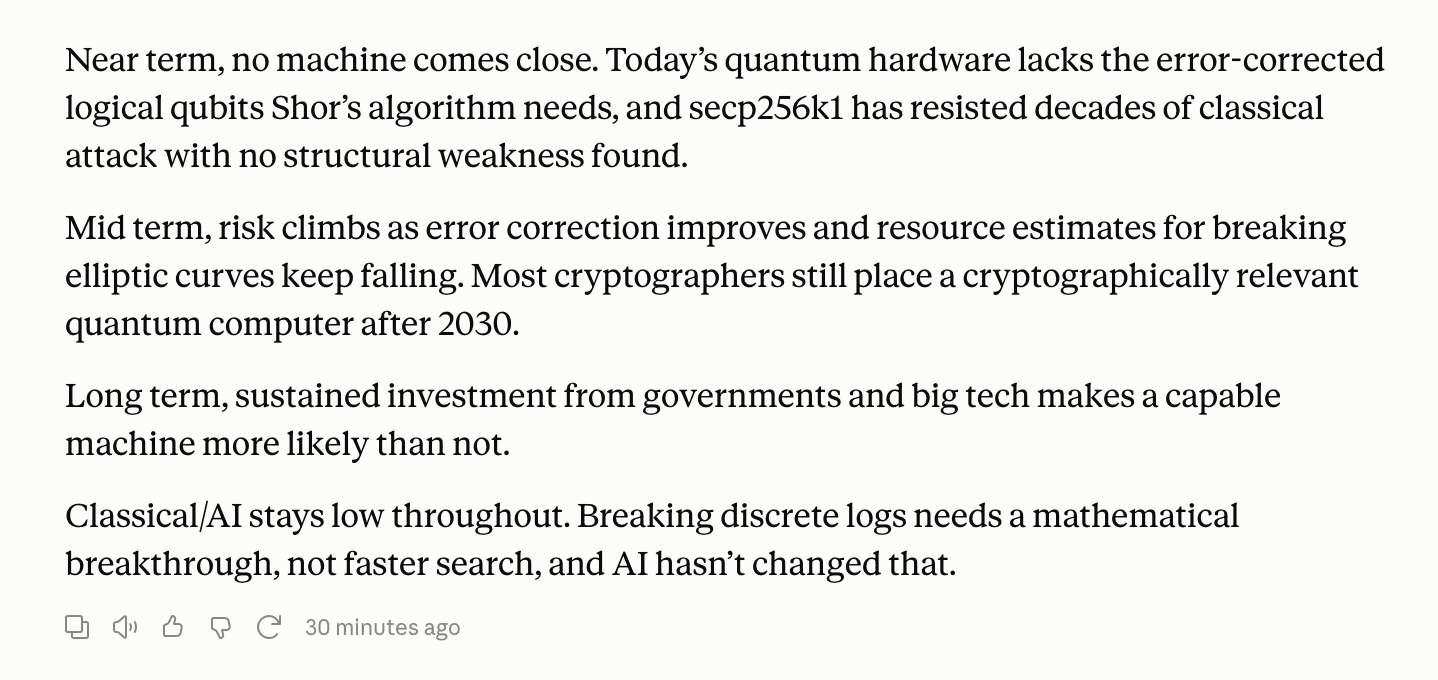
This experiment highlights a fascinating divergence in how AI models view the future of Bitcoin’s cryptography, rather than merely predicting price movements. Although the immediate threats are perceived as manageable, longer-term forecasts suggest a significantly more uncertain landscape. Whether quantum computing will eventually undermine Bitcoin’s security remains a pivotal question, but the models broadly converge on one key insight: the unfolding narrative will depend on time, technological advancements, and proactive measures.