
Flare is developing a decentralized finance (DeFi) ecosystem utilizing FXRP, based on XRP, to facilitate activities like lending, staking, trading, and earning yields.
Contents
Flare (FLR) Expands Its XRP DeFi Ecosystem
As of May 2026, the network boasts approximately $200 million in XRP Total Value Locked (TVL) and has facilitated over 3.4 million FXRP transactions in DeFi. Future updates will incorporate institutional lending and on-chain derivatives into the XRFi ecosystem.
Why XRPFi is Central to Flare’s Growth Strategy
Unlike other DeFi platforms, XRP lacks an integrated smart contract framework, making Flare’s XRPFi initiative essential for creating decentralized products for lending, staking, and liquidity using XRP.
The program now includes several protocols such as Morpho, which facilitates modular lending using XRP, and Firelight to enhance staking opportunities. This multi-faceted approach allows XRP to be utilized across various financial applications on the Flare network, rather than being limited to a single DeFi solution.
Read More: Could Solana Reach $200 by 2026? Three Key Catalysts That Could Propel SOL Higher
Introducing FXRP to the DeFi Landscape
Flare’s FXRP is a 1:1 tokenized representation of XRP that is issued in a secured format through FAssets, thereby enabling the use of XRP in DeFi activities such as lending and trading.
The latest update, FAssets v1.3, simplifies the minting process, allowing XRP transactions to be executed directly on the XRP Ledger with the option of using destination tags and memos. This improvement aims to facilitate smoother integration with various wallets, custodians, and exchanges.
| Metric / Area | Current Status | Relevance |
| FXRP Minted | Over 155 Million since inception | Indicates growing involvement of XRP in Flare |
| FXRP Utilization in DeFi | Approximately 85% as of April 2026 | Reflects active deployment of minted FXRP |
| XRP TVL | About $200M as of May 2026 | Measures the amount of XRP capital in use within the ecosystem |
| FXRP Transactions | 3.4 Million+ as of May 2026 | Shows on-chain utilization beyond mere asset holding |
| Primary FXRP Use Cases | Lending, staking, liquidity providing, yield, derivatives | Broadens XRP’s utility in DeFi |
| Major Ecosystem Protocols | Morpho, Firelight, Spectra, earnXRP | Offers various options for XRP-focused strategies |
Accelerating Expansion of Flare’s XRPFi
The Flare DeFi ecosystem focusing on XRP has witnessed remarkable growth in 2026, with FXRP actively engaged in cross-chain bridging, lending, staking, yield vaults, and derivative services. As of April 2026, over 150 million FXRP tokens were reported in circulation, with new integrations continuously enhancing DeFi use cases.
FXRP Supply Exceeds 150 Million
By April 2026, approximately 150 million FXRP had been minted, with 85% reportedly utilized in DeFi transactions. By August, it was noted that 155 million FXRP token had been issued since the launch.
This achievement illustrates the increasing adoption of FXRP, while the records on the FAssets page confirm that most of the minted FXRP in the initial months were actively used in DeFi rather than being stagnant on-chain.
Yield Products Propel New Demand
A pivotal aspect of Flare’s XRPFi growth is its yield products. The earnXRP vault, initiated by Upshift, Clearstar, and Flare, takes deposited FXRP and employs it for liquidity generation and collateralized lending, with returns compounded into XRP.
Access has expanded with wallet integrations. Recently, Flare announced that D’CENT users could deposit XRP into specially curated Flare vaults using Smart Accounts, with similar options available via Xaman integration.
Flare Aims for Billions of XRP in DeFi
Flare’s long-term vision anticipates a much larger influx. In August, a report indicated CEO Hugo Philion’s aspirations to incorporate 5 billion XRP into the Flare Network within six months, in sharp contrast to the 155 million FXRP already created.
This ambition signals a significant gap between current WXRP usage and the expectations set forth for Flare Network, emphasizing the need for a substantial increase in DeFi activities.
FXRP Gains New Utility Across DeFi
FXRP functionality has been expanded beyond merely ferrying XRP into the new EVM ecosystem, now encompassing activities like lending, liquidity provision, yield strategies, and collateral for derivatives. The XRPFi portal tracks over 122 million XRP-equivalent tokens associated with FXRP in DeFi.
FXRP Serves as Collateral for Options and Perpetuals on Derive
As of August 2026, FXRP has been incorporated as collateral for XRP options and perpetual contracts on the Derive platform. FXRP can be utilized as collateral through the portfolio margining system, providing opportunities for unregulated hedging and derivatives involving XRP. Notably, the options are settled in USDC▼$0.9998 and are not physically settled in XRP.
FXRP holders can also utilize this tool to sell options for premiums or hedge their XRP positions with protective puts, assuming relevant margins and market risks.
Liquidity for XRP Expands Across Flare’s DeFi Protocols
FXRP liquidity is distributed across several platforms: SparkDEX and Enosys for liquidity provision, Kinetic for lending and borrowing, Firelight for staking, and Spectra facilitating yield markets. Additionally, as of February 2026, Morpho launched modular lending for XRP on Flare.
The FXRP liquidity pool has also spread beyond Flare, with FXRP spot markets introduced on Hyperliquid, such as FXRP/USDC and FXRP/USDH, extending the reach of XRP-linked liquidity into another trading environment.
Increasing Institutional Access to FXRP
The infrastructure supporting institutional access to FXRP continues to evolve. In February, Hex Trust expanded its collaboration with Flare to facilitate institutional minting and redemption of FXRP, along with governance and compliance functionalities.
In August, FXRP was leveraged as a collateral asset on Morpho through Sentora’s institutional-managed RLUSD▲$1.0000 main vault. The FXRP/RLUSD market allows users to borrow RLUSD against FXRP collateral on Ethereum without liquidating their XRP assets, enhancing FXRP’s liquidity provisions for institutional investments.
Could XRPFi Boost Demand for FLR?
While an increase in XRPFi could enhance Flare’s overall activity, it does not guarantee that such activity will lead to greater utility for FLR. To fortify this connection, Flare proposed a series of amendments to the Network in April 2026. This proposal, termed FIP.16, received approval on April 24.
How FLR Supports the Flare Ecosystem
FLR serves as the native currency for the network, utilized for transaction fees, governance, and staking for validators as well as delegating to the Flare Time Series Oracle. The token also undergoes a burn mechanism to limit supply and enhances security within the proof-of-stake framework.
The FIP.16 proposals seek to tie ecosystem revenues to FLR’s economic model by reducing inflation from 5% to 3%, with a portion of revenue, up to 15%, allocated to lower inflation and token burns.
Staking, Network Activity, and FLR’s Role
FLR staking will become accessible to existing token holders following the FlareDrop distribution, which concluded on January 30, 2026. Protocol-level staking and FTSO delegation remain in motion. In February, Hex Trust commenced offering native FLR staking services to its clientele.
Increased technical engagement could potentially enhance fee burning, since transaction fees on the Flare Network must be paid in FLR. The measures outlined in FIP.16 may further bolster this relationship through the allocation of protocol revenues into the network’s economic growth.
Why FXRP’s Growth Doesn’t Necessarily Translate to Higher FLR Demand
Moreover, using FXRP does not compel users to purchase a corresponding amount of FLR tokens. Flare has indicated that the protocol has reduced the necessity for FLR collateral in FAssets compared to its initial design, thus diminishing its previous role in the framework.
This is a critical consideration when evaluating the implications of increased XRPFi transactions on FLR’s demand. Although FXRP utilization may bring about added utility and revenue for Flare, its effect on FLR is contingent on various economic parameters such as fee burning, the staking model, and the FIP.16 outcomes. Consequently, growth in XRPFi doesn’t automatically equate to an increase in FLR prices.
Indicators of Flare’s Latest XRPFi Growth
In recent months, Flare’s XRPFi infrastructure has expanded, with the earnXRP vault’s capacity increased several times alongside new integrations for lending, derivatives, and institutional-grade collateral for FXRP.
Clearstar’s earnXRP Vault Expands Its Capacity
Initially launched in December 2025 with a cap of 5 million FXRP, Clearstar’s earnXRP vault has since been enhanced, increasing the limit to 45 million FXRP after new borrowing avenues were developed. This allows more FXRP to be utilized for lending instead of remaining static in the earnXRP vault.
This is advantageous because earnXRP combines various strategies, aggregating successes that result in returns paid in XRP, with Clearstar managing the strategy alongside Upshift.
Read More: Why Is Zora Crypto Experiencing a Decline? Token Unlock and Coinbase Delisting Add Pressure
Flare Continues Integrating DeFi and Institutional Solutions
As of 2026, the ecosystem has made substantial additions, including FXRP lending markets on Morpho, enhanced FXRP institutional minting and redemption through Hex Trust, and using FXRP as collateral on Derive for XRP options and perpetuals.
In an important advancement, FXRP was acknowledged as collateral in Sentora’s $280 million RLUSD Main vault on Morpho in August, permitting users to borrow RLUSD against their FXRP without liquidating their XRP investments.
Implications of Increased FXRP Activity for Flare
The growth of FXRP supply enables larger amounts of XRP-backed capital to be employed across smart contracts, which encompasses various activities such as lending, yield generation, spot trading, and collateral agreements. This development signifies a substantial increase in economic engagements linked to smart contracts on Flare.
However, despite high activity levels, it does not unequivocally indicate that growth is imminent. Reports have highlighted that only 155 million FXRP has been minted vis-a-vis the ambitious target of 5 billion XRP set by Flare CEO Hugo Philion for ecosystem usage.
| XRPFi Developments | Latest Reported Metrics | Significance |
| EarnXRP Vault Capacity | Raised from 5M to 45M FXRP | Increases opportunities for yield strategies based on XRP |
| FXRP Minted | 155M since initiation, reported as of August 2026 | Serves as an indicator of FXRP’s adoption levels |
| Morpho Integration | Introduced FXRP lending markets | Expands utility for both borrowing and lending |
| Hex Trust Integration | Enables institutional FXRP minting and redemption | Broadens access for institutional participants |
| Derive Integration | Utilized FXRP as collateral for options and perpetuals | Adds new avenues for derivatives trading |
| Sentora RLUSD Vault | FXRP accepted as collateral | Facilitates borrowing against FXRP |
| Long-Term XRP Target | 5B XRP envisioned by Flare CEO | Highlights the disparity between existing usage and Flare’s objectives |
FLR Price Analysis: Can Flare Surpass $0.01?
Currently, the FLR token trades below the critical psychological level of $0.01. As noted by CoinMarketCap, its price hovers around $0.007, which is consistent with a snapshot price of approximately $0.006864. In order to reach the $0.01 mark, a 43% increase is necessary from this level.
Recent Performance of FLR Prices
After an unstable period in August, the FLR token started September at around $0.00588 on August 18, 2023. By the month’s end, the price had reclaimed the $0.007 mark. Currently, FLR is valued around $0.0071, with CoinGecko indicating a significant percentage increase within a 24-hour period.
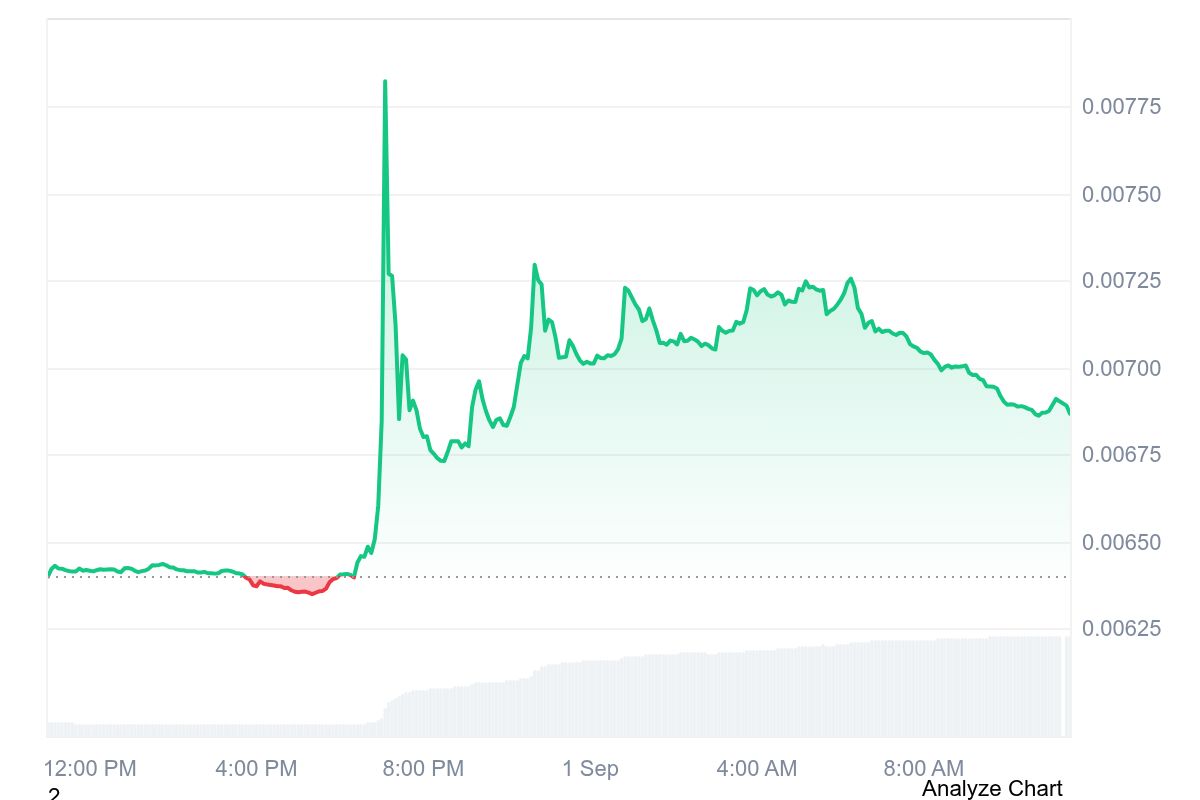
Prior to this recover, the token reached its lowest point at $0.005858 on August 19, remaining over 90% down from its peak in January 2023.
Significance of the $0.01 Resistance Level
The $0.01 price level is widely regarded as a crucial psychological milestone. Although it does not represent a definitive technical resistance level, prices dipped below $0.008 and briefly crossed above $0.0081 on Gate.io, achieving this on August 31.
This distinction is crucial when considering FLR’s potential to reach $0.01. The token must first recover from its current range; historical price actions indicate that $0.01 is not a level frequently tested and successfully breached.
Criteria for a Credible Breakout Above $0.01
Simply crossing the $0.01 threshold does not signal a true breakout unless FLR can maintain this position without quickly retracing back below it.
Additionally, one should observe volume levels. Although there has been an uptick over 24 hours, relying on a single day is insufficient. Thus, any FLR price forecast should differentiate between a temporary price spike and sustained levels above $0.01.
What Factors Could Propel FLR Above $0.01?
Hitting the $0.01 milestone would necessitate a notable uptrend from its current valuation, though no discernible catalysts have emerged thus far. The primary influences identified include increased adoption of XRPFi and augmented liquidity for FXRP within the ecosystem, along with favorable market conditions.
Strengthening XRPFi Adoption
Enhanced use of XRPFi could potentially stimulate greater activity in Flare. By May, Flare managed an approximate TVL of $200 million in XRP, with over 3.4 million FXRP DeFi transactions processed by around 16,500 users. Since then, FXRP has served as collateral for derivatives trading on Derive and for institutional lending through Sentora’s RLUSD vault.
For Flare’s price trajectory in 2026, beyond ecosystem advancements, Flare has indicated that improving economic ties between XRPFi activities and FLR are essential for sustainable growth of the token.
FXRP has demonstrated significant growth, with Flare reporting the minting of over 155 million FXRP since its inception. The dashboard for XRPFi currently indicates approximately 149.4 million XRP on Flare and around 122.2 million XRP in DeFi TVL.
An increase in FXRP supply and active liquidity suggests XRPFi is attracting capital, but this does not automatically translate into higher demand for FLR.
Broader Altcoin Market Trends
Market conditions have also evolved. Bitcoin experienced significant gains, marking its best month since November 2024 with a 24% rise in August, while other cryptocurrencies showed mixed responses as they entered September, including BTC▲$77,666.00 surpassing $78,000, accompanied by declines in Ethereum, Solana, and Dogecoin over 24 hours.
This ongoing rotation to altcoins could present a favorable environment for smaller cryptocurrencies like FLR, but without a risk-on sentiment, positive Flare developments may not be sufficient to push FLR above the $0.01 threshold.
| Potential Catalyst | Current Indicator | Impact on FLR |
| Increased XRPFi uptake | ~$200M TVL; 3.4M+ FXRP transactions | May amplify Flare’s network activity |
| Growing FXRP supply | 155M+ FXRP generated in initial seven months | Demonstrates increasing XRP integration in Flare |
| DeFi liquidity escalation | ~122.2M XRP-equivalent in DeFi TVL | More committed capital could deepen the XRPFi ecosystem |
| Emerging FXRP utility | Derive derivatives, Sentora lending collateral | Expands FXRP’s overall DeFi application range |
| Enhanced FLR value accrual | Flare aims to strengthen ties between activities and FLR economics | Could align ecosystem expansion with token demand |
| Overall altcoin rally | Current market conditions remain varied | Improved risk appetite might create a more supportive landscape for FLR |
What Factors Might Hinder FLR from Exceeding $0.01?
Despite the ongoing expansion of XRPFi, FLR’s price might encounter challenges in surpassing $0.01 due to excess token emissions, the absence of synergy between XRPFi advancements and FLR’s value proposition, and unfavorable conditions for smaller-cap altcoins.
FLR Supply and Selling Pressure
Currently, FLR is in an inflationary state. The FIP.16 proposal introduced in April suggested a reduction in the annual inflation rate from 5% to 3%, capping it at 3 billion FLR instead of the previously projected 5 billion. This plan also encapsulates various strategies for lowering supply, including the burning of fees and the FIRE initiative to generate revenue from network usage.
While these measures may limit future supply, their short-term impact will be negligible as FIP.16 is implemented gradually. Future supply balances, burns, staking, and demand will all be crucial factors to consider when forecasting Flare’s token price.
XRPFi Growth May Not Translate to FLR Demand Growth
Flare has indicated that these enhancements have led to greater efficiency for FAssets, decreasing the amount of FLR needed compared to the initial system architecture. The introduction of a stablecoin collateral and Core Vault has also made FAssets more secure and capital-efficient, further detaching economic demand for FXRP from demand for FLR. The FIP.16 changes aim to strengthen this connection, but it highlights the independence of FXRP growth from proportional purchasing pressure on FLR. By May, the reported XRP TVL and FXRP transactions were around $200 million and 3.4 million, respectively, although this should not be misconstrued as a forecast for token performance.
Weakness in the Altcoin Market
External market conditions are posing additional hurdles. Bitcoin eclipsed $81,000 on August 28, marking its highest point in three months. However, consolidation among altcoins suggests that this Bitcoin strength hasn’t positively influenced other cryptocurrency sectors.
Unless there’s a significant boost in the liquidity of altcoins and demand for riskier assets, forecasts for FLR in 2026 may not signal substantial increases, regardless of Flare’s ongoing release of XRPFi products. If the Flare ecosystem performs favorably and demand for riskier assets rises, we might see FLR surpass the $0.01 hurdle.
Read More: HNT Price Prediction: Why Helium Crypto Surged 33% — Is $1 Next?
Flare (FLR) Price Outlook: Bullish vs. Bearish Scenarios
The future of FLR hinges on whether an increase in XRPFi activity can positively affect token economics within the protocols. The following outcomes are not price predictions: Flare has acknowledged the need for further alignment between network activity and FLR value generation.
Bull Case: XRPFi Becomes a Significant DeFi Growth Catalyst
For a bullish scenario to materialize, XRPFi must continue to attract fresh capital while maintaining robust usage within the Flare Network. As noted in April, over 150 million FXRP actively circulate, with 85% used within DeFi applications, according to Flare.
If the initiatives introduced through FIP.16 succeed—like reduced inflation and fee-burning measures designed to mitigate inflation within set limits—this could fortify the economic nexus between engaging with the ecosystem and acquiring FLR.
Base Case: FLR Could Remain Below $0.01
This scenario suggests ongoing ecosystem development with weak demand for the token, keeping FLR below the $0.01 mark over an extended period. Currently, FLR is still trading below one cent but experienced a strong recovery at the beginning of the month.
This would allow XRPFi to continue its upward trajectory while FLR remains stable. This situation is crucial for any 2026 Flare price forecast, as adoption and price appreciation are separate realities.
Bear Case: Ecosystem Growth Fails to Elevate Token Values
In this scenario, XRPFi might continue to grow in terms of user base and liquidity yet may only generate modest additional demand for FLR. Flare has indicated that the increased capital efficiency of FAssets has diminished FLR’s previous role in the system.
While FLR remains inflationary, FIP.16 proposes capping its yearly inflation at 5% and requesting further reductions to 3% over time. These precautions arise from concerns that demand may not meet the output of supply, leading to a lack of lasting price stability.
| Scenario | Conditions for Success | Potential FLR Outcome |
| Bull Case | XRPFi attracts fresh assets and FXRP usage escalates | Increased activity might support a favorable environment for FLR |
| Bull Case Catalyst | FIP.16 enhances value retention through reduced inflation and fee-burning strategies | Network revenues may link more closely with FLR economics |
| Base Case | XRPFi matures, but FLR demand remains stagnant | FLR might continue fluctuating below the $0.01 threshold |
| Base Case Signal | Growth in adoption without proportional FLR purchasing | Ecosystem and token price dynamics may not align |
| Bear Case | FXRP uses expand but yield little incremental demand for FLR | FLR could remain pressured despite XRPFi growth |
| Bear Case Risk | Inflation and new supply could outweigh demand and growth potentials | Ecosystem advancement may fail to generate sustained price support |
Can Flare (FLR) Ultimately Surpass $0.01?
Surpassing $0.01 is feasible, but there are currently no signals confirming an upcoming breakout. FLR trades around $0.0071, positioning it approximately 41% short of the crucial one-cent mark, despite posting a gain of about 12% in the last 24 hours.
Read More: Is PI Crypto Still Below $0.10: Can New Use Cases Advance the Price?
On a fundamental level, the situation has improved: over 155 million FXRP have been issued, with Flare’s XRPFi tracking dashboard currently showing roughly 122 million XRP-equivalent in DeFi TVL.
Whether this growth propels FLR beyond $0.01 will heavily depend on sustained activity in XRPFi, translating into increased demand for the native token alongside favorable broader market conditions.
FAQ
What is Flare and its purpose?
Flare is a Layer 1 blockchain designed to deliver decentralized data and smart contracts for assets such as XRP. The ecosystem can host decentralized applications (dApps) for various activities including lending, trading, staking, and liquidity provisioning.
What is FXRP and how does it function?
FXRP is a 1:1 pegged variant of XRP created within Flare’s FAssets framework, enabling XRP holders to utilize their XRP in smart-contract environments without making changes to the XRP Ledger.
Why is XRPFi essential for Flare?
XRPFi aims to position XRP as a foundational currency for a multitude of decentralized financial applications. Higher user adoption will result in more transactions and versatile applications, driving overall growth.
Does rising FXRP usage boost FLR value?
Increase in network use from FXRP additions leading to revenue growth does not necessarily correlate with FLR value uplift. It depends on revenue streams, fee structures, and benefits provided to FXRP holders.
What influences FLR’s price in 2026?
Factors impacting FLR’s price include the rate of XRPFi adoption, activity levels on the network, token issuance and burning mechanisms, DeFi liquidity, and overarching cryptocurrency market dynamics.