
Bitcoin Market Recap: Election Gains Gone, 7-Week Low in View
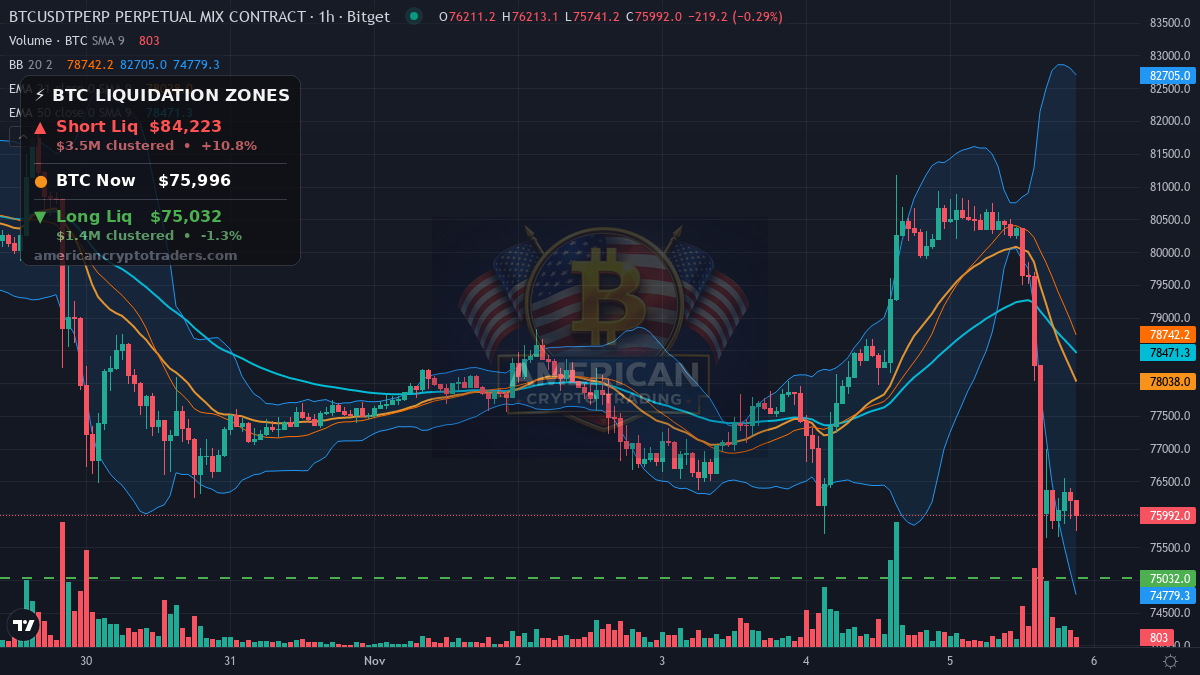
Thursday’s New York session delivered a punishing bitcoin market recap for bulls. BTC shed 5.11% to close around $75,975, touching an intraday low of $75,525 as correlated selling swept from equities straight into crypto. The 24-hour high of $80,930 now feels like a distant memory, and the broader crypto market cap fell 7.38% to roughly $2.57 trillion.
The pain was broad and deep. Every major asset on the board closed red, BTC dominance held at 59.2%, and the altcoin complex absorbed even sharper losses. When macro storms hit this hard and fast, capital does not rotate — it exits.
What Moved Markets Today
US stocks erased their post-election gains in a single session, with the S&P 500 crashing 4.36% to 7,353. The index had been riding euphoria from election-driven optimism, and today’s reversal was violent enough to trigger forced selling across risk assets globally. BTC and equities have traded with tight correlation at key inflection points throughout this cycle, and today was no exception — as institutional desks hit sell on equities, crypto bids evaporated in lockstep. The 10-year Treasury yield eased slightly to 4.84% and gold ticked up 0.64% to $4,099, but those safe-haven flows offered zero cushion for digital assets caught in the crossfire.
The Binance hack confirmation sent a secondary wave of fear through the market, compounding the equity-driven selloff. The Federal Reserve and the OCC moved quickly to assess US bank exposure to the breach, a response that underscores just how embedded crypto infrastructure has become in the broader financial system. Binance and Deribit both revoked SignalPlus API keys after a sophisticated social engineering attack — reportedly a fake Microsoft Teams invite — allowed attackers to gain access. Security incidents of this scale erode confidence at exactly the wrong moment, pushing already-nervous participants further to the sidelines and widening bid-ask spreads across spot and derivatives markets.
On the other side of the ledger, Amundi — Europe’s largest asset manager — announced the tokenization of an equity index fund on Ethereum. This is a structurally significant real-world asset development that, in a calmer market, would likely have driven ETH outperformance. Instead, ETH dropped 7.62% on the day, closing near $2,234 against a 24-hour high of $2,444. The Amundi move confirms that institutional RWA adoption on Ethereum is accelerating regardless of short-term price action, but today the market had no appetite to celebrate it.
Altcoin Action
The altcoin complex took a severe beating, with DeFi tokens leading losses. UNI fell 10.1%, ZRO dropped 10.8%, and ETHFI shed 11.2% — all consistent with a risk-off flush where leveraged long positions in lower-liquidity names get unwound first and hardest.
SOL dropped 5.0%, closing near $89.90 after touching an intraday low of $88.70. DOGE fell 5.94% to $0.072, nearing its 24-hour low of $0.071. Neither showed any meaningful divergence from the broader market, suggesting the selloff was macro-driven rather than asset-specific.
The lone green spots were sparse. BTW gained 10.8%, INJ added 3.2%, and PEARL edged up 1.9%. In a session this red, isolated token-specific catalysts can still carve out gains, but they represent noise against the signal of broad-based deleveraging.
Positioning and the Liquidation Map
With BTC trading near $75,975 at the NY close, the liquidation map is worth watching carefully into the Asia session. On the downside, the long liquidation cluster sits at $75,032 — just 1.3% below current price. A sustained move through that level would trigger approximately $1.42 million in forced long liquidations and could accelerate the sell cascade into thinner overnight books.
To the upside, shorts are clustered at $84,223 — roughly 10.8% above spot. Any recovery rally that reaches that level would squeeze approximately $3.53 million in short positions and could produce a sharp, fast move higher. However, with macro headwinds still in play, that level looks far out of reach in the near term unless sentiment shifts dramatically.
Funding rates remain relatively benign — BTC at 0.0001 and ETH at 0.00007 — indicating the market is not yet in extreme short bias. That is a double-edged signal: it means there is no imminent short squeeze fuel, but it also means we have not hit the kind of capitulation funding that typically marks bottoms.
The Macro Picture
The DXY ticked up 0.09% to 101.6 — a modest dollar bid, but not a panic flight to safety. The more telling macro read is the 10-year yield retreating 1.16% to 4.84% alongside equities selling hard; that combination suggests risk aversion rather than inflation repricing, which is at least marginally less hostile for crypto than a rates-driven selloff would be.
Gold’s 0.64% gain to $4,099 reinforces the safe-haven narrative. If institutional capital continues rotating into gold and bonds at the expense of equities, BTC’s correlation to risk assets becomes the dominant short-term driver — and that is not where bulls want to be positioned heading into Asian hours.
Levels to Watch
The immediate line in the sand is $75,032 — the long liquidation cluster below. Asia session opens with that level less than 1.3% away. A clean break and hold below $75,000 would mark a fresh multi-week low and likely invite follow-on selling. Watch for volume confirmation; a low-volume wick through $75K is recoverable, but a high-volume close below it changes the structure.
To the upside, reclaiming $78,000–$79,000 would be the first sign that buyers are defending the range. BTC needs to clear the intraday high zone near $80,930 before any talk of trend reversal is warranted. For ETH, the $2,216 intraday low is the key support; a break puts $2,100 in focus.
Upcoming Catalysts
The economic calendar is quiet for the immediate Asia and London sessions ahead, with no major scheduled macro releases in the data. Price action will be driven primarily by risk sentiment carry-over from the US equity close and any further developments on the Binance security situation. Thin overnight liquidity amplifies both directions.
Sentiment Check
The Fear & Greed Index sits at 50 — Neutral. That reading is striking given the severity of today’s selloff; it suggests the market had already been cooling from recent greed extremes, and today’s move drained enthusiasm without yet tipping into outright fear. Historically, Neutral readings in the middle of a macro-driven correction can precede further downside before capitulation sentiment sets in.
For a longer-term perspective on where we stand in the cycle, our 28-for-28 monthly candle analysis remains one of the most useful frameworks for filtering signal from daily noise.
Bottom Line
Today was a macro event masquerading as a crypto story. The S&P 500’s 4.36% wipeout of post-election gains did the heavy lifting, and BTC’s 5.11% drop to a 7-week low was the predictable consequence of tight correlation in a risk-off environment. The Binance hack confirmation added a crypto-native layer of fear that pushed altcoins — particularly DeFi tokens — into double-digit losses.
The constructive longer-term reads — Amundi’s RWA tokenization, steady BTC dominance at 59.2%, and benign funding rates — are real, but they are not today’s trade. Into Asia session, the $75,032 long liquidation cluster is the number that matters. A hold above it keeps the range intact; a break below it opens the door to the next leg down. Manage size, watch the equity futures open, and stay disciplined.
Disclaimer: This recap is for educational and informational purposes only and does not constitute financial advice. Cryptocurrency trading involves substantial risk of loss. Always do your own research. American Crypto Traders and its contributors may hold positions in the assets discussed.
Originally published on American Crypto Traders
This article was syndicated from the American Crypto Traders daily brief. For original analysis and trading signals, visit americancryptotraders.com