
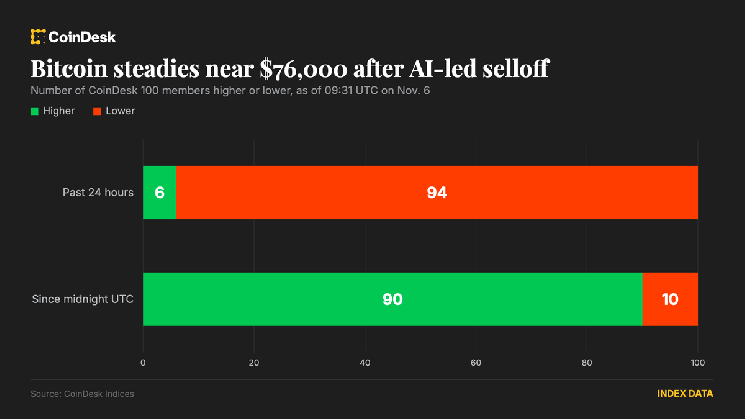
Bitcoin $BTC$76,031.25 experienced a slight increase of 0.2%, reaching approximately $76,150 since midnight UTC. This rise followed a drop to about $75,200 around 23:00 UTC on Thursday. Meanwhile, Ether ETH$2,239.34 climbed by 0.3%, and the CoinDesk 80 Index also saw a 0.2% upswing, with the CoinDesk Memecoin Index leading the pack with a notable 4% gain.
This rebound happened after a significant sell-off the previous day, during which the Nasdaq Composite plummeted by 5.5% due to investor concerns that the Democratic majority in Congress may hinder the expansion of AI data centers. This downturn affected the cryptocurrency market as well, leading to over $1 billion in liquidated leveraged positions in just 24 hours, as reported by CoinGlass. Within this timeframe, Bitcoin declined by 5.3% and Ether by 7.3%.
Fidelity’s FBTC recorded a loss of roughly $200 million on Thursday, while BlackRock’s IBIT faced a loss of $105 million, extending IBIT’s outflow streak to five consecutive days, according to Farside Investors.
Market participants are now awaiting the U.S. jobs report set to be released at 8:30 a.m. EST (13:30 UTC), with economists surveyed by FactSet predicting an increase of 65,000 jobs for October.
Derivatives Market Insights
- $BTC open interest has risen to $22.1 billion (up from $21.8 billion), but 24-hour liquidations reached $1.27 billion, with approximately $1.1 billion in long positions liquidated. The net growth obscures the reality; leverage was both flushed and rebuilt rather than simply increased. Funding rates exhibited volatility, briefly turning negative on Bybit (-5% annualized) before stabilizing between 0-5% on other platforms. The three-month basis remained steady at 5.7%. Overall: longs were flushed and then reestablished.
- Options trading has taken a more cautious tone. The put/call volume ratio over the last 24 hours is around 51/48 in favor of puts, with the one-week 25-delta skew rising to approximately 15% (up from around 11% last week) as demand for downside protection increased. The at-the-money term structure remains in contango, with near-term stress causing the front end to settle around 50%, while the mid to long-term outlook is approximately 38-40% through late 2027.
- On the Binance heatmap, with prices hovering around $75,100, a significant liquidity cluster to monitor is located just below the current level in the $74,000-$75,000 range, which could become relevant with any further declines. Conversely, on a potential rebound, a key resistance level to observe is in the $76,800-$77,000 range.
Token Trends
- The World Liberty Financial WLFI$0.04676 saw an increase of about 3.5% since midnight UTC, coinciding with the announcement of upcoming token buybacks funded partly by fees derived from reserves backing its USD1 stablecoin. Despite this, the token remains down around 10% since the midterm elections on Tuesday and has dropped more than 66% this year, while the official Trump token (TRUMP) also reached a record low this week.
- Privacy-focused cryptocurrencies fared better during the sell-off, with Monero (XMR) decreasing by 3.2% over the past 24 hours, compared to Bitcoin’s 5.3% decline. Zcash (ZEC) successfully implemented its NU7 upgrade early Friday, reducing the target block time from 75 seconds to 25 seconds, resulting in a 1% increase since midnight UTC.
- Hyperliquid (HYPE) has declined about 19% from its peak of $96 last week, during which optimism surged following a deal between ICE and Trade[XYZ] to introduce Hyperliquid-based perpetual futures to U.S. retail traders. However, enthusiasm has since diminished.
- Injective $INJ$8.2333 has seen a 14% increase this week, following the Nasdaq’s approval of the listing for Canary Capital’s staked $INJ ETF, according to a filing with the SEC.
- According to CoinMarketCap’s altcoin season index, the reading is now at 44/100, its lowest level since September, reflecting a continuing decline in speculative sentiment.