

- Over half of the Bitcoin supply is currently held at a loss due to a 14% decline over the past week, pushing the cryptocurrency to trade 8.5% lower than its 200-week average.
- The exposure to leveraged Bitcoin ETFs has plummeted to its lowest level since March 2024, with total outflows reaching 44,900 BTC in a span of two weeks.
- The market is focusing on the earnings report from Nvidia, minutes from the Federal Reserve due out Wednesday, October’s PCE data, and the market debut of Anthropic.
The downward pressure on Bitcoin (BTC) is exacerbated by ETF withdrawals and significant leverage in derivatives. After a 14% dip over the past week, BTC is now trading below its 200-week moving average, with K33 reporting that 51.5% of the circulating supply is at a loss.
What Caused Bitcoin to Have Over Half Its Supply in the Red?
In light of a 14% weekly decline, 51.5% of Bitcoin’s circulating supply is now held at a loss. The cryptocurrency has returned to values last seen in early August and was trading as much as 8.5% below its 200-week moving average on November 15. A report from K33 released on Tuesday noted that this recent decline marks the sixth consecutive week of losses, a rarity in Bitcoin’s history, occurring only twice before.
K33 commented: “This places BTC’s price in a position where holders could have sold for more in the last four years on average,”
Net ETF outflows reached 44,900 BTC over the fourteen trading days since October 29, according to K33. While this amount is lower than June’s record of 71,000 BTC, recent outflows are “similar to the extremes” witnessed around past local lows.
With leveraged ETF exposure at 21,900 BTC, it has dropped to the minimum level recorded since March 2024.
K33 further indicated that the Bitcoin ETF flows over the past 30 days strongly correlate with BTC’s price changes.
The firm elaborated: “This correlation has been consistent for several years, showcasing an R² of 0.71 between 30-day flows and returns in 2026,”
Why Is Bitcoin Derivatives Leverage Remaining High Despite Selling Pressure?
There has been a strong demand for protective measures, driving the one-month 25-delta options skew above 20, a mark not reached since July.
This pressure cascaded into Bitcoin perpetual futures when the asset dipped below $70,000. Sustained negative funding rates, along with a significant dip in open interest, pointed to forced selling, as noted by K33.
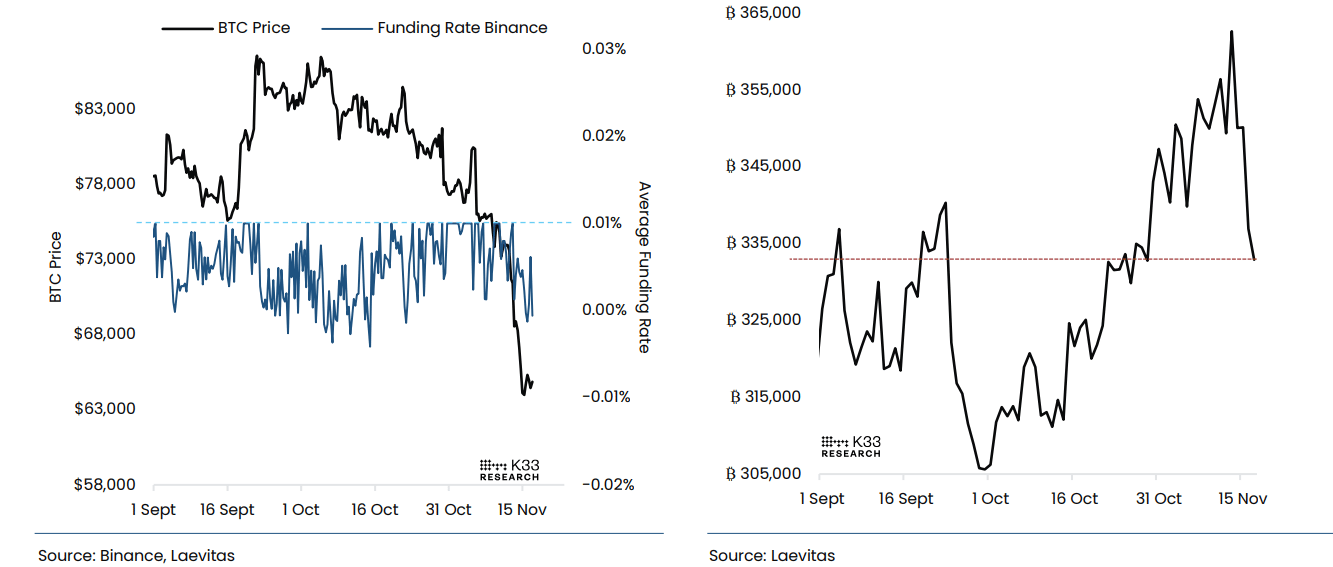
Liquidations of long Bitcoin positions reached approximately $1.3 billion between November 13 and 14, marking the largest two-day liquidation total since October 2025 and the second-largest event of 2026. Although this wave of liquidations reduced perpetual futures open interest by 30,000 BTC, it remained above 330,000 BTC, near levels recorded in September.
The report concluded: “Despite some deleveraging during this sharp downturn, leverage levels are still high compared to historical averages,”
A more cautious perspective was shared by digital asset trading firm Wintermute, which referred to the rally since July as a “fake-out” in a Tuesday report.
Wintermute expressed: “This market is driven by rates where Bitcoin is the non-yielding funding asset, the ETF interest has diminished, and technicals have deteriorated. Therefore, we remain defensive, indicating the path of least resistance still seems downward, likely leading to fluctuating prices,”
They noted that a daily close above the 200-week moving average, around $68,000, along with net ETF inflows, could trigger a reassessment of their cautious stance.
With holiday trading conditions being thin, Wintermute identified various potential catalysts for volatility, including Wednesday’s Fed minutes, October PCE data, and upcoming market events such as Nvidia’s earnings and Anthropic’s market debut.
As of the latest update, Bitcoin has experienced a 2% drop in the past 24 hours, trading at $63,800.