



 BBC
BBCHear Mike’s narration of this story
For the past half-decade, a persistent drone has mingled with the natural soundscape in Dresden, a small village nestled in upstate New York.
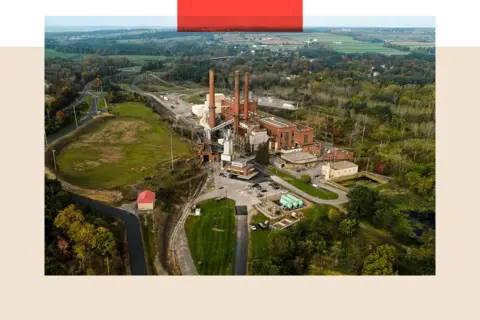
The noise emanates from the Greenidge Generation facility, a power station reactivated after years of dormancy, and it has become a point of contention for some residents.
“It’s truly an imposition,” laments Ellen Campbell, a homeowner residing near Seneca Lake. “When relaxing by the water, the last thing I want is that constant noise.”
“This relentless hum wasn’t part of the deal when we moved here.”
In Dresden, a community of roughly 300 people defined by rural roads, railway tracks, and vineyards, the situation echoes the familiar narrative of environmental concerns clashing with the promise of economic advancement.
But this disruption also highlights a surprising paradox: pushback against the policies of former President Donald Trump is emerging from the very rural areas that fueled his election.
The root of the issue? Bitcoin mining.
This energy-demanding process, reliant on high-powered computers to generate and secure cryptocurrency, has experienced considerable growth within the US. The previous presidential administration actively supported this industry, a stark contrast to the current policies.
Trump had voiced his desire to establish the US as the world’s premier location for crypto-mining, declaring in June of 2024 his ambition for “all remaining Bitcoin to be mined here in America”. This stance carries significant implications for rural communities throughout the nation, many of whom backed Trump politically.
 Associated Press
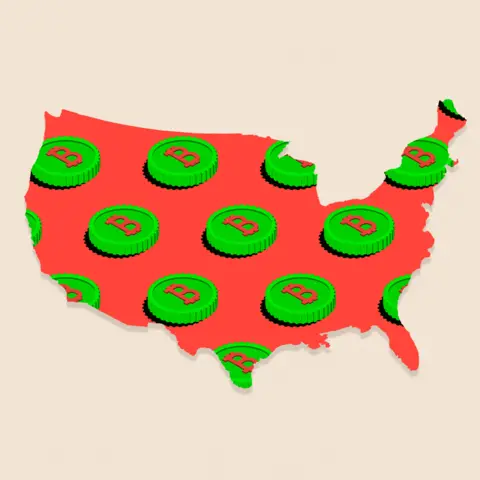
Facilities akin to the one neighboring Dresden are appearing across the US, drawn by crypto price surges alongside the availability of cost-effective power. Official data indicates that at least 137 Bitcoin mining sites are active across 21 states, with more in development. The US Energy Information Administration (EIA) estimates that Bitcoin mining now accounts for roughly 2.3% of the nation’s electricity consumption.
The substantial consumption of energy, in addition to broader environmental impacts, has created significant concern in Dresden.
Yet it’s the continuous hum, a direct result of the cooling systems necessary for the computer hardware, that has become a consistent complaint in communities hosting Bitcoin mines. This noise ranges from a subtle whir to a noticeable din.
“There’s a perpetual buzzing noise,” explains Dresden inhabitant, Lori Fishline. “This loud, incessant humming is impossible to disregard. It’s new to our neighborhood and significantly impacts the peaceful essence of our bay.”
Campbell voices that her reservations regarding Trump’s stance on Bitcoin mining are causing a reconsideration of her affiliation with the Republican Party. “At this time, I have severe reservations regarding that party,” she remarks.
Grievances in Trump’s base
What is taking place near Seneca Lake is playing out nationwide, potentially posing obstacles to any administration’s pro-crypto agenda.
Approximately 100 miles west of Dresden, a strong community reaction in Niagara Falls led to a temporary ban on new mining activities by the town’s mayor in December 2021. Subsequent restrictions were enforced, establishing maximum noise levels of between 40 and 50 decibels around residential zones. The mayor stated, “The noise produced by this industry exceeds all others.”
Local residents have described the noise as being akin to a 747 jet or as constant as a toothache. The noise was so loud, they claimed, that it overpowered the sound of Niagara Falls.
In Granbury, Texas, in 2023, a barrier designed to block sound, measuring at 24 feet tall, was erected around a mining facility after neighboring inhabitants shared concerns with local authorities that constant roaring sounds prevented them from sleeping and led to headaches.
All these Bitcoin facilities were established before Trump’s return, yet the ensuing opposition suggests public officials in Republican-voting regions will likely face pressure to oppose further expansions.
Will Trump’s ambitions be hampered in areas that generally support him?
 SOPA Images via Getty
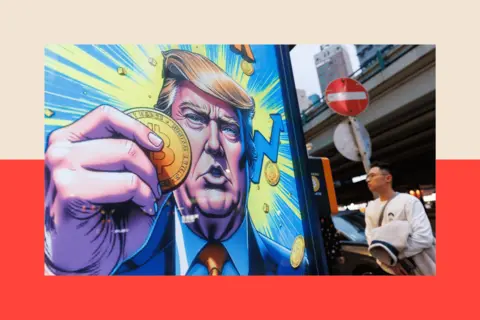
Less than four years ago, Trump labeled Bitcoin “a scam.” Yet his views have transformed. The Trump family has launched the cryptocurrency company, World Liberty Financial, and Trump has personally introduced his own cryptocurrency, called $TRUMP, which was celebrated during a private gala for 220 premier purchasers.
Trump’s sons Eric and Donald Jr. are behind a crypto mining operation dubbed American Bitcoin, which intends to start trading on the Nasdaq. It plans to establish one of the world’s top Bitcoin mining operations based in America.
The rise in Bitcoin mining within the US has occurred partly because of restrictions implemented in China in 2021 to address environmental impact. Alexander Neumueller from the University of Cambridge confirms that the US now leads Bitcoin production and accounts for approximately 40% of all mining.
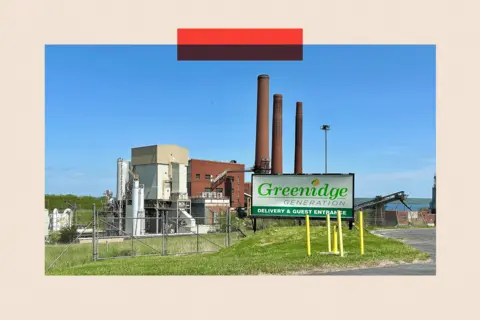
Dresden exists within New York’s Finger Lakes region, known for its wineries and outdoor activities, and roughly 60% of the voters in Yates county supported Trump in the last election.
The owners of Greenidge claim that roughly 40 to 120 Bitcoins are mined per month, along with surplus electricity which is routed back to the grid.
The company claims they converted an old coal burning facility into a relatively cleaner, gas-fired power installation, but they refused requests for an interview.
New York State and Greenidge are engaged in a legal battle regarding the plant’s future. New York state is attempting to challenge the gas-fired plant’s operating permit. Power generation has continued throughout proceedings.
Abi Buddington, who owns a home in Dresden, claims this has become a big issue locally.
“The climate has changed in our quiet, small town,” she said, recalling arguments during town hall meetings.
Ms. Buddington is attempting to change opinions in Dresden and around the country.
“Even in red states, elected officials are opposed to cryptocurrency mining once they are educated about the harms,” she said.
“They’ve been a good corporate neighbor,” says Brian Flynn, Dresden’s recently elected mayor, referring to the mine. “I’m pro-business, whether it be Greenidge or local agriculture… I think it’s important to have a mix of both industry and recreation.”
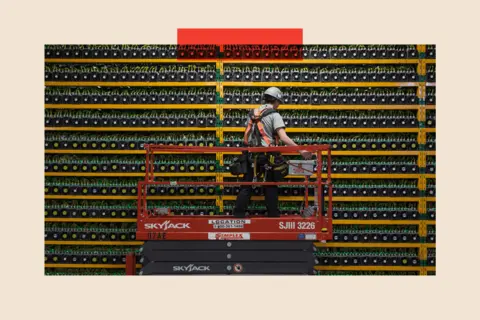 LARS HAGBERG/AFP via Getty
Ongoing legal actions are demonstrating the realities of the industry.
Bitcoin “miners” verify cryptocurrency transactions by solving complex cryptographic problems. In return, they are awarded Bitcoin.
As Bitcoin prices have skyrocketed, the demand for computing power has increased substantially.
Mining also has environmental effects, as described by a Harvard study, which states millions of Americans are exposed to harmful air pollution.
The