
The groundwork for a coming era of renewed innovation and advancement is steadily being established.
Many in the United States recognize that substantial industrial growth and groundbreaking ideas are ready to emerge, held back only by energy constraints. A potential surge of power, capable of transforming the world, is currently limited by insufficient development and modernization of our power grid. While this presents challenges, there’s reason for optimism.
Currently, Bitcoin mining is acting as a crucial outlet for surplus and intermittent energy, also aiding outdated grid systems. As highlighted before, Bitcoin mining holds significant potential for our future and the industry could provide vital assistance to our nation, positioning it as a key component of national security.
A considerable amount of energy in Bitcoin mining and data centers is dedicated to managing heat and preventing corrosion. Water near electrical equipment poses significant risks. However, insufficient humidity can lead to static electricity. Furthermore, these facilities tend to accumulate dust rapidly, which, if ignited by a spark, can create a dangerous explosion.
Maintaining adequate humidity is also crucial for dissipating heat from electrical components. Overheating can damage equipment, so managing temperature effectively is essential.
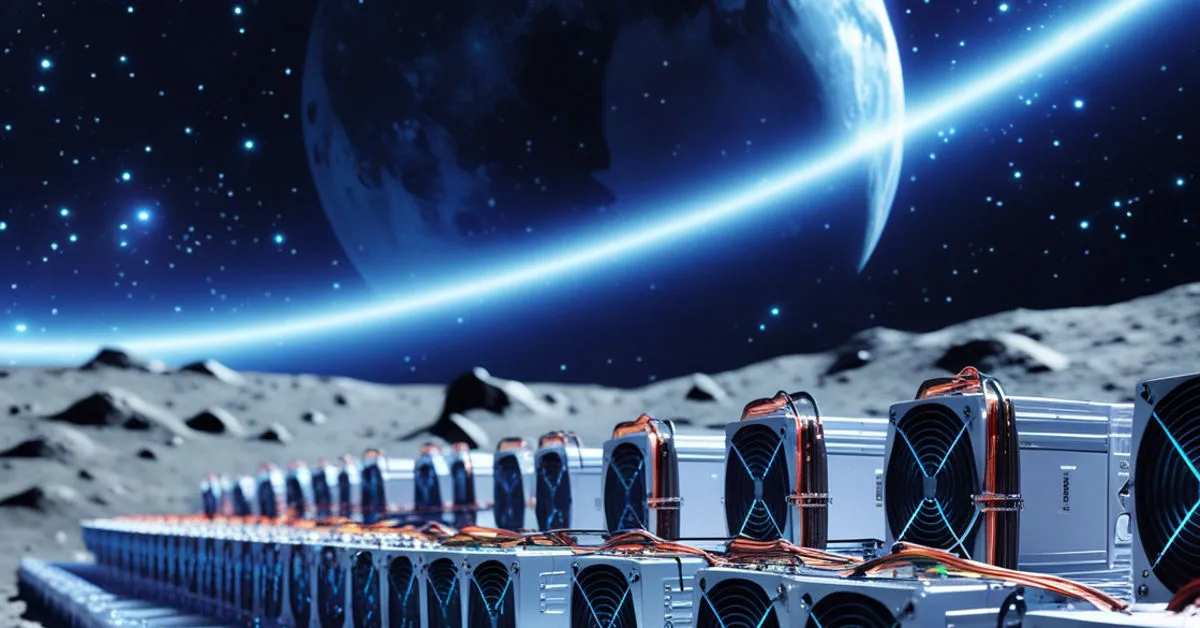
What if Bitcoin mining operations were moved to an environment with significantly reduced atmospheric conditions?
Consider that our atmosphere is heated by the sun. Seasonal changes depend on our planet’s position in orbit, and weather patterns arise from heat transfer influenced by these conditions. This introduces a high degree of variability in operations, requiring a dynamic approach, much like a professional athlete’s training regimen. Dealing with so many factors can be difficult in highly competitive industries.
Therefore, why not explore uncharted territories? Why not consider new, more advantageous locations? The development of the American West was driven by individuals who ventured into the wilderness seeking energy resources. Now, space presents the next frontier. From accessible technology to lunar missions, space exploration opens new possibilities, along with fresh challenges.
One primary challenge is power. Bitcoin mining is already reshaping power plant deployment strategies on Earth. Could it do the same in space? A power plant must be economically viable. Otherwise, the endeavor becomes unsustainable.
Bitcoin mining offers power plants the opportunity for immediate, consistent revenue unaffected by power cycling. Miners simply require a reliable power source, with easy maintenance and environmental control.
Intercosmic Energy believes that low Earth orbit provides a compelling environment for Bitcoin mining. The near-absence of an atmosphere eliminates weather-related concerns, simplifying operational management. Greater exposure to sunlight is also possible. The vacuum of space provides ample cooling capacity, making heat management the key thermal challenge. Focusing on a single, primary variable greatly simplifies environmental control, increasing operational efficiency. A consistent atmosphere extends the lifespan of equipment significantly beyond what is possible on Earth.
Space-based Bitcoin mining would stimulate the development of space-based power infrastructure. Visionary individuals will rise to the occasion, paving the way for manufacturing and shipping capabilities on the moon. This would establish a vital hub for both Earth and deeper space exploration. These advancements become increasingly achievable as we harness untapped energy resources.
Nick Moran, CEO of Intercosmic Energy, is responding to this future. He’s aware of the inherent challenges and risks, but recognizes that collaboration is essential. Intercosmic Energy is seeking passionate individuals in the Bitcoin mining sector to join their team.
Moran has identified several key roles that he hopes the Bitcoin community can assist in filling: an aerospace engineer with orbital mechanics expertise; a skilled software engineer specializing in Bitcoin mining technologies and ASIC hardware; and a thermal management expert proficient in fluid dynamics, ideally with space-related experience.
This initiative, while ambitious, is attainable through collaboration and a shared vision. Moran elaborates on this:
“Since 1974, organizations such as NASA have dedicated research to energy transfer methods concerning space-based solar power. Yet, they have not built a functional concept.
Billions of taxpayer dollars have been spent studying this topic. Intercosmic’s approach leverages data transfer and is both safe and effective, in contrast to the current research methods of energy transfer, which are not and have only 11% effectiveness.”
Bitcoin miners drive efficiency in energy use and pioneer the exploration of new energy sources. We are currently utilizing readily available resources on Earth, such as coal, natural gas, hydro, solar, nuclear, and wind. We are now poised for the next major advancement: a space race driven by Bitcoin mining.
The Second Renaissance is gaining momentum, building more and more possibilities.
Mike Hobart is an Army Aviation veteran and a contributor to Bitcoin Magazine. Opinions expressed are solely those of the author.