

Understanding Jack Dorsey’s Bitchat: An Overview
Jack Dorsey, known for co-founding Twitter and leading Block, has initiated a trial run of Bitchat, a novel communication app. This innovative platform aims to transform how we communicate by functioning entirely without the need for an internet connection.
Initially conceived as a side project, this venture is quickly
developing
into a convincing demonstration of what’s possible. It has the potential to provide genuinely
decentralized,
censorship-resistant communication channels, attracting considerable attention within the tech community while simultaneously raising concerns among governmental bodies.
The beta version of Bitchat launched
on July 7, 2025, and promptly reached its 10,000-user TestFlight limit within hours, indicating a substantial interest in offline communication solutions.
More than just a technological experiment, this application represents a step toward a future where communication persists even in the absence of traditional infrastructure or in the face of censorship. In a digital landscape subject to ever-increasing monitoring, a communication tool resistant to censorship is drawing significant interest.
How Bitchat’s Offline Messaging System Operates
Bitchat employs a decentralized, peer-to-peer messaging system using a Bluetooth Low Energy (BLE) mesh network. This architecture eliminates the requirement for servers, internet access, phone numbers, or any central infrastructure.
Simply put, its operational foundation is distinct from that of conventional messaging services such as WhatsApp. Rather than relying on cell towers or Wi-Fi networks, it establishes a decentralized Bluetooth network.
As illustrated above, the mesh network leverages BLE to propagate messages across nodes within a 30-meter radius. A message sent by Alice to Dave transits through intermediary devices, such as Bob and Carol, before reaching its intended recipient.
Each device running Bitchat functions simultaneously as a messaging client for the user and a relay server, establishing a mesh topology. Here’s a breakdown:
- Upon sending a message, it doesn’t route through a cellular or internet network to a remote server. Instead, it directly relays between your device and nearby Bitchat users, who, in turn, forward it until it reaches the intended recipient. This is reminiscent of a modernized version of the “telephone game.”
- This message-relaying mechanism necessitates direct Bluetooth connectivity between devices within approximately 30 to 100 meters. Employing a store-and-forward approach, messages can traverse beyond this Bluetooth range. For instance, if a recipient is temporarily offline, messages can be cached and stored on adjacent devices, then delivered upon reconnection to the mesh.
Key Technical Components
Several key technical elements enable Bitchat to function in this peer-to-peer manner:
- Peer-to-peer architecture: The system is resistant to single points of failure because each device functions as both a sender and a relay node. Depending on hundreds or thousands of interconnected nodes fosters decentralization, making the network robust against targeted attacks or outages.
- Message hopping: Data packets can propagate through the networked devices up to seven times, with each device contributing routing information to facilitate efficient pathways.
-
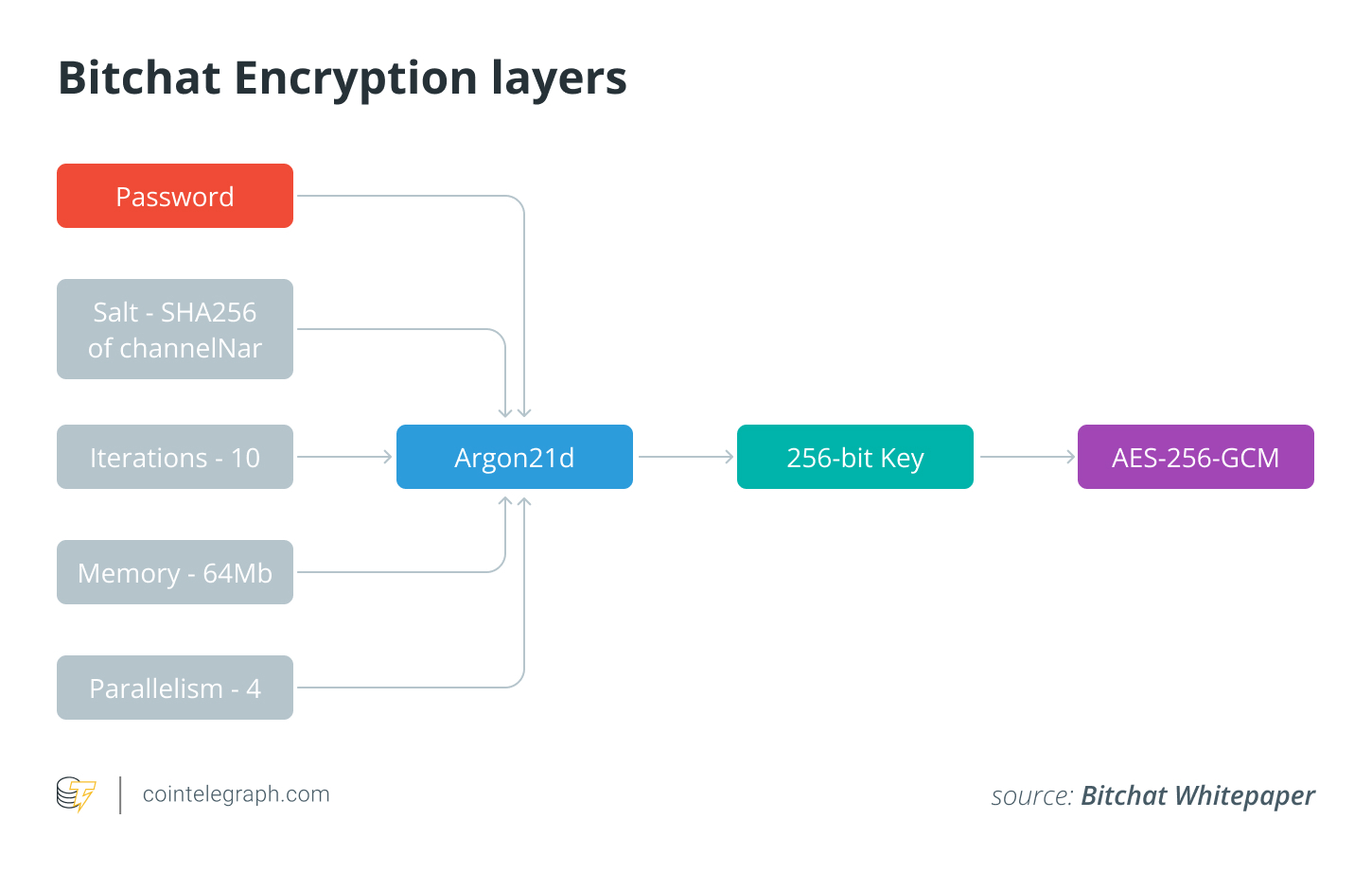
End-to-end encryption: Messages
utilize
X25519 key exchange and AES-256-GCM encryption. Consequently, while data passes through multiple devices, only the sender and the designated recipient can decipher its contents. - No persistent identifiers: Random peer IDs are generated for each session to protect user privacy. Each time you launch Bitchat, your device receives a new unique ID, rather than using a permanent phone number or email.
Did you know? The global messaging security market is projected to experience substantial growth, increasing from $8.56 billion in 2024 to $20.41 billion by 2029. This surge is fueled by heightened demands from users and organizations for privacy-focused solutions in response to increasing regulatory scrutiny and cyber threats.
Using the Bitchat Decentralized Messaging App: A Guide
Currently, Bitchat is not officially available on the iOS or Android app stores. It is accessible as a beta version for iOS devices through Apple’s TestFlight, a platform for testing apps before their official release. However, the beta program is currently at maximum capacity.
The GitHub community has also
developed
an unofficial Android version that users can access. However, Android users must sideload the app, involving downloading the APK file from GitHub and installing an application from an unknown source.
- Getting started with Bitchat is refreshingly straightforward. It avoids cumbersome processes like providing phone numbers, creating accounts, or submitting personal details.
- Upon launching, the Bitchat application initiates a search for nearby peers on the Bluetooth mesh. You will automatically receive a nickname like “anon1234,” which you can customize later.
- For individuals familiar with traditional chat rooms, the IRC-style command interface will be recognizable. Once connected to nearby users, you can engage in conversations even without cellular or internet coverage, as your messages are relayed through the Bluetooth mesh network.
The app’s privacy-centric design also incorporates an emergency wipe feature, enabling you to instantly clear all local data with a triple-tap.
Did you know? Block, Jack Dorsey’s company, holds over 8,000 Bitcoin (
BTC
) and facilitates BTC sales through its Cash App. These are clear indications of Dorsey’s preference for creating decentralized financial infrastructure.
Exploring Bitchat’s Potential Use Cases
Bitchat extends beyond a mere messaging novelty or a tool to evade surveillance. Dorsey highlights several significant applications:
Disaster Coordination
In scenarios where cell towers fail, such as during Hurricane Katrina in 2005, Bluetooth mesh networks could facilitate sustained community and emergency service connectivity. Mesh networking, in particular, could be crucial for emergency responders when traditional networks collapse.
Event Overflows
At large gatherings like festivals or protests, cellular networks can become overwhelmed or even nonexistent in areas with limited coverage. Mesh expansion aids in extending communication range, effectively spanning networks across the event area. It could empower attendees to establish topic-specific channels for messaging without internet access and disseminate critical announcements for group coordination.
Checkpoint Synchronization
In regions experiencing censored or intermittent internet access, users can continue communicating and sharing information using Bluetooth even when only briefly connected to the internet. Periodic synchronization can also enable devices within the mesh to briefly regain internet access at a checkpoint, such as a Wi-Fi hotspot, and then synchronize specific channels or messages with the broader network.
Cross-Community Bridges
Communities geographically close but separated can communicate without relying on centralized infrastructure, facilitating coordination, resource sharing, and collective decision-making across areas inaccessible via the internet. While the system supports movement in and out of mesh networks in adjacent communities, larger distances and extended travel times can pose challenges, as messages are typically cached on a device for 12 hours.
Did you know? A comparable Bluetooth messaging app, Bridgefy,
witnessed
a 4,000% usage spike during the Hong Kong protests, highlighting the capacity of offline, peer-to-peer messaging to protect against censorship.
Mesh Networks and the Future of Decentralized Messaging
Bitchat could catalyze a broader adoption of mesh networking technologies. Prominent tech companies have already invested in mesh solutions, as exemplified by Google’s Nest devices, which possess mesh networking capabilities, and Starlink, which utilizes satellite constellations to establish a space-based mesh network.
Bitchat’s direct device-to-device communication aims to reduce dependence on telecom providers and bolster resilience during outages, censorship, or disasters. In politically volatile regions or during internet shutdowns, such platforms could become vital tools for free expression and grassroots organization.
This raises significant considerations for regulators. The absence of a central authority and the presence of complete encryption can complicate law enforcement efforts. As evidenced by
privacy-focused messaging apps like Telegram,
law enforcement agencies often struggle to trace criminal activities within completely private encrypted messaging systems. The app’s rapid adoption suggests significant demand for decentralized communication tools.
As users become increasingly aware of data ownership and surveillance, decentralized messaging aligns with a growing desire for autonomy. With no single point of failure or control, these systems are harder to shut down or censor. As mesh networking technology develops, it could bring a fundamental shift in how people perceive trust, privacy, and control in their digital interactions.