
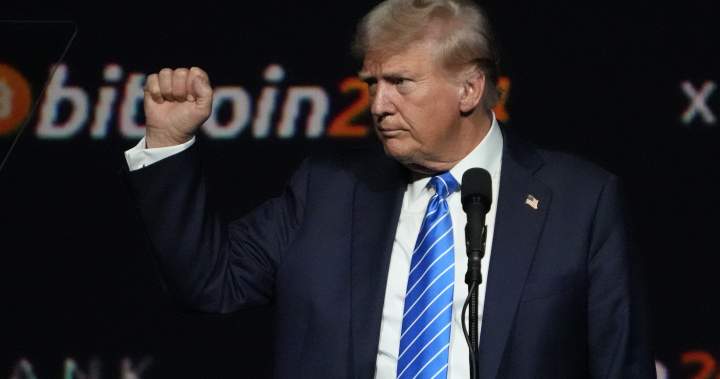
Former U.S. President Donald Trump actively engaged with leading figures in the digital currency sector at a groundbreaking meeting held at the White House on Friday. The summit centered on Trump’s strategies for establishing a government-managed stockpile of digital assets.
Trump’s social media posts highlighted that the guest list included Zach Witkoff, a co-founder of World Liberty Financial, a cryptocurrency venture with ties to the former president.
The White House State Dining Room hosted a diverse group of individuals. Notable attendees included Michael Saylor, the CEO of MicroStrategy, Brian Armstrong, co-founder and CEO of Coinbase, investors Cameron and Tyler Winklevoss, and entrepreneur David Bailey, alongside prominent administration officials and legislators.
A central topic of discussion was Trump’s ambition to create a national digital currency reserve, especially focusing on bitcoin. This objective was formalized through an executive order issued on Thursday, which also outlined plans for including other digital currencies in the reserve.
The executive order tasked the Secretaries of the Treasury and Commerce with devising “budget-neutral strategies” for procuring additional bitcoin without imposing “incremental costs” on taxpayers.
“We don’t want any cost to the taxpayers,” Trump emphasized during the summit.
David Sacks, the White House’s expert on cryptocurrency, explained on social media platform X that the reserve would be funded using bitcoin already in federal possession due to asset forfeitures resulting from criminal and civil cases.

Sacks told journalists at the White House that the creation of a bitcoin reserve should have happened much earlier. He assured that no taxpayer money would be used for acquiring digital assets and pointed out the existence of measures designed to protect consumers involved in crypto investments.
The plans did not meet the expectations of some market participants who had hoped for a definitive plan for purchasing new digital tokens. Following the announcement, the price of bitcoin experienced a downturn, dropping by 3.4% to $86,394.
JP Richardson, the CEO and co-founder of the bitcoin wallet developer Exodus, commented, “This strategic reserve is going to be the biggest point of contention for many of us.” While he possesses the four cryptocurrencies other than bitcoin that Trump suggested for the reserve, he believes they are unsuitable for a strategic reserve.
Richardson added, “While the crypto industry has advanced significantly, it’s still in its early stages.” He noted that alternative cryptocurrencies are generally smaller and operate differently, which he believes could introduce additional risks.
U.S. Regulator Greenlights Bank Involvement in Cryptocurrency Activities
In a separate development on Friday, the U.S. regulator responsible for overseeing national banks provided clarification that banks are permitted to participate in specific cryptocurrency-related activities. They also removed the requirement for firms to seek preliminary authorization from regulators before engaging in such activities.

Get weekly money news
Get expert insights, Q&A on markets, housing, inflation, and personal finance information delivered to you every Saturday.
The Office of the Comptroller of the Currency (OCC) released a statement indicating that national banks are now authorized to engage in activities like cryptocurrency asset custody, certain stablecoin operations, and involvement in distributed ledger networks.
Furthermore, the OCC revoked earlier guidance that mandated banks to obtain regulatory clearance for cryptocurrency-related ventures, including demonstrating the implementation of adequate risk controls.
Acting Comptroller Rodney Hood explained in a statement that the updated guidance ensures banks implement robust risk management practices, irrespective of the underlying technology.
Hood stated, “Today’s action will reduce the burden on banks to engage in crypto-related activities and ensure that these bank activities are treated consistently by the OCC, regardless of the underlying technology.”
Notably, the OCC on Friday rescinded guidance for banks issued under former President Joe Biden’s administration, effectively setting additional guardrails for banks seeking to engage in some crypto activities. The rescinded letters told banks they should brief their supervisors on crypto activities beforehand, show how they would handle risks, and ensure the supervisor had no objection.
The OCC also withdrew from joint statements previously issued by U.S. regulators effectively cautioning banks against engaging with crypto. One such statement, issued in 2023, did not prohibit banks from doing crypto business, but warned the sector is prone to “significant volatility” and said any bank activities would be closely scrutinized.

Industry Leaders Commend Trump’s Reversal of Biden-Era Regulations
Attendees at the summit applauded Trump’s efforts to facilitate growth within the industry. Executives voiced their approval of the administration’s collaborative stance, especially after periods when they felt unduly scrutinized regarding security and consumer protection.
Les Borsai, a co-founder of the crypto investment advisory firm Wave Digital Assets, noted, “For the first time, industry leaders feel they’re walking into a collaborative discussion.” He also mentioned that he did not receive an invitation to the summit.
Trump expressed optimism about the future of the cryptocurrency industry, stating, “We feel like pioneers in a way.”
He further remarked, “From this day on, America will follow the rule that every bitcoin knows very well, never sell your bitcoin. That’s a little phrase that they have. I don’t know if that’s right or not. Who the hell knows, right? Who knows? Who knows, but so far, it’s been right, and well, let’s keep it that way.”
Trump’s executive order explicitly states that the government’s bitcoin assets should remain unsold.
Treasury Secretary Scott Bessent reassured attendees that the U.S. would maintain the dollar’s position as the world’s primary reserve currency and utilize stablecoins to support this.
Brad Garlinghouse, the CEO of the technology firm Ripple, expressed his approval on X, welcoming Trump’s acknowledgment of the broader scope of cryptocurrencies beyond just Bitcoin. XRP, the cryptocurrency linked to Ripple, is one of the candidates Trump has suggested for inclusion in the government’s crypto reserve.
Summit participants conveyed their optimism about collaborating with an administration that regards cryptocurrency as a significant asset class. They expressed hope for streamlined regulatory procedures.
Yesha Yadav, a professor of law at Vanderbilt University, emphasized, “What everyone really needs to have at this point is clarity on what the level of scrutiny and intensity of regulation will be, who the key regulators will be.”
Such clarity could potentially expedite the Securities and Exchange Commission’s (SEC) approval process for numerous new listings of exchange-traded funds.
It should be noted that Trump’s family has been involved with launching cryptocurrency meme coins, and he also maintains a stake in World Liberty Financial, a cryptocurrency platform, which has raised concerns about potential conflicts of interest.
His aides have stated that Trump has transferred control of his business operations, and these operations are being reviewed by external ethics lawyers. As of now, the White House has not provided any comments on these matters.