

Key Takeaway
Analysts are increasingly predicting that Ethereum (ETH) could overtake Bitcoin (BTC) as the leading cryptocurrency due to various positive factors. Options trading data suggests significant expectations for ETH, potentially exceeding $4,000 by July and reaching $5,000 by the year’s end.
A growing number of financial experts believe that Ethereum (ETH) is poised to surpass Bitcoin (BTC) and claim the top position in the crypto market.
In a recent CNBC interview, Paul Brody, the Global Blockchain Lead at Ernst & Young (EY), voiced a similar opinion, stating:
“Ethereum is projected to become a larger asset than Bitcoin.”
ETH’s Future: A Look at the Short-Term and Long-Term
Brody also anticipates a surge in adoption as more corporations and financial institutions integrate ETH into their treasury operations, especially following the enactment of the GENIUS Act.
Highlighting the ongoing tokenization trend, with Robinhood’s launch of its Layer-2 solution on ETH, Brody emphasized that these developments will boost network activity, propelling ETH beyond Bitcoin.
“Since Ethereum powers these tokenization activities within its ecosystem, demand for ETH will increase significantly, establishing it as a larger asset than Bitcoin.”
His prediction regarding ETH treasury demand is already materializing, with corporate holdings exceeding $6 billion.
Notably, SharpLink Gaming, with support from Consensys and Ethereum co-founder Joseph Lubin, alongside BitMine, spearheaded by Tom Lee, have surpassed the $1 billion mark in ETH treasury within a short three-month period.
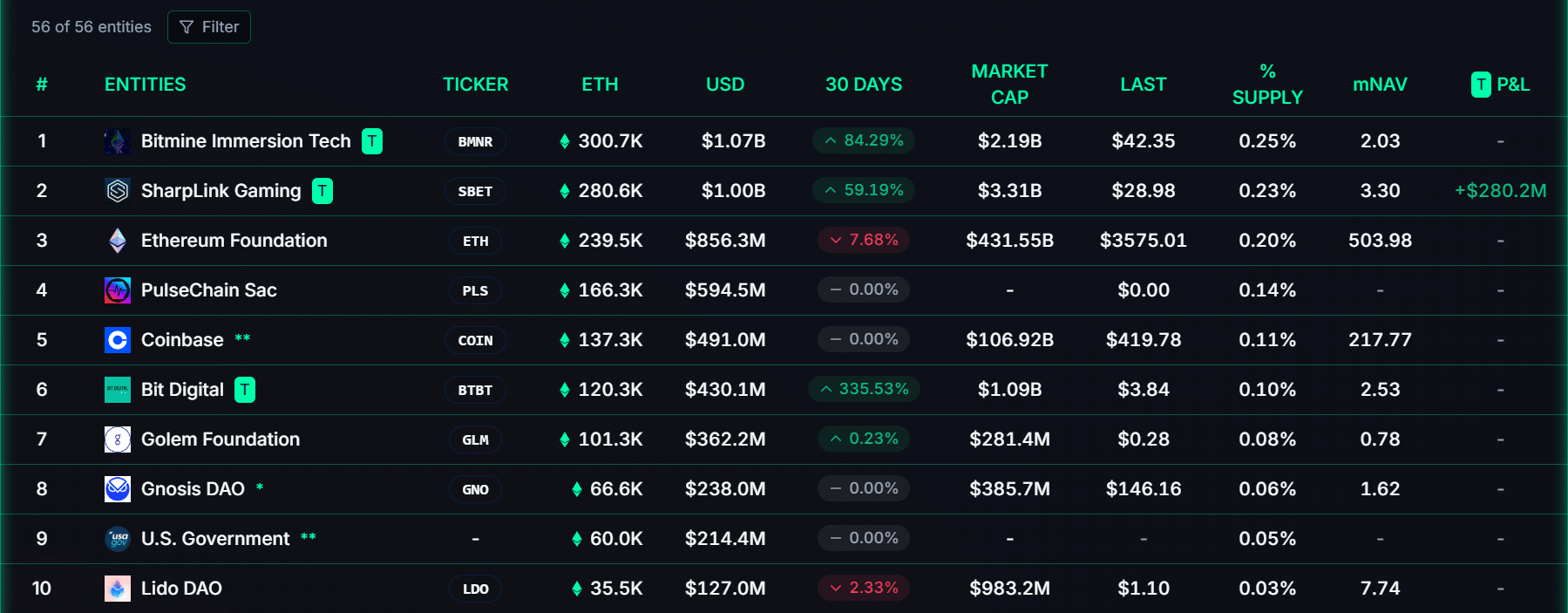
Specifically, BitMine holds 300.7K ETH and plans to acquire 5% of the total ETH supply, amounting to 6 million ETH, to enhance staking rewards and capitalize on the anticipated stablecoin and tokenization booms.
ETH/BTC Ratio Trends
Given Bitcoin’s nascent DeFi sector and Ethereum’s established leadership in this area, ETH may be set for long-term outperformance.
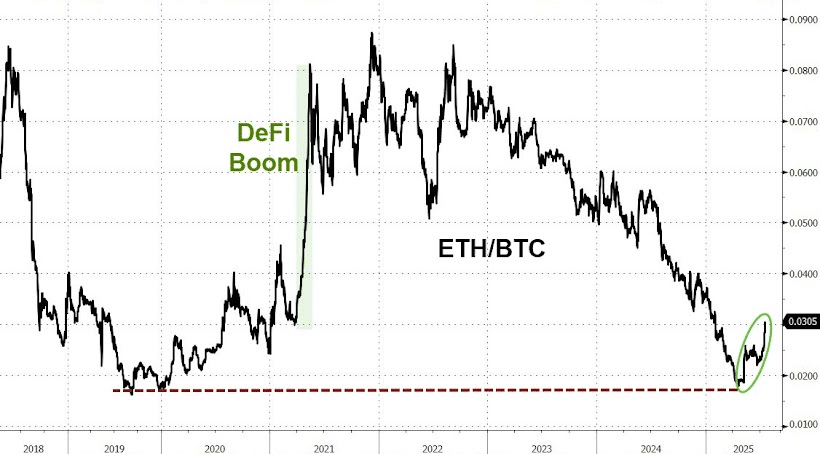
Furthermore, the Ethereum/Bitcoin (ETH/BTC) ratio indicates a shift in market sentiment towards Ethereum since the second quarter, with capital rotating from BTC to ETH.
Source: X
The ETH/BTC ratio, reflecting Ethereum’s relative price performance compared to Bitcoin, initially fell to a 5-year low of 0.017, but has since recovered by 72% to 0.030.
This translates to ETH investors earning over 70% more than BTC holders between May and July.
While the continuation of this recovery in the long term, as Wall Street projects, remains uncertain, short-term market interest has undoubtedly favored Ethereum over Bitcoin.
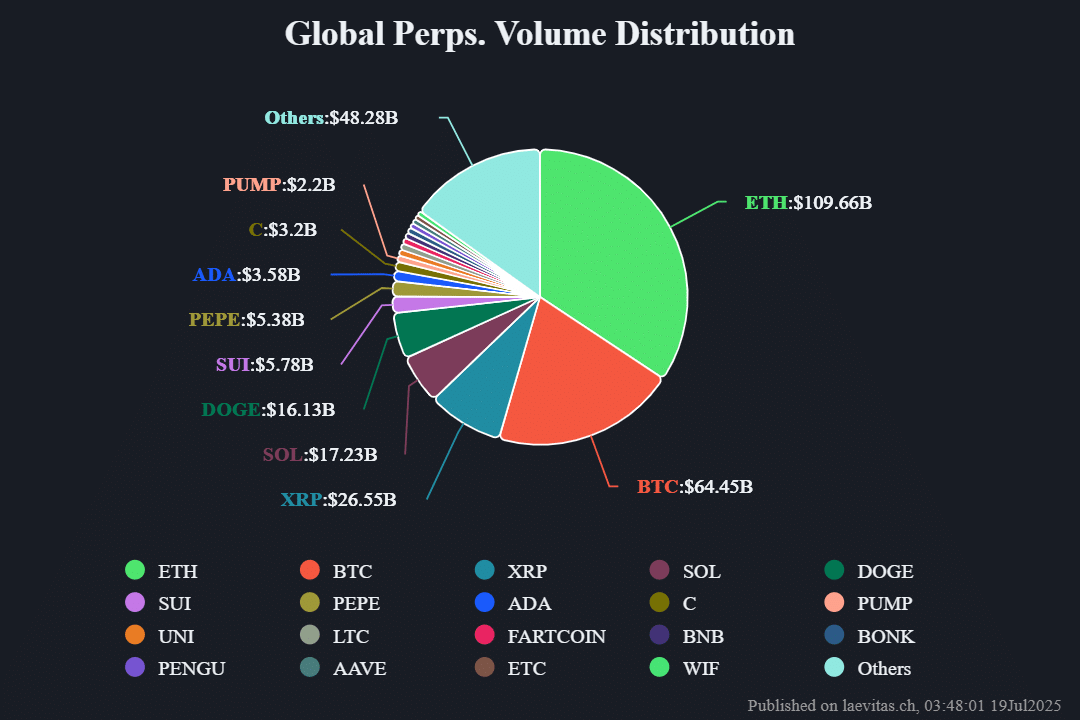
Coinbase analysts reported that Ethereum’s perpetual trading volume nearly doubled that of Bitcoin in the past 24 hours, largely driven by basis trading activity.
“Data from perpetual swaps indicated that Ethereum trading volume reached approximately $106 billion yesterday, representing about 37% of the global market and nearly twice the volume of Bitcoin. Additionally, open interest across perpetuals, term futures, and options for Ethereum reached a new all-time high.”
Source: Laevitas
As of this writing, ETH is trading at $3,560. So, what can we expect for Ethereum in the near future?
Sean Dawson, Head of Research at crypto derivatives platform Derive, suggests that options traders anticipate a significant surge above $4,000 by July 25th.
Dawson further noted that the likelihood of ETH surpassing $4,000 by the end of July has increased by 14%. For a price target of $5,000 by the end of 2025, the probability has risen to 27%.
“With favorable macroeconomic conditions, declining interest rates, and ETF momentum aligning, the second half of 2025 appears to be shaping up as Ethereum’s most promising period in years.”
Despite this bullish outlook, some traders are hedging against potential short-term pullbacks, according to Coinbase.
“The ETH 25D put-call skew (30-day) shows a slightly positive value (+0.95%), indicating that certain investors are still seeking downside protection for Ethereum in the immediate term.”